

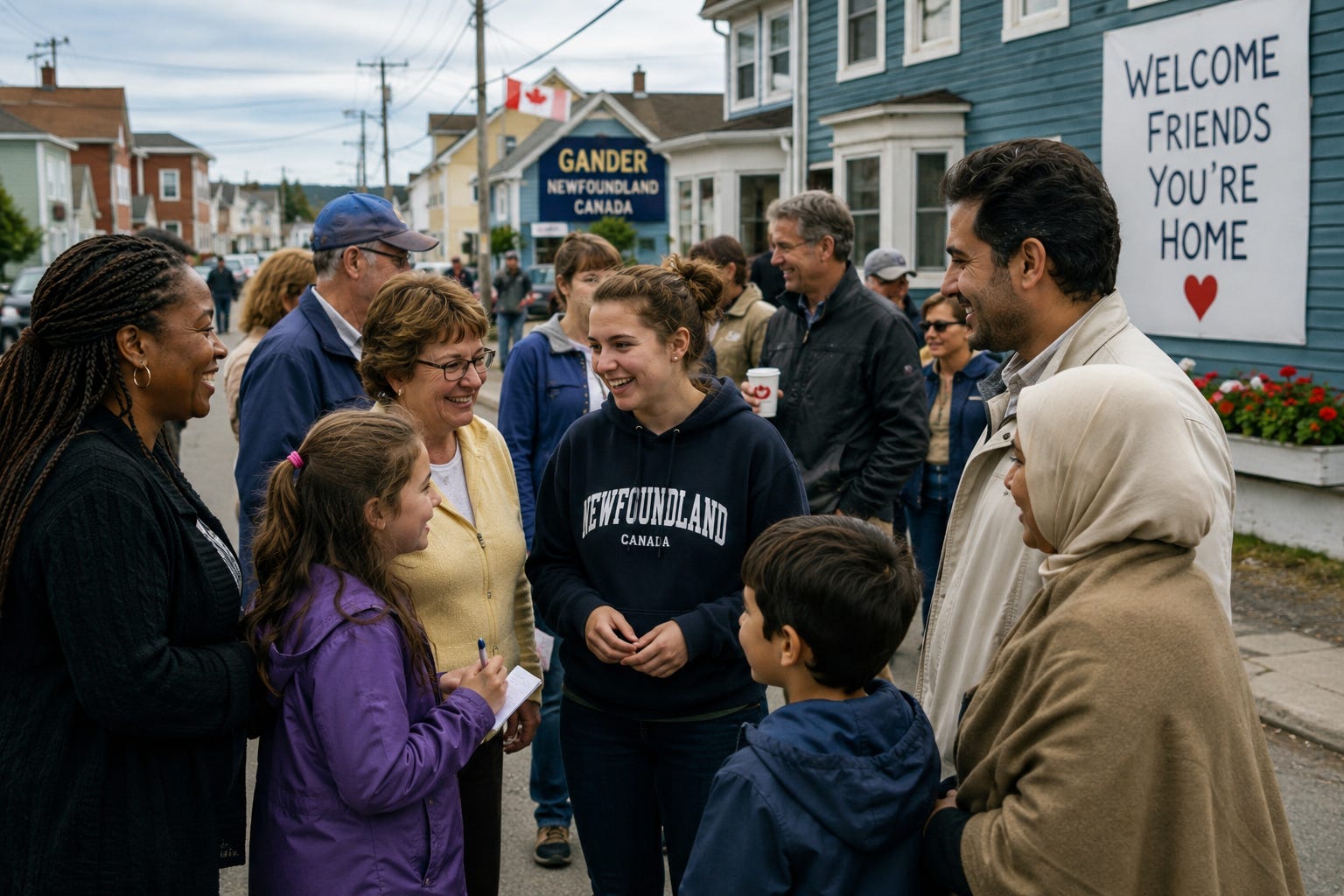
When Strangers Started Understanding Where They Had Landed
By Friday, something remarkable was happening.
The stranded passengers were no longer asking where they were.
They were discovering who these people were.
The shock of September 11 hadn’t disappeared.
The uncertainty remained.
Nobody knew exactly when they would leave.
But the relationship between the passengers and the people of Newfoundland had begun to change.
The world had come to Newfoundland.
Now Newfoundland was introducing itself to the world.
One of the first lessons arrived in the middle of a street in Lewisporte.
A visitor from New York or New Jersey stood staring in amazement at a large truck that had stopped to let pedestrians cross the road.
No crosswalk.
No traffic light.
No stop sign.
The truck simply stopped.
The man could hardly believe what he had seen.
“Did you see that?” he kept shouting.
The local teachers watching the scene couldn’t quite understand the excitement.
To them, it was normal.
To him, it was extraordinary.
Sometimes you don’t realize what makes a place special until you see it through someone else’s eyes.
The cultural surprises kept coming.
At a Wal-Mart in Gander, Winnie House was shopping when she noticed a young girl staring at her.
The child finally gathered enough courage to walk over.
“Can I have your autograph?” she asked.
Winnie laughed.
“I’m really a nobody.”
The girl’s mother smiled.
“You’re somebody to her.”
The child asked if she could touch Winnie’s hair.
Winnie agreed.
The little girl carefully stroked it while Winnie signed her name.
It was a small moment.
A simple moment.
Yet Winnie would later remember it as one of the few times in her life when she felt completely accepted.
Not judged.
Not categorized.
Just welcomed.
Across the region, passengers continued discovering that kindness wasn’t a special event.
It was simply how things worked.
A young couple carrying a small child down a residential street heard someone calling after them.
A woman came running from her house carrying a stroller.
“Here, why don’t you use this?”
The couple explained they might be leaving soon and wouldn’t know how to return it.
The woman shrugged.
“It doesn’t matter.”
The stroller was theirs for as long as they needed it.
Those four words kept appearing everywhere.
“It doesn’t matter.”
How will people get their towels back?
It doesn’t matter.
Will I get my stroller back?
It doesn’t matter.
Can strangers stay in my home?
It doesn’t matter.
Need seemed to matter.
People mattered.
Everything else was secondary.
That lesson wasn’t lost on Denise Gray-Felder of the Rockefeller Foundation.
She arrived in Newfoundland as a passenger.
She left as a witness.
Like thousands of others, she watched local volunteers work around the clock.
She saw women washing donated towels until two in the morning so passengers would always have clean ones available.
When she asked how people planned to reclaim their towels afterward, the answer stunned her.
“It doesn’t matter.”
The selflessness was unlike anything she had experienced.
The Rockefeller Foundation oversees billions of dollars and funds projects around the globe.
Yet during those few days in Lewisporte, its executives found themselves receiving something more valuable than money.
They experienced generosity without conditions.
When the foundation learned that the local school’s computers were badly outdated, they decided to replace the entire computer lab.
Not because anyone asked.
Not because they felt obligated.
Because kindness has a funny way of inspiring kindness.
Even the airline crews were discovering Newfoundland’s unique character.
Captain Reinhard Knoth of Lufthansa tried walking from his hotel to the school where his passengers were staying.
It never worked.
Every few blocks somebody would stop and offer him a ride.
Every single day.
Eventually he realized resistance was futile.
The people of Gander simply weren’t going to let him walk anywhere.
Meanwhile, life continued in strange and unexpected ways.
A world-famous fashion executive from Hugo Boss worried about finding decent underwear.
A Middle Eastern prince discovered that cabins in the woods were sometimes the only accommodation available.
Passengers swam in lakes.
Played baseball.
Went canoeing.
Took long walks.
Made new friends.
Shared meals.
Laughed.
Fell into routines.
Not because they had forgotten what happened.
But because human beings eventually find ways to keep living.
That’s what strikes me most about this stage of the story.
The passengers arrived carrying the weight of one of the darkest days in modern history.
Yet day by day, they began discovering something unexpected.
Hope.
Not grand speeches.
Not dramatic gestures.
Just ordinary people showing extraordinary kindness.
One ride.
One towel.
One stroller.
One autograph.
One cup of coffee at a time.
The world had come to Newfoundland expecting a temporary refuge.
Instead, many found a lesson.
A lesson about community.
A lesson about generosity.
A lesson about what happens when people stop asking what they can keep and start asking what they can give.
Thousands of people arrived in Newfoundland expecting to remember the tragedy.
Many left remembering the people.
For five days, a small Newfoundland town became home to thousands of strangers.
This is their story.
And it is Canada’s story too.
Next in the series: Part 7 – The Waiting Begins to End
Missed the beginning? Read Part 1 here: The Day the World Came to Town
#TheWorldCameToTown #GanderSeries #GeezerWiseSays
Source: The Day the World Came to Town by Jim DeFede.
Enjoying this story?
Join thousands of readers who get my articles delivered free to their inbox.
No paywall. No spam. No algorithms deciding what you should see.
Just straight-talk Canadian commentary, interesting stories, and the occasional rabbit hole worth exploring.
And if it’s not for you?
One click and you’re gone.
Enter your email below and I’ll see you in your inbox.
Each passage reinforces the last, and sets the bar for the next. And the most meaningful lesson of these is that they're true. The best of compassion at the worst of times. Thanks for writing these Fred. Its an important time to review our humanity.
I remember vividly where I was and what I doing on 9/11. These passengers who found a town willing to give and not recieve, how many still remember that level of compassion and pay it forward today, has the Rockefelker Foundation executives remembered, has the Middle Easstern Prince remembered or have they slipped back into their ways of pre 9/11.
This year is the 25th anniversary and even now if an aeroplane goes overhead spooling it's engines down I look up.