

Nobody Expected It To Be This Hard
By Friday afternoon, the first passengers were finally getting the news they had been waiting days to hear.
Flights were leaving.
The long detour through Newfoundland was coming to an end.
Or so they thought.
After everything that had happened since September 11, most passengers expected to feel only relief.
Instead, many discovered something they never expected.
Leaving was harder than arriving.
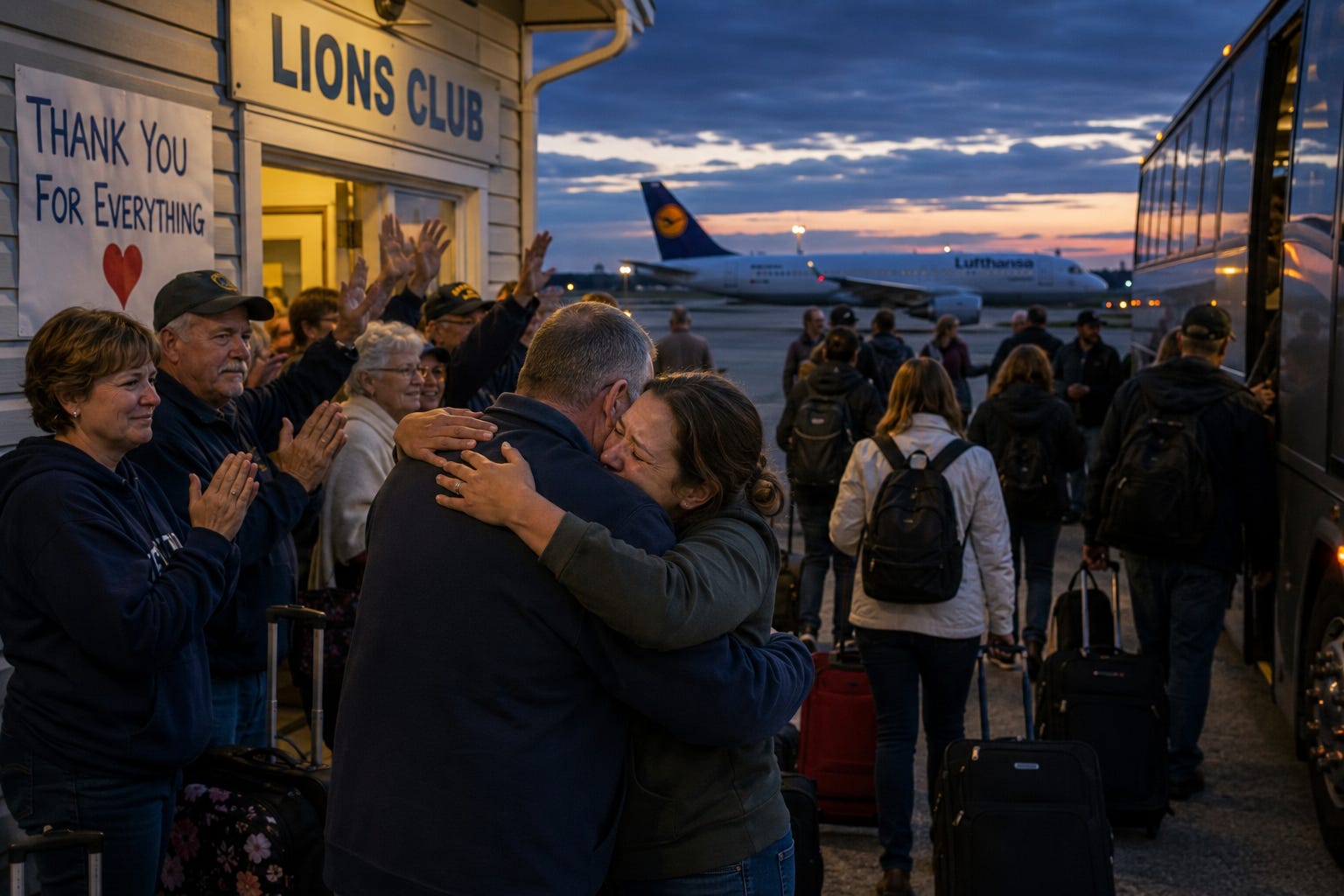
When the pilot of Lufthansa Flight 438 arrived at the Lions Club with news that passengers would soon be departing, the room erupted in cheers.
People hugged.
People smiled.
People started gathering their belongings.
For the first time since their lives had been interrupted by tragedy, there was a clear path forward.
Home was finally within reach.
Yet as the buses pulled up outside the Lions Club, another feeling began to creep in.
Sadness.
The volunteers who had spent days feeding, comforting, driving, and caring for complete strangers lined up beside the exit doors.
One by one, passengers walked through the receiving line.
Handshakes became hugs.
Smiles became tears.
Goodbyes became harder than anyone imagined.
Roxanne Loper had known these people for less than thirty-six hours.
Yet somehow they already felt like family.
Among those saying goodbye was Bruce MacLeod.
By now Bruce had become far more than a volunteer.
He was a friend.
A father figure.
A problem solver.
The kind of person who simply appeared whenever somebody needed help.
Before the passengers boarded the bus, Bruce noticed a young woman travelling alone.
She had spent the last of her money while stranded in Newfoundland.
She was heading to relatives in the United States and spoke very little English.
Bruce quietly pulled her aside and slipped an American twenty-dollar bill into her hand.
The young woman looked confused.
Bruce smiled.
“I wouldn’t send my daughter on a plane without money in her pocket,” he told her. “And I’m not sending you that way either.”
The young woman burst into tears.
So would a lot of readers.
At the airport, however, the mood changed.
Passengers were herded through layers of security.
Luggage was individually identified.
Groups were escorted onto the tarmac.
Everything seemed routine.
Then rumours started spreading.
Someone had heard the plane wasn’t going to Dallas after all.
Someone else said it was returning to Germany.
Most passengers dismissed it as gossip.
Until they asked.
And discovered it was true.
The reaction was immediate.
Anger.
Shock.
Confusion.
Many passengers felt betrayed.
For days they had been told one thing.
Now they were hearing another.
Families argued.
Passengers shouted.
Flight crews struggled to regain control.
Inside the aircraft, people stood in the aisles demanding answers.
Some cried.
Some swore.
Some simply stared in disbelief.
For Roxanne and Clark Loper, the decision became simple.
They weren’t getting on that plane.
Not after learning the truth this way.
Not after being told they were heading to Texas.
Not after feeling they had been misled.
Another family joined them.
Then another.
Soon several passengers were refusing to board.
Meanwhile, inside the aircraft, emotions boiled over.
One passenger stood and told everyone he desperately wanted to get home too.
His mother was being buried the next day.
But arguing wouldn’t change reality.
The sooner the plane reached Germany, he reasoned, the sooner people could continue their journey home.
For some passengers, his words made sense.
For others, they changed nothing.
The divisions remained.
Eventually the plane departed.
Some families stayed aboard.
Others remained behind.
Standing on the tarmac, Roxanne watched the aircraft disappear into the darkness.
As its lights faded into the distance, doubt crept in.
Had they made a terrible mistake?
Had they just missed their best chance to get home?
Then something unexpected happened.
Relief.
The doubts vanished.
Deep down, she knew they had made the right decision.
There was only one problem.
Now they were stranded again.
No flight.
No plan.
No transportation.
Three children.
Eleven suitcases.
A cat.
And more than two thousand miles between Newfoundland and Texas.
The airport had emptied.
The volunteers were gone.
The Red Cross tables had disappeared.
For the first time since arriving in Gander, they were truly on their own.
Or so it seemed.
Roxanne reached into her pocket and pulled out the piece of paper Bruce MacLeod had handed her earlier that day.
A phone number.
An email address.
A promise to stay in touch.
She dropped a coin into a payphone and dialed.
“Hey, Bruce,” she said.
“Guess what?”
“We’re still here.”
Bruce listened as Roxanne explained what had happened.
The cancelled plans.
The arguments.
The luggage.
The children.
The uncertainty.
When she finished, Bruce asked only one question.
“How many of you are there?”
There was no hesitation.
No sigh.
No complaint.
No suggestion that his job was finished.
Just the most Newfoundland answer imaginable.
“I’ll be there in ten minutes with two vans.”
That’s what strikes me most about this chapter.
The passengers thought they were saying goodbye.
The people of Gander weren’t finished helping yet.
Within hours, the stranded families were sitting around the MacLeod dinner table trying to solve a new problem.
How do you drive from Newfoundland to Texas when Newfoundland is an island?
The answer wasn’t obvious.
Neither was the next obstacle.
A phone call revealed that the ferry service might soon shut down.
And why?
Because a hurricane was heading their way.
The planes may have started leaving Newfoundland.
But for some passengers, the journey home was only getting more complicated.
For five days, a small Newfoundland town became home to thousands of strangers.
This is their story.
And it is Canada’s story too.
Next in the series: Part 8 – The Long Road Home
Missed the beginning? Read Part 1 here: The Day the World Came to Town
#TheWorldCameToTown #GanderSeries #GeezerWiseSays
Source: The Day the World Came to Town by Jim DeFede.
Enjoying this story?
Join thousands of readers who get my articles delivered free to their inbox.
No paywall. No spam. No algorithms deciding what you should see.
Just straight-talk Canadian commentary, interesting stories, and the occasional rabbit hole worth exploring.
And if it’s not for you?
One click and you’re gone.
Enter your email below and I’ll see you in your inbox.
This story just becomes immeasurably richer in spirit, as humanity shines through adversity.
Dear Fred, - so Glad that we live in a country where loving and caring is allowed to be a normal part of life. Thank you for all the "human" details of the story that I did not know.