

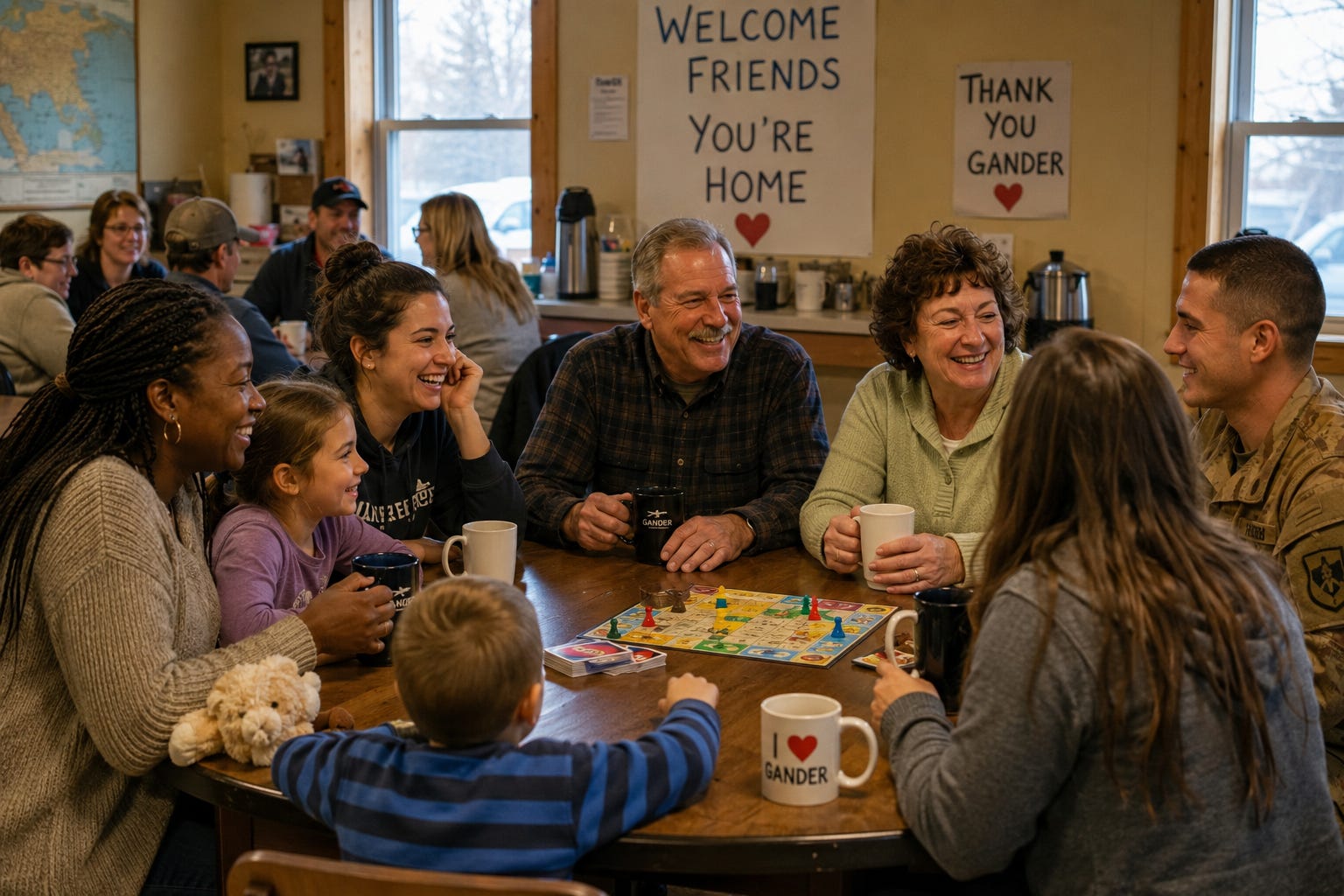
The Day Strangers Began Living Like Neighbours
By Thursday morning, something had changed.
The fear was still there.
The uncertainty was still there.
Nobody knew when flights would resume.
Nobody knew when they would get home.
And for some families, the waiting had become almost unbearable.
Yet despite all of that, life was beginning to return.
Not normal life.
But something close enough to remind people what normal felt like.
For the first time since the planes landed, many of the stranded passengers woke up and realized they weren’t simply enduring an emergency anymore.
They were living in a community.
Bruce and Susan MacLeod certainly treated them that way.
The couple invited the Lopers and the Wakefields to their home so they could use a computer, send emails, and spend a few precious hours away from the crowded shelters.
Their own lives had been placed on hold. Susan’s birthday had passed almost unnoticed while they volunteered at the Lions Club, and they were fully prepared to postpone their thirtieth wedding anniversary as well if the passengers still needed help.
For the two families who had just adopted daughters overseas, those few quiet hours meant everything.
The first days after an adoption are supposed to be spent bonding.
Instead, they had been spent sleeping in shelters surrounded by hundreds of strangers.
The MacLeods understood that.
So they opened their home.
Across town, friendships continued to deepen.
Deb Farrar woke up on George and Edna Neal’s living room floor after a long night that included a trip to Gambo’s only pub and a growing friendship with a young Marine named Greg Curtis.
Everyone greeted her with knowing smiles and playful teasing. Nothing had happened, she assured them.
Still, it was obvious something had changed.
People who had been strangers forty-eight hours earlier now felt comfortable enough to tease one another over breakfast.
That’s when you know a community is forming.
For some passengers, Gander was beginning to feel surprisingly familiar.
Lenny O’Driscoll, who had left Newfoundland decades earlier to build a life in New York, found himself reconnecting with the place he once called home.
Sitting around kitchen tables with local residents, swapping stories and memories, he felt old ties coming back to life.
“You can’t beat a Newfie,” he kept saying.
The events of September 11 had brought him back to Newfoundland by accident.
The people reminded him why he never forgot it.
Even the simple routines of daily life were returning.
Two women from first class had become known around town as “the tent girls.”
Sara Wood and Lisa Zale had turned camping beside the Knights of Columbus hall into an adventure.
They decorated their tent, shopped for supplies, wandered town, got manicures and pedicures, and treated the whole experience like an extended slumber party.
The situation wasn’t normal.
But they were finding ways to create normality anyway.
That’s what people do.
Meanwhile, the people of Gander never stopped looking for ways to help.
When someone realized there weren’t enough toys for all the children stranded in town, a fire truck was dispatched on a special mission.
Lights flashing.
Sirens blaring.
Not for a fire.
For toys.
Canadian Tire donated whatever was needed.
Sleeping bags.
Air mattresses.
Blankets.
Games.
Stuffed animals.
Even toys purchased from competing stores.
The only rule was simple.
No toy guns.
No war toys.
Not after what had happened.
The volunteers wanted children to smile.
Not relive the reason they were there.
And everywhere you looked, the generosity continued.
Families offered showers.
Businesses donated supplies.
Volunteers drove people wherever they needed to go.
Nobody seemed concerned about the cost.
Nobody seemed worried about the inconvenience.
People simply kept asking…
“What else do you need?”
One story captures the spirit of those days better than almost any other.
Patsy Vey had already welcomed multiple passengers into her home so they could shower and clean up.
When another elderly couple needed help, she immediately volunteered.
There was only one problem.
She had run out of clean towels.
Most people would have apologized.
Most people would have said they couldn’t help this time.
Instead, Patsy phoned a friend.
“Come on over,” the friend replied.
Problem solved.
Because that’s how things worked in Gander.
If one person couldn’t help, somebody else could.
During the drive, Patsy learned the elderly couple’s daughter lived in Alexandria, Virginia.
The daughter was worried sick.
Her parents were stranded in a town she had never heard of.
Patsy smiled.
As it happened, her own daughter lived in Alexandria too.
That evening, Patsy’s daughter met the worried woman in person and reassured her that her parents were safe.
More than safe.
They were being cared for.
Then she told her something remarkable.
Something that sounded impossible when the planes first landed.
Something thousands of passengers were beginning to believe.
“There isn’t a better place in the world to be stranded than Gander.”
That’s what strikes me most about Day Three.
The crisis hadn’t ended.
The airports were still closed.
Families were still separated.
And Hannah O’Rourke was still waiting for news about her missing firefighter son.
Yet somehow, in the middle of all that uncertainty, life kept moving forward.
Friendships formed.
Communities grew.
Laughter returned.
And strangers who arrived expecting only a temporary refuge began discovering something they never expected.
They had found a home away from home.
For five days, a small Newfoundland town became home to thousands of strangers.
This is their story.
And it is Canada’s story too.
Next in the series: Part 6 – Waiting for News
Missed the beginning? Read Part 1 here: The Day the World Came to Town
#TheWorldCameToTown #GanderSeries #GeezerWiseSays
Source: The Day the World Came to Town by Jim DeFede.
Enjoying this story?
Join thousands of readers who get my articles delivered free to their inbox.
No paywall. No spam. No algorithms deciding what you should see.
Just straight-talk Canadian commentary, interesting stories, and the occasional rabbit hole worth exploring.
And if it’s not for you?
One click and you’re gone.
Enter your email below and I’ll see you in your inbox.
In a world of strife and hurt and fear, it is good to be reminded that Canadians are good people. We have built a culture in Canada based on civility, courtesy and respect of others. We are not a perfect people, but in the long run, these are the values that support our country. And we are STRONG. Thank you, Fred. I wish I knew you as a person. I think we would be friends. Liz
Thank you so much for pulling this story together in your unique way. Such a unique joy and deep pride in my country keeps growing.