

When Newfoundland Opened Its Front Door
By the evening of September 12, something unexpected was happening across central Newfoundland.
The stranded passengers were no longer being treated like guests.
They were being treated like family.
Not in a symbolic sense.
Not as a slogan.
In the most literal way possible.
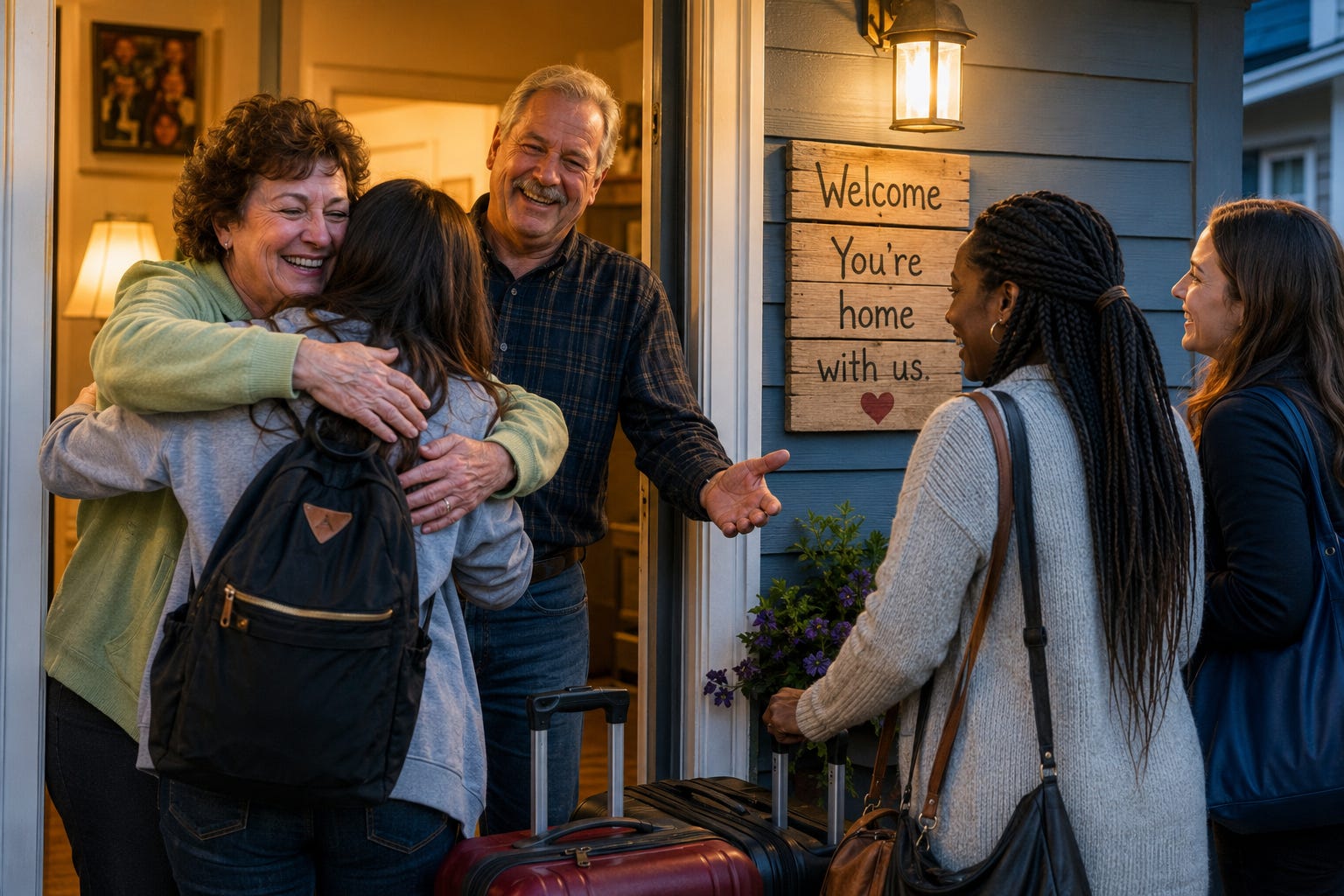
People were opening their homes.
The day before, the passengers had arrived as strangers.
They slept on cots.
Classroom floors.
Church halls.
Community centres.
They were grateful simply to have a roof over their heads.
Twenty-four hours later, that was no longer enough for many Newfoundlanders.
People looked around at the exhausted faces and came to a simple conclusion…
“Why are these folks sleeping here when they could be staying with us?”
And just like that, front doors began opening all over the region.
In Gambo, George and Edna Neal sat quietly in their kitchen discussing the four passengers who had spent the afternoon at their house.
Deb from Texas.
Winnie from Nigeria.
Lana from Zimbabwe by way of Houston.
Mark.
A group of strangers brought together by events beyond anyone’s control.
George liked them.
Edna liked them.
The decision wasn’t complicated.
“Why don’t we ask them to stay?” George suggested.
For the passengers, the answer came just as quickly.
A comfortable home or another night sleeping on a church floor?
Not exactly a difficult choice.
Think about that for a moment.
A day earlier these people had never met.
Now they were moving into each other’s homes.
Not because anyone ordered it.
Not because a government program existed.
Not because there was paperwork to fill out.
Because people saw a need and decided to help.
That theme keeps showing up throughout this story.
Nobody waited to be told what to do.
They simply did it.
The same thing was happening all across the region.
Families emptied linen closets.
Blankets appeared.
Pillows appeared.
Fresh clothes appeared.
Entire communities cooked meals and delivered them to shelters.
If someone needed a shower, all they had to do was raise a hand.
Sometimes they didn’t even need to do that.
People would walk into a shelter and ask…
“Who wants a shower?”
Imagine hearing that today.
A complete stranger offering to take you home so you could clean up and feel human again.
Yet in Newfoundland during those days, it became perfectly normal.
Meanwhile, in Glenwood, teacher Eithne Smith found herself solving problems she never imagined facing.
One moment she was helping passengers send faxes home.
The next she was organizing kosher meals for Orthodox Jewish passengers who had gone more than a day without eating because they couldn’t find suitable food.
A Newfoundland school suddenly found itself hosting people from more than forty countries.
Different languages.
Different customs.
Different faiths.
Different cultures.
And somehow it all worked.
Not perfectly.
Not without misunderstandings.
But it worked because people approached one another with curiosity instead of fear.
Respect instead of suspicion.
One story from that school has stayed with me.
A mother in Australia was desperately trying to locate her son.
The last conversation they had before his flight left had ended badly.
Now the world had changed.
And she didn’t know where he was.
Eithne Smith tracked him down.
When she found him, she kissed him on the cheek and delivered a message.
“That’s from your mother.”
Then she told him his mother wasn’t angry anymore and wanted him to call home.
The young man broke down in tears.
In moments like that, titles and borders stop mattering.
All that remains is humanity.
The deeper this story goes, the more one truth becomes impossible to ignore.
The people of Newfoundland weren’t just solving logistical problems.
They were caring for emotional ones too.
They understood people were frightened.
Homesick.
Exhausted.
Worried about loved ones.
So they found ways to ease the burden.
Sometimes it was a hot meal.
Sometimes it was a phone call.
Sometimes it was simply sitting beside someone who needed company.
Even General Barbara Fast of the United States Army felt it.
As she prepared to leave Newfoundland and return to her command in Europe, she thanked the people who had cared for her.
On the drive to the air base, she remarked how everyone had treated her like family.
The response came from a Canadian officer.
“We’re all Americans tonight.”
There it is.
One sentence.
Seven words.
Everything this story is about.
Not politics.
Not borders.
Not ideology.
Not religion.
Not race.
Not nationality.
Human beings helping other human beings.
By the end of September 12, the passengers were no longer simply stranded travellers.
The people of Newfoundland knew their names.
Knew their stories.
Knew their worries.
Some were sharing meals together.
Some were sharing living rooms.
Some were sharing tears.
And friendships were beginning to form that would last for decades.
The world had come to Newfoundland.
But Newfoundland had done something extraordinary in return.
It had opened its front door.
And invited the world inside.
For five days, a small Newfoundland town became home to thousands of strangers.
This is their story.
And it is Canada’s story too.
Next in the series: Part 5 – The Friendships Begin
Missed the beginning? Read Part 1 here: The Day the World Came to Town
#TheWorldCameToTown #GanderSeries #GeezerWiseSays
Source: The Day the World Came to Town by Jim DeFede.
Enjoying this story?
Join thousands of readers who get my articles delivered free to their inbox.
No paywall. No spam. No algorithms deciding what you should see.
Just straight-talk Canadian commentary, interesting stories, and the occasional rabbit hole worth exploring.
And if it’s not for you?
One click and you’re gone.
Enter your email below and I’ll see you in your inbox.
Beyond beautiful! What can I say? You aced it again Fred, but, do you have to make me cry every time?
Thank you Fred for this series! It is a refreshing lesson for what Humanity is capable of in dark moments while we are experiencing a time of grievance, hatred and fear!