

When Strangers Started Becoming Neighbours
When thousands of stranded passengers finally went to sleep on September 11, 2001…
nobody knew what the next day would bring.
Many still hadn’t reached family members.
Many still didn’t know the full scope of the attacks.
Some were desperately waiting for news from New York.
Others were simply exhausted.
The planes had landed.
The immediate crisis was over.
Now came the waiting.
And for thousands of passengers scattered across central Newfoundland, September 12 began with a simple realization.
The kindness they had experienced the day before wasn’t a one-time gesture.
This was just how these people were.
Roxanne and Clark Loper woke up at the Lions Club with their newly adopted daughter, Alexandria.
Sleep had been hard to find.
Babies cried.
Parents worried.
Nobody was entirely comfortable.
But morning brought something unexpected.
Breakfast.
Not a few muffins and coffee.
A full Newfoundland breakfast.
Eggs.
Bacon.
Toast.
Sausage.
And fried bologna.
The Texas couple had never seen fried bologna before. Their daughter loved it.
The volunteers smiled.
The passengers smiled.
For a few moments, the world felt normal again.
Then the invitations started.
Not from government officials.
Not from relief agencies.
From ordinary people.
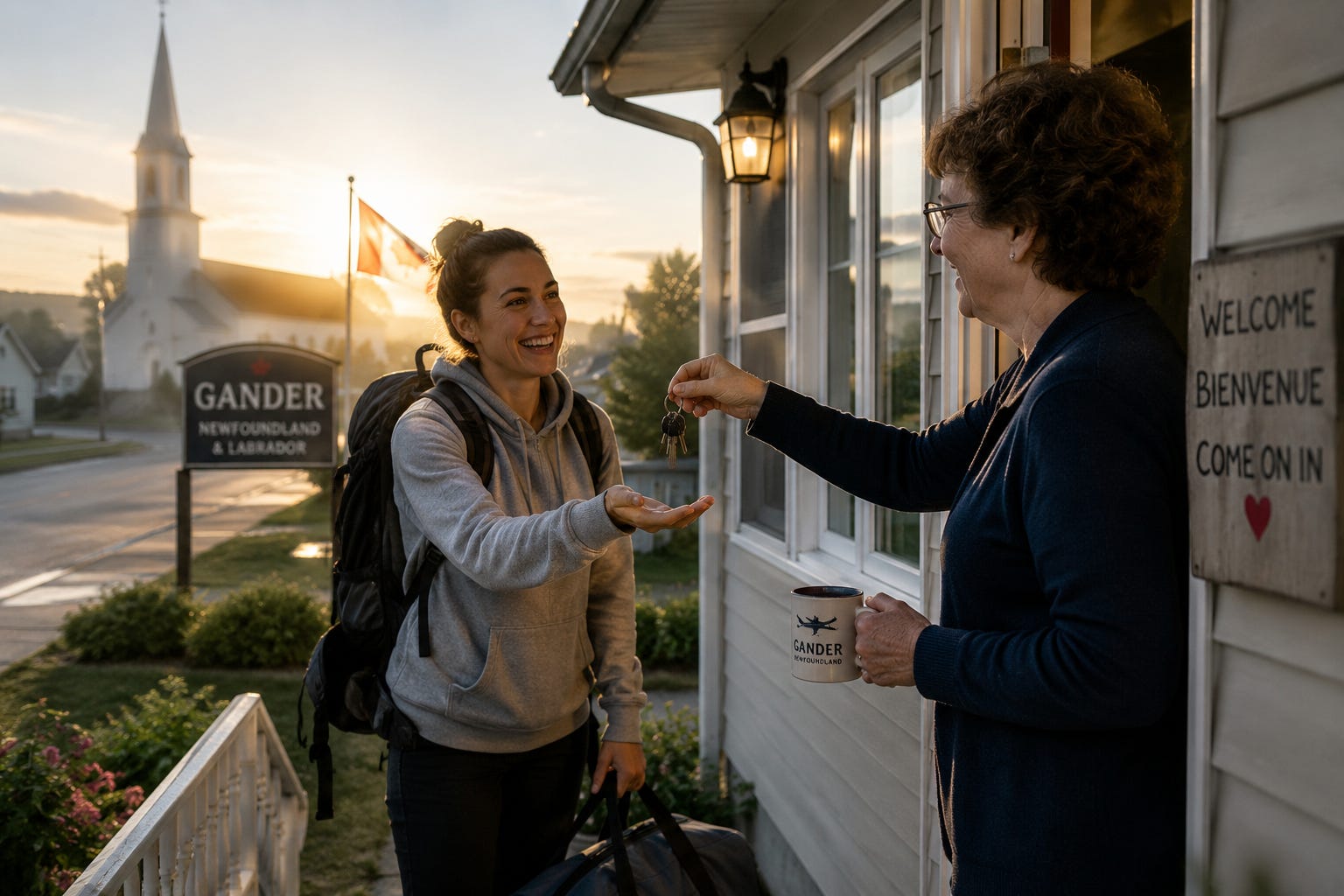
A woman the family had never met offered to drive them shopping.
Another invited them to her home to take a shower.
A complete stranger handed them the keys to comfort and privacy without expecting anything in return.
Roxanne could hardly believe it.
Who invites strangers into their home after only a few minutes of conversation?
Apparently Newfoundlanders do.
The same story was unfolding across town.
George Vitale, a New York State trooper, went for a run through Appleton trying to process everything that had happened.
Back home, friends and fellow firefighters were still missing.
The grief sat heavy on his shoulders.
When he returned, local residents offered him their home.
Use the shower.
Use the phone.
Use the computer.
Help yourself to the refrigerator.
Stay as long as you like.
Then they left him alone with the keys.
The trust was almost overwhelming.
In a world that suddenly felt broken, complete strangers were reminding him that goodness still existed.
Others discovered the same thing.
Two women from Texas decided to buy air mattresses, sleeping bags, and a tent.
When they reached the cash register, the store refused to take their money.
“You’re off the plane, right?”
When they nodded, the answer was simple.
Take it.
You need it.
That was enough.
Across the region, businesses quietly joined the effort.
Restaurants delivered food.
Phone companies set up free long-distance calling stations.
Internet access appeared on folding tables.
Cable companies connected shelters so passengers could follow the news.
Pharmacists worked around the clock replacing critical medications for people whose prescriptions remained locked inside aircraft luggage compartments.
Thousands of problems appeared.
Thousands of solutions appeared right behind them.
No fanfare.
No headlines.
Just people helping.
Yet beneath all the kindness ran another story.
A harder story.
A mother named Hannah O’Rourke spent the day waiting for news about her son Kevin, a New York firefighter.
Every ringing phone mattered.
Every conversation carried hope.
Every hour without answers felt longer than the last.
The people at the Royal Canadian Legion understood.
They sat with her.
Prayed with her.
Talked with her.
Tried to make her laugh.
Not because they could fix the situation.
Because nobody could.
But because nobody should carry that burden alone.
That’s what strikes me most about September 12.
The people of Gander and the surrounding communities couldn’t change what had happened in New York.
They couldn’t reopen the airports.
They couldn’t reunite families.
They couldn’t erase the fear.
But they could make sure thousands of strangers didn’t face those things alone.
And so they did.
One meal.
One shower.
One phone call.
One joke.
One act of kindness at a time.
Twenty-four hours earlier, Gander had been a place most of these passengers had never heard of.
By the end of September 12, many were beginning to wonder how they would ever thank the people who lived there.
Because something remarkable was happening.
The passengers were arriving as strangers.
But they were no longer being treated like strangers.
They were being treated like neighbours.
For five days, a small Newfoundland town became home to thousands of strangers.
This is their story.
And it is Canada’s story too.
Next in the series: Part 3 – Strangers Become Friends
Missed the beginning? Read Part 1 here: The Day the World Came to Town
#TheWorldCameToTown #GanderSeries #GeezerWiseSays
Source: The Day the World Came to Town by Jim DeFede.
Enjoying this story?
Join thousands of readers who get my articles delivered free to their inbox.
No paywall. No spam. No algorithms deciding what you should see.
Just straight-talk Canadian commentary, interesting stories, and the occasional rabbit hole worth exploring.
And if it’s not for you?
One click and you’re gone.
Enter your email below and I’ll see you in your inbox.
Fred, thanks for capturing these memories -- frankly, for a whole new generation of Canadians, Americans, and anyone else who might need a "way forward" around the world in these chaotic times.
I will never tire of reading and listening to these incredible stories.
Good for the soul.
Thank you for this.