

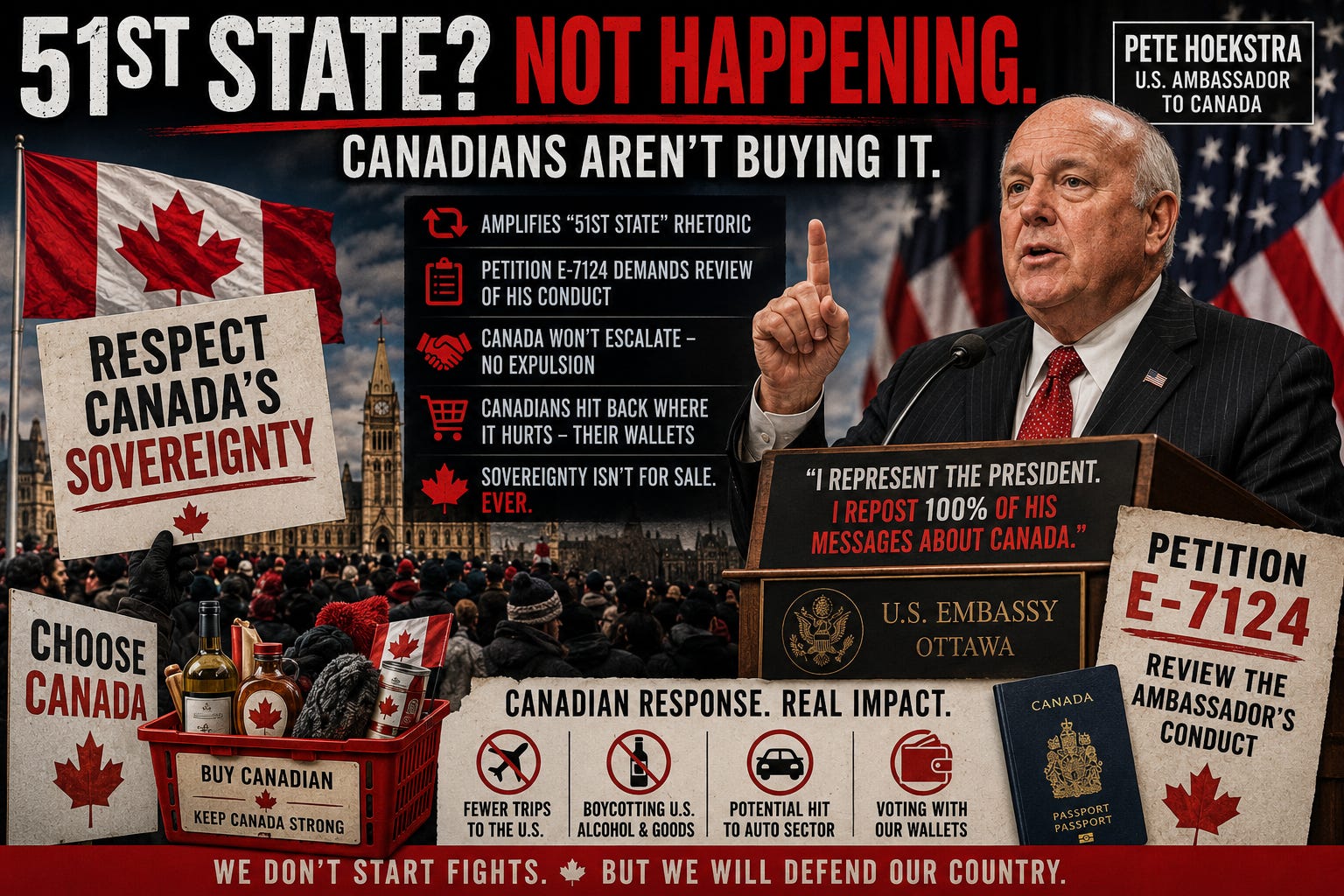
About a year ago, Canadians got a taste of something many of us dismissed as political theatre.
The “Canada should become the 51st state” talk started floating around from south of the border.
At first, some people laughed.
Others rolled their eyes.
Then Canadians quietly did something far more effective than yelling on social media.
They opened their wallets… and closed them.
Trips to the U.S. slowed.
American booze came off shelves.
“Buy Canadian” stopped sounding like an old bumper sticker and started looking more like economic self-defense.
Funny thing about money… politicians notice when it disappears.
The noise faded for a while.
Or at least, we were told it had.
Now it’s back.
And this time, people are paying closer attention because the message isn’t only coming from politicians. It’s being amplified by the very person who’s supposed to represent diplomacy between our countries.
That matters.
Because diplomats are supposed to build bridges.
Not stand on the shoreline with a megaphone repeating political talking points.
A growing number of Canadians are now questioning the role of the U.S. ambassador after he publicly echoed messaging tied to the “51st state” idea… including reposting rhetoric connected to the U.S. president.
His explanation?
He says he represents the president, not himself.
Fair enough.
That is part of the job.
But there’s a difference between representing a government and acting like a full-time amplifier for politically loaded messaging aimed at an ally.
Especially when sovereignty is the punchline.
That’s why a parliamentary petition… E-7124… is now calling for a formal review of the ambassador’s conduct.
To be clear… the petition does not demand he be thrown out of the country tomorrow morning.
It asks for accountability.
A line in the sand.
A reminder that there are still diplomatic standards between neighbouring countries that are supposed to be allies.
Prime Minister Mark Carney has already signaled Canada won’t escalate this into a diplomatic cage match by expelling the ambassador.
And honestly, that’s probably the right move.
No country wins a shouting contest with its largest trading partner.
But restraint should never be confused with weakness.
There’s another layer to this story nobody should ignore.
This isn’t only about politics.
It’s about respect.
Canadians can disagree on taxes, pipelines, healthcare, immigration, carbon policy, hockey teams, and what counts as “real winter.”
But one thing tends to unite us pretty quickly…
We don’t like being talked down to.
Especially by people who seem to think our country is some unfinished extension project waiting to be folded into someone else’s map.
And here’s the part Washington may still not fully understand…
Canadians are polite.
We are not passive.
You don’t usually see us screaming in parking lots.
We just quietly change our buying habits.
We stop crossing the border.
We cancel trips.
We choose local products.
We reroute spending.
That may not trend on social media the same way outrage does.
But economically?
It speaks loudly.
And we already know it gets noticed because similar backlash reportedly forced the rhetoric to cool down once before.
That should tell everyone something.
People keep asking…
“Is this annexation talk serious?”
Honestly?
That’s not even the real question anymore.
The real question is this:
Why keep saying it if you know it damages trust?
Because even if nobody believes Canada is literally becoming the 51st state, repeated messaging still sends a signal.
Signals matter.
Especially between allies.
They shape public opinion.
They harden attitudes.
They turn irritation into resentment.
And resentment has a funny habit of eventually showing up in economics.
Maybe that’s the bigger lesson here.
Canada’s strongest response may not come from Parliament.
It may come from ordinary people making quiet decisions every single day.
Buy this.
Skip that.
Travel here.
Support local.
No shouting.
No drama.
Just choices.
And sometimes, choices hit harder than speeches.
The Recap…
The “51st state” talk is back.
Only now, it’s not just politicians saying it.
When an ambassador starts sounding more like a political megaphone than a diplomat, Canadians notice.
And if history repeats itself? Don’t underestimate the power of Canadians quietly voting with their wallets.
The Gut-Punch…
You can joke about Canada.
You can underestimate Canada.
You can even disrespect Canada.
But eventually Canadians stop arguing… and start changing where their money goes.
That’s when people south of the border usually realize we were paying attention the whole time.
Source credit:
Based on public reporting, parliamentary petition details (E-7124), ambassador statements, and ongoing Canada–U.S. political coverage and research notes.
🔎 The GeezerWise Standard
This space is built on disciplined thinking.
Facts over spin.
Verification before amplification.
Good-faith discussion over tribal noise.
I use AI tools to help shape my spoken drafts into clear writing.
The judgment, conclusions, and final message are mine.
If you’re new here, this explains how I decide what’s worth sharing:
How I Decide What’s Worth Sharing → [link]
💌 Subscribe at GeezerWise.com to receive future letters:
www.geezerwise.com/subscribe
— Fred Ferguson
GeezerWise
#CanadaStrong
Am inclined to believe Hoekstra’s presence in Canada is a daily reminder to all that keeping our $ out of the US has been having a meaningful impact on the US. Can’t wait to never hear his name but agree with PM Carney- the US is doing a brilliant job showing the world what a petty administration they have
I have stopped purchasing anything made in the USA. We all need to keep an eye on the influence that money from the US will have on Alberta and the (vast minority of) people that think they want to separate from Canada. They are just plain deluded.