

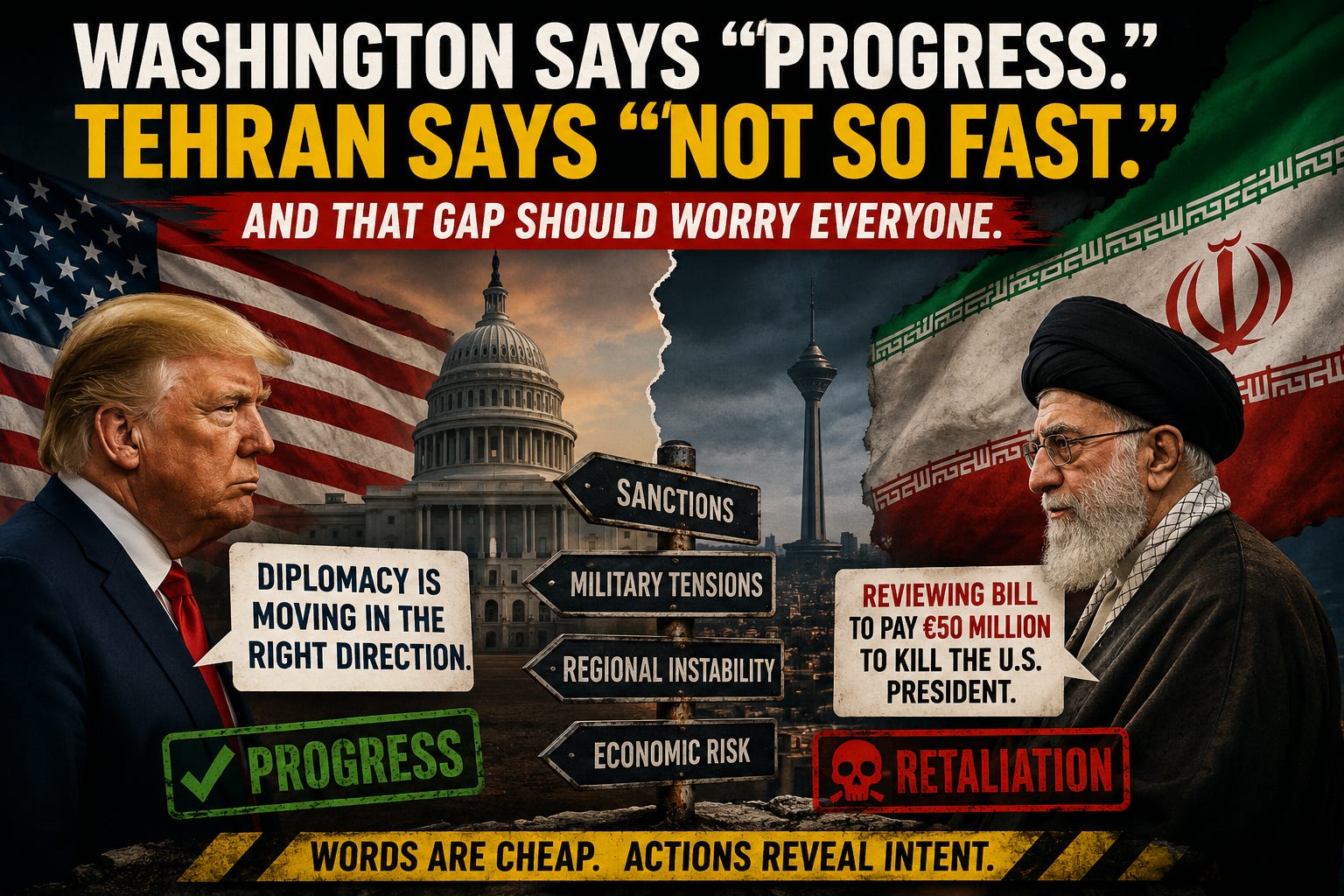
For the last little while, Americans have been told something comforting.
Negotiations with Iran are moving forward. Diplomacy is working. Cooler heads are supposedly in the room.
Maybe.
But here’s the problem.
Governments don’t just speak with press conferences.
They speak with actions.
And right now, the actions and the messaging don’t seem to be telling the same story.
This week, reports emerged that Iran’s parliament is reviewing a proposal tied to retaliation against the U.S. president following the killing of senior Iranian military and political figures during this year’s fighting.
The proposal has been widely reported, though it remains under review… not law, and not official state policy.
That distinction matters.
But so does the signal.
Because while Washington keeps publicly talking about diplomacy and progress, parts of Iran’s political machinery appear to be moving in a far more confrontational direction.
That disconnect is the real story.
Not the headline-grabbing rhetoric.
The gap.
And in geopolitics, gaps like this usually matter.
A lot.
Think of it this way.
If your neighbour tells you everything is fine while quietly boarding up the windows, moving valuables into the basement, and checking the batteries in the flashlight…
You stop listening to the words.
You watch the behaviour.
That’s where things get uncomfortable.
The U.S. has continued describing negotiations as constructive.
At the same time, reports suggest Iran’s latest demands included major concessions: sanctions relief, changes to military positioning around the region, and compensation tied to damages from recent military action.
Washington reportedly rejected the package quickly.
Iran responded with harder language.
American officials kept military options on the table.
Iranian officials responded in kind.
Regional mediators, including countries like Qatar and Pakistan, continue trying to keep communication alive.
But if you step back from the daily headlines, the pattern looks less like “breakthrough diplomacy” and more like two people arguing over where to sit before they’ve even agreed what the argument is about.
That matters.
Because this isn’t happening in a vacuum.
The bigger pressure point may actually be inside Iran itself.
Its economy is under strain.
Its currency has been battered.
Inflation has hammered ordinary people.
Everyday costs are biting harder.
Public frustration hasn’t magically disappeared.
And governments under pressure at home often get louder abroad.
Sometimes strength becomes performance.
Sometimes defiance becomes theatre.
Sometimes external enemies become politically useful.
That doesn’t mean conflict is inevitable.
Far from it.
Even within Iran’s political system, there are obvious reasons to believe some of the more extreme proposals never move very far.
Crossing certain diplomatic lines carries consequences nobody fully controls.
And despite all the chest-thumping from every side, most governments understand how dangerous uncontrolled escalation can become.
But pretending everything is “moving in the right direction” while the temperature keeps rising?
That’s where people should start paying attention.
Because credibility matters.
If leaders keep saying diplomacy is advancing while observable behaviour keeps flashing warning signs, eventually people stop believing the public script.
Markets notice.
Allies notice.
Adversaries notice.
And ordinary people? They feel the consequences last.
Usually through higher prices, energy shocks, instability, supply disruptions, and another round of politicians explaining why something nobody expected suddenly became unavoidable.
History has a nasty habit of whispering before it starts shouting.
The mistake people make is waiting for the shouting.
The Recap…
Washington says diplomacy with Iran is progressing.
Meanwhile, the signals coming out of Tehran tell a very different story.
When words and actions stop matching, smart people stop listening to speeches — and start watching behaviour.
The Gut-Punch…
Governments rarely announce the truth in real time.
They announce optimism.
Reality usually leaks out through behaviour long before the press conference catches up.
Source credit:
Research based on publicly reported developments regarding U.S.–Iran diplomatic negotiations, regional mediation efforts, and Iranian parliamentary discussions, including reporting referenced in the original transcript and additional verification of public claims. Transcript treated as research notes only.
🔎 The GeezerWise Standard
This space is built on disciplined thinking.
Facts over spin.
Verification before amplification.
Good-faith discussion over tribal noise.
I use AI tools to help shape my spoken drafts into clear writing.
The judgment, conclusions, and final message are mine.
If you’re new here, this explains how I decide what’s worth sharing:
How I Decide What’s Worth Sharing → [link]
💌 Subscribe at GeezerWise.com to receive future letters:
www.geezerwise.com/subscribe
— Fred Ferguson
GeezerWise
#CanadaStrong
The whole world knows that every time Trump speaks about progress on negotiations it is just another lie. This lie serves two purposes. Firstly, he's boxed in with no way out while saving face, he knows it, but can't admit it out loud. The other purpose is to manipulate the stock market, his lies and his actions have such a huge impact on the markets it should be considered manipulation, and he is using it to his full advantage.
Thanks Patsy ❤️
I think a lot of people are feeling that same exhaustion right now.
Let’s hope cooler heads eventually beat chaos... because ordinary people always pay the price when leaders don’t.