

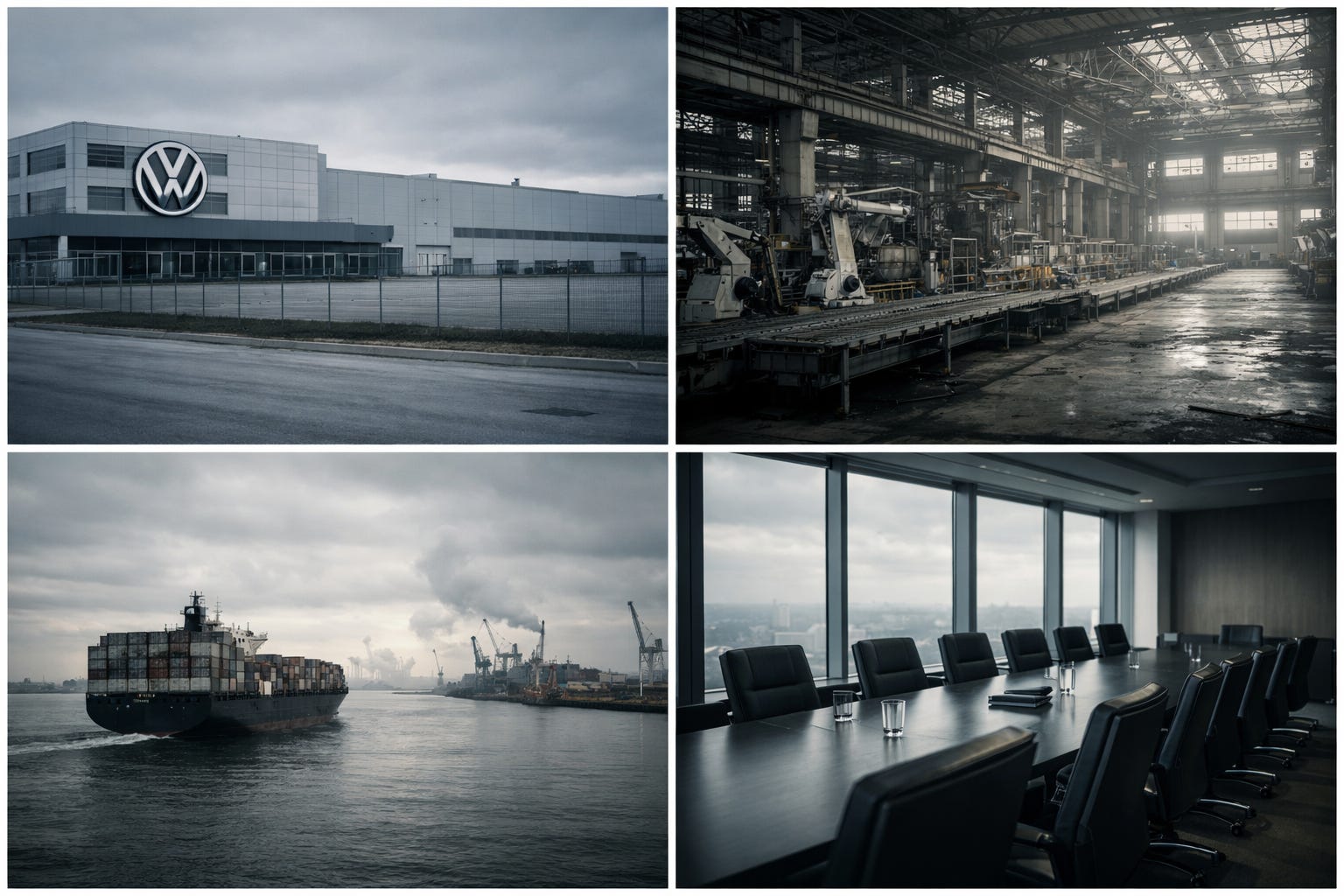
They Walked Away…
This wasn’t a delay.
It wasn’t a rethink.
It wasn’t “under review.”
Volkswagen pulled the plug on a major U.S. manufacturing expansion and walked.
That matters… not because it’s one factory, but because of why it happened.
The number that killed the deal
Volkswagen’s CEO confirmed the company has already eaten €2.1 billion (about $3.4 billion CAD) in U.S. tariff costs in just nine months of 2025.
That’s not theoretical pain.
That’s cash bleeding out the door.
And the conclusion from the top was blunt:
With tariffs staying as they are, large new U.S. investments don’t pencil out.
When a company that thinks in 20-year timeframes says that out loud, the decision is already made.
This wasn’t sudden… it was years in the making
Volkswagen has been flirting with a second U.S. plant since 2018.
They already…
Build vehicles in Tennessee (ID.4 and Atlas)
Are spending $2 billion on a new South Carolina plant for Scout Motors
Own land set aside specifically for a possible Audi factory
Multiple U.S. states lined up with incentive packages.
On paper, the deal looked solid.
Why? Because under earlier policy, local production protected them from import tariffs.
Audi builds key models like the Q5 in Mexico, which no longer qualifies for duty-free treatment.
A U.S. factory would’ve fixed that.
Then tariffs stacked up… and the math broke.
The real killer wasn’t cost
It was unpredictability
Volkswagen is now facing 27.5% total U.S. tariffs:
25% new auto tariffs
Plus the existing 2.5%
Here’s the problem most politicians never grasp:
Businesses can plan for high costs.
They can’t plan for unknowable ones.
Tariffs were imposed.
Then threatened to rise.
Then negotiated down.
Then threatened again.
That’s not policy… that’s roulette.
A factory isn’t a pop-up shop.
It’s a 20–30 year bet.
If the rules swing with political weather, those projections become fiction.
Here’s the trap Volkswagen hit
They needed U.S. production to escape tariffs.
But tariffs were draining the capital needed to build that production.
That’s like asking someone to climb out of a hole while you keep shovelling dirt in.
To stay competitive, Audi absorbed most of the tariff cost instead of dumping it on buyers… which means every car sold in the U.S. made less money.
That weakens the business globally, not just in America.
And Volkswagen isn’t alone
German investment into the U.S. fell 45% year-over-year in 2025… from €19 billion to €10.2 billion.
Exports told the same story…
Total German exports to the U.S. down 7.8%
Auto exports: down 17.5%
Machinery: down 9%
Chemicals: down over 10%
Those sectors make up 40%+ of Germany’s exports to America.
This isn’t a wobble.
It’s a retreat.
Capital doesn’t argue… it leaves
Here’s the analogy politicians hate:
Capital behaves like a long-term renter.
You can raise the rent… but if you keep changing the locks and threatening eviction, it doesn’t negotiate.
It moves.
One in five German manufacturers has already shifted production abroad… up 8 percentage points in just two years.
Only 19% of German financial executives are now considering new North American investments, down from 25%.
That’s a structural shift, not a headline.
The quiet cost America doesn’t see
When Volkswagen cancels an Audi plant:
Thousands of U.S. jobs never exist
Suppliers never build nearby
Local tax bases never grow
States that competed for the factory don’t get a runner-up prize.
They get nothing.
The theory was tariffs would force companies to build in America.
The reality?
They’re teaching companies to reduce exposure instead.
This is bigger than cars
China is on track to replace the U.S. as Germany’s top trading partner:
€231B in trade with China
€222B with the U.S. (first 11 months of 2025)
For 75 years, American power rested on being the stable anchor of the global system.
Size mattered… but reliability mattered more.
Once reliability cracks, it takes decades to rebuild trust.
Not tweets.
Not threats.
Not “tough talk.”
Bottom line
Volkswagen didn’t cancel a factory.
They priced in risk… and walked.
If this keeps up, expect more quiet exits over the next 12–24 months.
Capital moves first.
Press releases come later.
Economic power isn’t just about being big.
It’s about being predictable.
And once that’s gone, it doesn’t come back quickly… if it comes back at all.
Source credit:
Source note: Based on publicly reported data and analysis from European financial reporting and trade coverage. Original video used as research only; wording and structure rebuilt from scratch.
Canada Strong Movement… House Rule & Disclosure
Canada Strong exists to defend Canadian sovereignty, democratic norms, and economic independence… without imported talking points or borrowed outrage.
House rule… Facts and good-faith discussion are welcome. I use AI tools to help turn my spoken drafts into clear writing. I’m 73, my hands shake, and I type with two fingers… so I speak first, then edit.
The ideas, positions, and final message are mine.
💌 If you enjoyed this, subscribe at GeezerWise.com to get future Unlearn letters straight to your inbox: www.geezerwise.com/subscribe ✌️
#CanadaStrongMovement #CanadaStrong
I read they were thinking about pulling out but not that they had. But man the world news is flying so fast these days one can't keep up.
Nice work Fred Hadn't really heard anything so detailed concerning Volkswagen.