

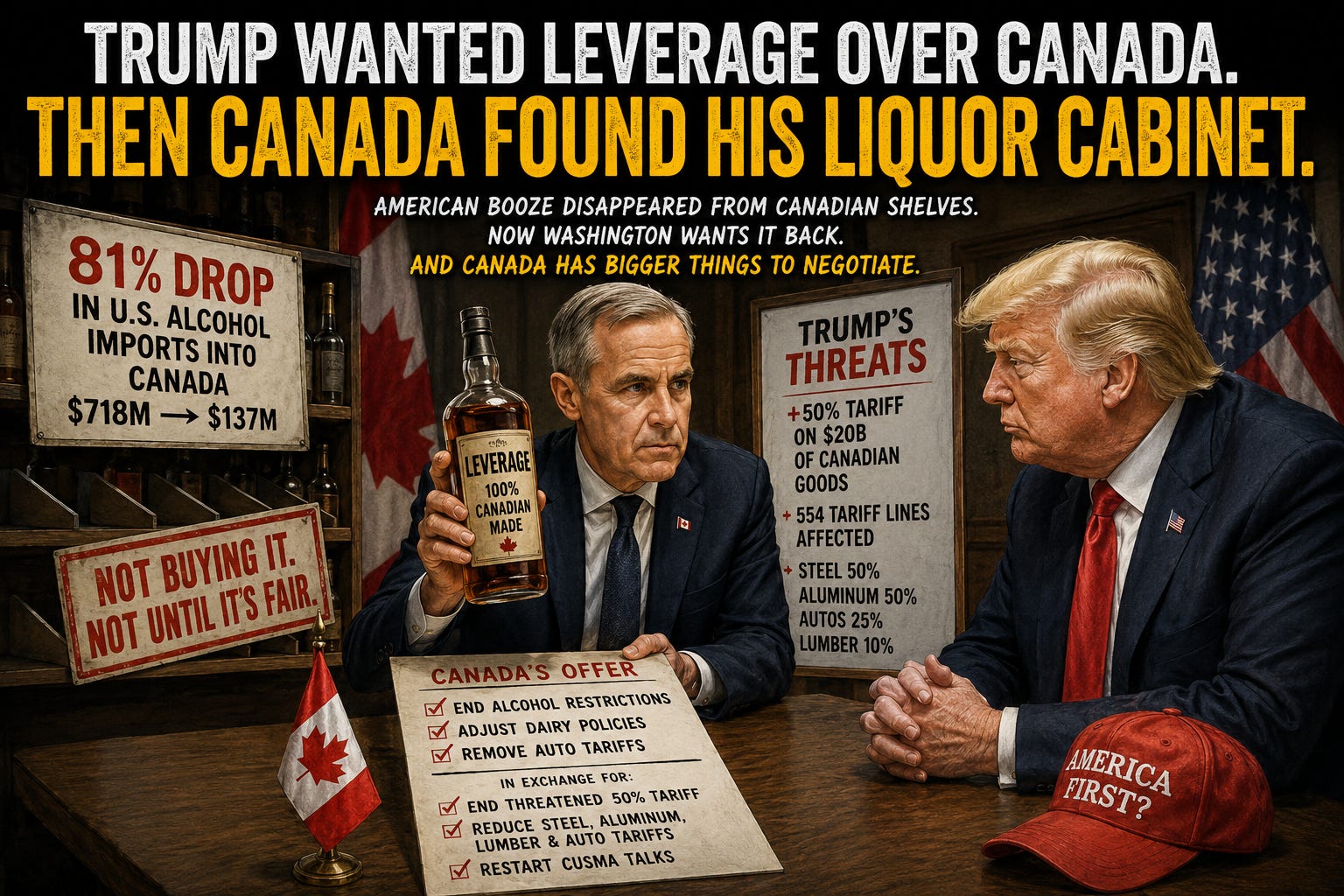
Something rather interesting happened when Canadians stopped buying American booze.
It worked.
Not as a slogan.
Not as a patriotic Facebook meme.
Not as another round of politicians pounding their chests.
It worked where trade wars actually matter:
At the cash register.
American alcohol imports into Canada reportedly plunged by roughly 81%, falling from about $718 million to $137 million over the period cited in the research.
That gets somebody’s attention.
And suddenly the bottles Canadians stopped buying aren’t just bottles anymore.
They’re bargaining chips.
Ottawa Has a Shopping List
Canada and the United States are heading into another round of high-level negotiations with Washington threatening another major tariff escalation.
The reported Canadian offer includes several concessions…
Ending restrictions on American alcohol.
Adjusting some dairy import policies.
Removing Canadian retaliatory tariffs on American automobiles.
But Canada isn’t proposing to hand those over for a handshake and another Trump promise.
Ottawa reportedly wants something substantial in return:
Relief from the threatened new 50% tariffs.
Reductions in existing American tariffs on Canadian steel, aluminum, lumber and automobiles.
And a commitment to get the broader CUSMA discussions moving again.
That’s a negotiation.
You want something.
We want something.
Let’s talk.
Which is considerably more useful than spending six months shouting “WINNING!” into a microphone.
There’s One Hell of a Catch
Ottawa doesn’t actually control all the booze.
Canada is a federation.
Provincial governments control their liquor systems.
That means the federal government can negotiate American alcohol access with Washington.
But it can’t simply snap its fingers and order every provincial liquor board to put Kentucky bourbon and California wine back on the shelves.
Quebec has already made its position pretty clear.
American alcohol comes back when Quebec thinks the deal is fair.
That creates a fascinating wrinkle for Mark Carney.
He may be negotiating with Donald Trump across the table while simultaneously negotiating with Canadian premiers behind him.
Trump has one Canada to negotiate with.
Carney has thirteen of them.
Welcome to federalism.
And That May Not Be Entirely Bad
Think about what Canada accidentally discovered here.
When the provinces removed American alcohol in response to U.S. tariffs, it looked mostly symbolic.
Canadians were pissed off.
Premiers responded.
American products disappeared.
But symbolism becomes something else when somebody starts losing sales.
American producers didn’t lose a theoretical market.
They lost customers.
That’s why the booze issue matters.
Canada demonstrated that retaliation doesn’t necessarily require matching Trump tariff for tariff.
Sometimes you find something the other side wants badly enough to notice when it’s gone.
Then you keep it in your pocket until the negotiating starts.
Meanwhile, Trump Has Another Tariff Hammer Raised
The research notes point to an additional 50% U.S. duty on certain Canadian goods, reportedly affecting roughly $20 billion worth of trade.
And that’s on top of the existing mess involving steel, aluminum, automobiles and lumber.
Those aren’t abstract industries.
Steel goes into buildings and factories.
Aluminum goes into vehicles, aircraft, packaging and manufacturing.
Lumber goes into American houses.
Canadian components cross the border inside deeply integrated North American supply chains.
Put a tariff on those goods and the Canadian exporter certainly feels it.
But that’s only half the transaction.
Somebody in America is importing that product.
Somebody is manufacturing with it.
Somebody is selling the finished product.
And eventually somebody reaches for a wallet.
That’s the part Trump keeps conveniently leaving out.
Tariffs don’t magically send an invoice to Canada.
The U.S. government collects the tariff from the importer.
The cost then works its way through the economy.
Sometimes the importer absorbs some of it.
Sometimes suppliers cut margins.
Sometimes businesses change suppliers.
But plenty of that cost eventually lands exactly where you’d expect.
On businesses and consumers.
Tariffs advertised as punishment for foreigners have an irritating habit of becoming bills for Americans.
Canada Isn’t Bulletproof
Let’s not get carried away.
Canada still sends an enormous amount of its exports to the United States.
Canadian workers can absolutely get hurt in a prolonged trade war.
Steelworkers don’t pay their mortgages with patriotic speeches.
Neither do auto workers, lumber workers, farmers, truckers or small-business owners.
And one good Canadian economic report doesn’t mean we’ve suddenly turned into Switzerland with oil wells.
The research material cites strong recent Canadian employment and growth figures, but monthly numbers move, get revised and aren’t directly comparable between two countries simply by counting jobs.
So I’m not interested in declaring some ridiculous…
CANADA WINS! AMERICA LOSES!
That’s Trump economics.
The more important development is this:
Canada is discovering it has leverage.
Energy.
Aluminum.
Critical minerals.
Automotive supply chains.
Agricultural products.
A huge market for American exports.
And, apparently, one surprisingly effective liquor cabinet.
Carney’s Real Test Starts Here
Mark Carney doesn’t need to humiliate Trump.
He doesn’t need a victory parade.
And Canada doesn’t need another politician telling us how tough he is.
We need results.
If Canada can exchange relatively narrow concessions for meaningful reductions in tariffs affecting billions of dollars in Canadian industries, that’s worth discussing.
But there’s a line.
Removing one threatened tariff while leaving steel, aluminum, lumber and auto tariffs largely intact isn’t a comprehensive trade victory.
It’s a ceasefire.
Useful?
Absolutely.
Mission accomplished?
Not even close.
The real prize is restoring something businesses on both sides of the border desperately need…
Predictability.
Companies can survive taxes.
They can survive regulations.
They can survive tough competition.
What they struggle to survive is waking up every morning wondering whether the rules changed overnight because somebody in Washington got angry.
You can’t build factories that way.
You can’t plan supply chains that way.
You can’t commit billions of dollars in investment that way.
And you sure as hell can’t run the world’s most integrated trading relationship that way.
Canada Learned Something Important
For decades, Canada’s relationship with the United States operated on one comfortable assumption…
The rules mattered.
CUSMA was supposed to reinforce that.
Trump has forced Canada to consider a much uglier possibility:
What happens when the rules only matter until the president decides they don’t?
That’s why this fight is bigger than bourbon.
Canada isn’t merely negotiating tariff percentages anymore.
We’re learning how to deal with an American government willing to use access to its enormous market as political leverage.
And Canada is discovering that leverage works both ways.
American companies want Canadian customers.
American manufacturers need Canadian inputs.
American businesses want predictable access to our market.
American farmers, distillers, wineries and exporters would very much prefer Canadians to start buying their products again.
Good.
Now we’re negotiating.
Keep the bourbon in the warehouse.
Put the tariffs on the table.
And start talking.
The Recap…
Canada’s American booze boycott wasn’t just symbolic.
U.S. alcohol imports into Canada reportedly collapsed roughly 81%.
Now restoring that market has become part of the Canada-U.S. tariff negotiations.
Funny thing about leverage.
You don’t know how much you’ve got until somebody asks for it back.
The Gut-Punch…
Trump taught Canada that economic leverage works.
His mistake was assuming Canada didn’t have any.
Source credit:
Research notes supplied for this article, drawing on reporting from CBC News, Canadian and U.S. government trade materials, and reporting concerning the Canada-U.S. tariff negotiations. The notes report an approximately 81% decline in U.S. alcohol imports into Canada and describe the proposed trade package involving alcohol restrictions, dairy policy, automobiles and tariff relief.
If you enjoy thoughtful conversations, Canadian stories, and the occasional smart-ass observation about the world we’re living in, you’re in the right place.
Subscribe free and get new stories, insights, and observations delivered directly to your inbox.
No paywall.
No spam.
No nonsense.
Leave anytime with a single click.
I promise not to take it personally.
Everything you write here makes a lot of sense, but the weekly in the chain is Trump’s and his administration’s, unpredictability. Our Prime Minister could negotiate the best deal in the world and it might only last until next Thursday. We are dealing with an administration who, for the foreseeable future has proven they will not honour their promises and will change any deal on a whim just for media effect.
If we agreed to put any American alcohol back on the shelves, we need to consider the impact it will have on Canadian producers who have scaled up to meet the demand, and we need to be prepared to restock very slowly with everything in place to shut it right down again. And we should definitely do this if there is any reneging whatsoever.
If I’ve thought of this, I’m 100% sure that Mark Carney and his team have too.
A bargaining chip is only as good as the willingness of the other party to honour the promise.
I've said this before and will continue to repeat it:
- I don't think Carney, LeBlanc, etc. are actually truly negotiating a short-run deal. I don't mean this to imply that they are wasting time or not putting in constructive effort -- that's an important thing to be doing here, for both optics to Canadians (for credibility), and for WTO filing down the road (for improper American trade sanctions, etc.). What I think they are doing is something like this:
- If we get a comprehensive agreement to substantially avoid new tariffs and reduce old ones, in exchange for Canada reducing some of our "irritants" to them -- then Great!!! Hey, it always COULD happen with Trump -- but as many of us also note, that likely means an agreement exists for two days until somebody else pays him $million or so to take action against us.
- What I think Carney's real goal here is to literally HAVE that happen -- Trump screws us after making a deal -- The whole world will see it (again), but will also see how Canada tried to handle all of this in good faith. Very important right now -- everybody around the world is watching this trade dispute (seriously). Not because they believe Trump will act in good faith to us (or them, in turn), but really to see how the whole thing plays out. He screws us (again), and pretty much nobody will waste time doing any form of comprehensive trade agreement with Greer/Trump, etc. But Canada will look VERY GOOD in how it handles trade matters. I seriously believe Carney figures this is the likely outcome, and is really using it as (ahem) ADVERTISING to the world to say "deal with us, don't bother with USA."
- this is like a game of chess - you might sacrifice a pawn, but that's really to position yourself better down the road. Carney thinks 25-50 years ahead. Trump thinks about 10 minutes ahead (or at least until his next golf game).
And I do think we want to be cautious not to give Trump/Republicans an economic win before the midterms. There is some strategy to say "wait him Trump out until after the midterms."