

Trade wars are funny things.
Politicians announce them with cameras rolling. Markets respond with spreadsheets.
That’s exactly what happened when the United States slapped tariffs on Canadian aluminum.
The goal was simple enough… make Canadian aluminum expensive, force producers to accept worse terms, and strengthen American industry.
Instead, Canada did what businesses have always done.
It found another customer.
For decades, the United States was Canada’s default aluminum buyer.
Quebec, which produces roughly 90% of Canada’s aluminum, sent almost everything south of the border.
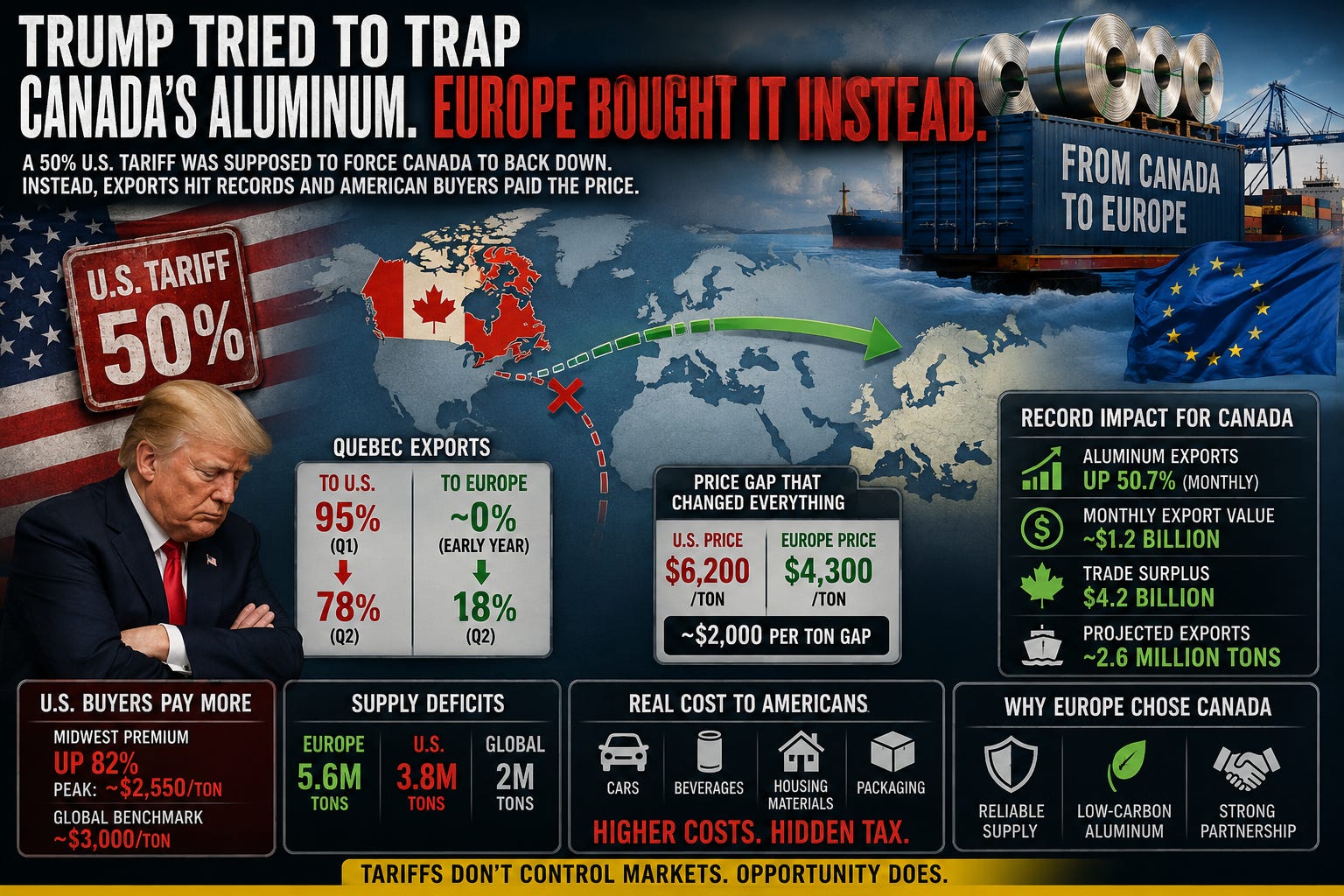
Early this year, about 95% of Quebec’s aluminum exports were headed to the U.S.
Then Washington raised tariffs to 25% in March.
By June, they had doubled them to 50%.
That was supposed to put Canada in a corner.
It didn’t.
Within months, Quebec’s share of exports going to the United States had fallen to about 78%.
At the same time, shipments to Europe exploded from virtually nothing to roughly 18% of exports.
Some companies moved even faster.
Alouette shifted from sending just 4% of its aluminum to Europe to roughly 57%.
That’s not a minor adjustment.
That’s a complete change of direction.
Markets Don’t Read Political Speeches
One lesson keeps showing up in global trade.
Markets chase opportunity.
Europe suddenly needed aluminum in a big way.
Supply shortages, combined with instability affecting global supply chains, created a massive deficit estimated at about 5.6 million tonnes.
Canada happened to produce exactly what Europe wanted.
Even better, Canadian aluminum has another advantage that’s becoming more valuable every year.
It’s among the lowest-carbon aluminum in the world.
European manufacturers increasingly care where their materials come from... Cleaner production isn’t just good for the environment anymore.
It’s becoming a competitive advantage.
The Americans assumed Canada had nowhere else to go.
Europe proved otherwise.
The Hidden Cost Lands at Home
Tariffs always sound like someone else pays.
Reality usually disagrees.
As Canadian shipments declined, American buyers found themselves competing for a smaller supply.
The result?
Record premiums.
The U.S. Midwest aluminum premium surged roughly 82%, reaching about $2,550 per tonne on top of global benchmark prices around $3,000 per tonne.
That extra cost doesn’t disappear.
It gets folded into the price of cars.
Beer cans.
Building materials.
Appliances.
Packaging.
Eventually, shoppers pay it without ever seeing “tariff” printed on the receipt.
That’s why I’ve called tariffs a hidden tax.
The importer writes the cheque.
The consumer reimburses them one purchase at a time.
Canada Didn’t Panic
One of the most interesting parts of this story isn’t what happened.
It’s how quickly it happened.
Trade routes that usually take years to develop shifted in a matter of months.
Major producers including Rio Tinto, Alouette and Alcoa adjusted distribution strategies almost immediately.
In some cases, companies even restructured supply chains to reduce the impact of U.S. tariffs.
Markets are remarkably good at finding side doors.
Governments often underestimate that.
The Numbers Tell the Story
During this period Canada recorded a monthly aluminum export increase of more than 50%.
Monthly export values climbed to roughly $1.2 billion.
Canada also posted a trade surplus of about $4.2 billion while all of this was unfolding.
In other words...
The tariff attack arrived.
Canadian exports grew anyway.
That’s not because tariffs don’t matter.
It’s because markets rarely behave the way politicians expect.
This Isn’t Just About Aluminum
The bigger story is diversification.
For decades, Canada often acted as though the United States would always be our primary customer.
Those days are ending.
Not because Canadians wanted this fight.
Because we’ve learned something important.
When one customer becomes unpredictable, smart businesses don’t argue.
They find another customer.
Europe needed aluminum.
Canada supplied it.
American manufacturers paid more.
Consumers paid more.
Canadian exporters sold more.
That’s about as clear an example of unintended consequences as you’ll find.
Markets don’t care about political slogans.
They care about supply.
Demand.
Price.
And opportunity.
The aluminum didn’t stop moving.
It simply changed direction.
The Recap…
A 50% tariff was supposed to squeeze Canada.
Instead, Canadian aluminum headed for Europe.
Exports climbed. Canada’s trade surplus grew. American manufacturers paid record premiums.
Markets always find the door tariffs forget to lock.
The Gut-Punch…
You can tax a border.
You can’t tax away demand.
The moment Canada proved it had other customers, the tariff stopped being a weapon against Canada and became an expensive lesson for the country that imposed it.
Source Credit
Sources: Statistics Canada trade data; Quebec aluminum export data; industry reporting on Rio Tinto, Alouette and Alcoa; aluminum market pricing and premium data from major commodities reporting; European aluminum market supply assessments and publicly available trade reports.
If you enjoy thoughtful conversations, Canadian stories, and the occasional smart-ass observation about the world we’re living in, you’re in the right place.
Subscribe free and get new stories, insights, and observations delivered directly to your inbox.
No paywall.
No spam.
No nonsense.
Leave anytime with a single click.
I promise not to take it personally.
Trump's tariffs on Canadian aluminum was the biggest own goal, shoot yourself in the foot, total screw up that didn't make any sense for the USA from day one. Aluminum production takes a huge amount of electricity to make that Canada has in abundance at a cheap cost. The USA is sadly lacking in electrical generation. There used to be 2 dozen or so aluminum smelters in the US and they all closed as they couldn't compete with Canadian and other foreign producers. Now, American users of aluminum are coming hat in hand trying to buy whatever they can get their hands on, at a price demanded by Canada, with the added bonus of a 50% tariff for good measure. What has also helped Canada increase their exports to Europe was another Trump own goal: the Iranian war. That has caused havoc with all of the aluminum producers in the middle east. European users of aluminum could no longer get a reliable supply from the middle east and were able to quickly pivot to Canada as a reliable supplier. For Canadian aluminum producers, Europe should be a huge long term gain.
I love seeing that buyers are looking for sellers from clean-energy countries because Shitler hates clean energy. I'm American and I hate what this will do to costs I have to pay, but if the rest of the world can make the mango Mousseline squirm, I'm down with that!