

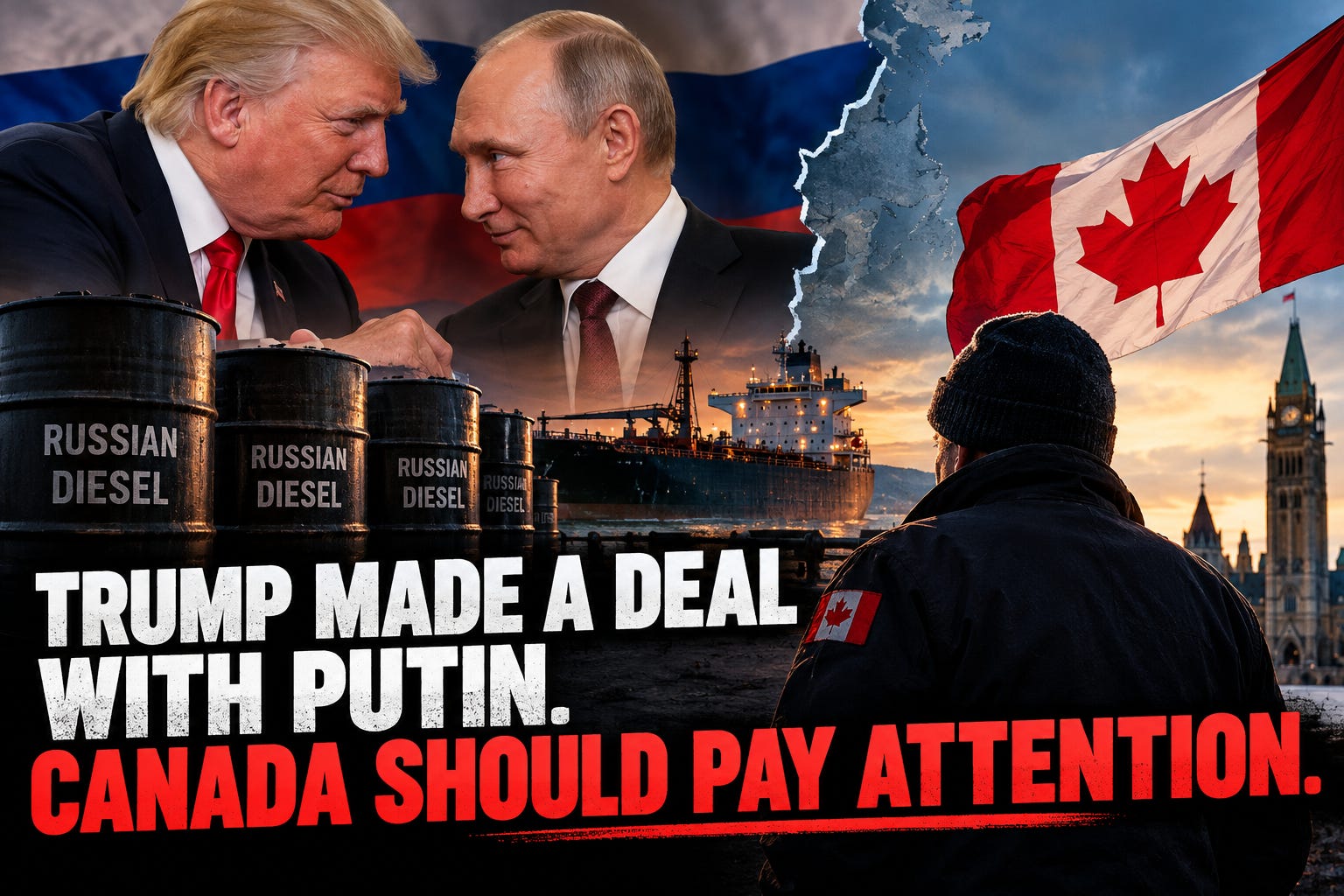
While Washington buys Russian diesel and Ukraine struggles with American-controlled military technology…
Canada is getting another reminder of why independence matters.
Twelve American senators just told Donald Trump to reverse his deal with Vladimir Putin.
Six of them are Republicans.
That caught my attention.
Not because Republicans suddenly discovered that Putin isn’t a particularly nice fellow. But because the president of the United States has agreed to ease restrictions on Russian diesel while Russia continues attacking Ukraine.
And members of his own party are calling him out.
On October 9, Trump announced an arrangement allowing Russian diesel back into international markets, supposedly to help bring down fuel prices.
Four days later, a bipartisan group of senators demanded that he reverse course.
Their objection was straightforward. Russia needs money to finance its war. Selling diesel brings in money. And the United States has spent years trying to restrict that revenue.
Now Washington is opening a door it previously worked to close.
The senators called the agreement a betrayal of Ukraine and warned that it would benefit America’s adversary.
Those aren’t my words. They’re the assessment of twelve sitting American senators.
And there’s something else worth noticing.
Congress had recently passed additional legislation designed to increase economic pressure on Russia. Trump signed it.
Then he turned around and agreed to ease restrictions on Russian diesel.
Try explaining that one to the Ukrainians.
Meanwhile, something happened in Ukraine.
On October 14, Reuters reported that Ukrainian military units were experiencing restrictions on Starlink satellite communications.
This wasn’t about somebody losing their internet connection while watching Netflix.
Ukrainian forces depend on satellite communications to operate drones, coordinate battlefield movements and carry out military missions.
According to Ukrainian officials, new restrictions affecting military-grade Starlink connections disrupted operations and forced some missions to be cancelled.
The reported restrictions involved equipment moving above certain speeds.
Imagine depending on a communications system to operate military equipment, only to discover that its capabilities have changed without warning.
That’s what Ukrainian officials say happened.
There are important details we don’t yet know, including precisely why those restrictions were imposed.
But the consequences are real enough.
At the same time, Ukrainian officials were raising concerns about warnings of incoming Russian missile attacks.
The Washington Post reported that American officials had threatened to restrict intelligence sharing if Ukraine continued attacking Russian oil facilities.
The report also indicated that intelligence sharing had not been completely suspended, and Ukrainian officials subsequently acknowledged receiving warnings during later attacks.
That distinction matters.
We shouldn’t claim America has stopped providing intelligence when the evidence doesn’t establish that.
But we can certainly ask why a country defending itself against Russian invasion is being threatened with losing support for attacking the infrastructure that helps finance Russia’s war.
Especially while Washington is arranging to purchase Russian diesel.
I find that combination disturbing.
Here’s where Canada comes in.
We’ve spent decades building our national security and economic relationships around the assumption that the United States is a dependable partner.
For much of that time, the assumption made sense.
We’re neighbours. We’re NATO allies. We cooperate through NORAD. Our economies, industries and defence systems are deeply connected.
None of that disappears because Trump occupies the White House.
But being allies doesn’t mean we have identical interests. And it certainly doesn’t mean Washington will always make decisions that protect ours.
Ukraine is discovering how dangerous dependence can become when critical military capabilities are controlled outside its borders.
Canada needs to learn from that experience without waiting for a Canadian emergency to teach us the lesson.
That means asking some uncomfortable questions.
How much of our defence capability depends on American equipment, software, maintenance or permission?
How quickly could we replace critical systems if access were restricted?
Are we building Canadian industries that can support our own security, or simply buying more expensive dependencies?
And when we diversify our trade, are we doing enough to ensure that our new relationships actually reduce our vulnerability?
These aren’t arguments for abandoning NATO or treating every American as an enemy.
They’re arguments for taking Canadian independence seriously.
Mark Carney’s government has been pushing to expand trade relationships, strengthen domestic industry and rebuild defence capabilities.
Those efforts will take years. Some will cost a fortune. Some won’t work as planned.
But there’s a reason to get moving.
The United States doesn’t have to become Canada’s enemy for American dependence to become a Canadian problem.
Washington only has to make decisions that serve Washington’s interests instead of ours.
And it has every right to do that.
Just as Canada has every right to protect itself.
I don’t believe Canadians should spend the next decade hoping that the next American president will restore everything to the way it used to be.
Maybe relations improve. I certainly hope they do.
But I don’t want Canada’s security, prosperity or sovereignty resting on the outcome of an American election every four years.
That’s a lousy national strategy.
And after watching what happened between Washington, Moscow and Kyiv this week, I think it’s an increasingly dangerous one.
Canada doesn’t need to pick a fight with the United States.
We need to build a country that doesn’t have to be afraid of one.
The Recap…
Trump’s Russian diesel agreement has drawn objections from twelve U.S. senators, including six Republicans.
Meanwhile, Ukrainian military operations have been disrupted by restrictions affecting American-controlled satellite communications.
Canada should be paying attention.
Dependence is convenient until someone else controls what you depend on.
The Gut-Punch…
An ally is valuable. Having the ability to stand on your own is priceless.
Sources
Reuters… Ukraine reports Starlink restrictions disrupting military missions, October 14, 2026
The Washington Post… Ukraine’s concerns over U.S. intelligence and Starlink access, October 14, 2026
Associated Press… Bipartisan opposition to Trump’s Russian diesel arrangement
If you enjoy thoughtful conversations, Canadian stories, and the occasional smart-ass observation about the world we’re living in, you’re in the right place.
Subscribe free and get new stories, insights, and observations delivered directly to your inbox.
No paywall.
No spam.
No nonsense.
Leave anytime with a single click.
I promise not to take it personally.
Just another reason, one of many, of why Canada should forgo on the F-35 and select Gripen.
Trump just showed his hand. He is definitely a Soviet stooge. He has invited musk back to the White House to screw over Ukraine. AND he is personally most probably going to benefit from his latest move.