

There’s a wonderfully inconvenient thing about industrial reality.
It doesn’t care what Donald Trump says.
You can announce tariffs. You can threaten companies. You can promise exemptions. You can stand behind a podium and declare that factories are coming back to America.
But eventually somebody has to plug the damned factory into the wall.
And aluminum needs one hell of a wall socket.
That’s the part of the Canadian aluminum fight Washington seems to have underestimated.
Trump’s strategy was straightforward… make Canadian aluminum more expensive to sell into the United States and encourage producers to move production south.
According to the research notes, U.S. officials reportedly sweetened the proposition with faster tariff relief for Canadian aluminum and steel companies willing to shift production into the United States.
Sounds simple.
Until you ask one question…
Where are you going to get the electricity?
Aluminum Is Basically Electricity You Can Sell
Making primary aluminum takes an enormous amount of continuous power.
Not sometimes.
Not when the wind is blowing.
Twenty-four hours a day.
And Quebec happens to have something extraordinarily valuable for that job… huge quantities of hydroelectric power.
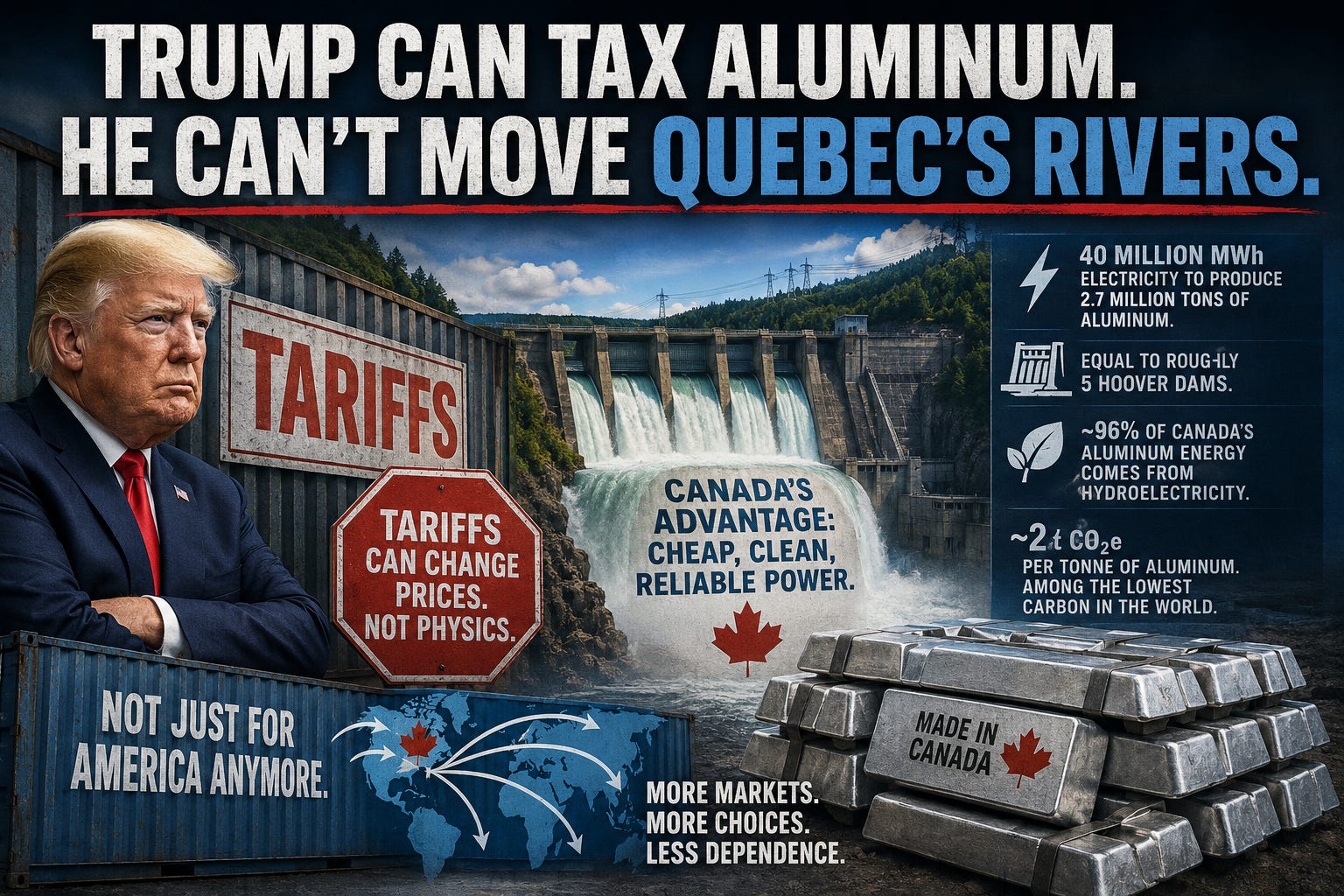
Roughly 96% of the energy used by Canadian aluminum production reportedly comes from hydroelectricity.
Canadian production is also estimated at about 3.2 million tonnes annually.
That isn’t some little environmental gold star to stick on the refrigerator.
It’s an industrial advantage.
Canada can produce aluminum using abundant hydroelectricity at a relatively low carbon intensity.
Meanwhile, many American smelters have disappeared over the years because electricity costs and international competition made them increasingly difficult to operate economically.
Trump can change a tariff with a signature.
He can’t sign an executive order creating another Quebec.
Here’s the Number That Makes This Nuts
The research notes estimate Canada ships about 2.7 million tons of aluminum into the United States annually.
Producing that amount reportedly requires about 40 million megawatt-hours of electricity.
The source compares that power requirement to roughly five Hoover Dams.
Think about that for a minute.
If America wants to replace Canadian production with new domestic smelters, it isn’t merely a matter of convincing a corporation to change its mailing address.
You need smelters.
Transmission.
Power generation.
Environmental approvals.
Construction crews.
Skilled workers.
Billions in capital.
And years.
That is the central weakness in the whole tariff strategy… tariffs can change aluminum prices tomorrow morning, but they cannot manufacture cheap electricity, industrial infrastructure or skilled labour overnight.
You can move the CEO.
Moving the physics is harder.
Canada Had Another Option
Here’s where this gets interesting.
Canada didn’t have to choose between surrendering its aluminum industry and losing every customer.
It could find more customers.
And Canadian producers began expanding sales toward Europe and other international markets.
That matters far more than one shipment of aluminum changing direction.
For decades, Canada enjoyed having the world’s richest consumer market sitting right beside us.
That was convenient.
It also created a nasty vulnerability.
When one customer buys most of what you’re selling, that customer starts thinking he’s your boss.
Trump’s tariffs have given Canadian businesses a rather expensive lesson in customer concentration.
And we’re learning it.
The research notes indicate Canadian producers increasingly gained the ability to direct aluminum toward whichever market offered the better final return after transportation and other costs.
That doesn’t mean America suddenly stops buying Canadian aluminum.
Far from it.
American automobile, aerospace, construction and other manufacturers still need the stuff.
But Canada having other buyers changes the conversation.
There’s a world of difference between…
“Please buy our aluminum.”
and:
“How much do you want to pay?”
Europe Changes the Equation
Europe isn’t simply Canada’s emergency backup customer.
Canadian aluminum comes with another increasingly valuable feature.
It’s relatively clean.
Canadian parliamentary and industry evidence cited in the research describes Canadian aluminum as producing roughly two tonnes of CO₂ equivalent per tonne of aluminum, while low-carbon aluminum is commonly defined as four tonnes or less under the relevant emissions measures.
That gives Canada something besides geography to sell.
As governments and manufacturers increasingly care about the carbon footprint buried inside cars, buildings, packaging and manufactured goods, Quebec hydro becomes part of the product.
We aren’t just selling aluminum.
We’re selling aluminum made with comparatively clean electricity.
That’s an advantage competitors can’t duplicate by slapping another tariff on the border.
Meanwhile, American Factories Still Need Metal
And this is where Trump’s policy starts arguing with itself.
The United States wants less dependence on Canadian aluminum.
Fine.
But American manufacturers still need aluminum.
Lots of it.
If Canadian producers send more supply elsewhere, American buyers don’t magically stop needing the material.
They compete harder for what’s available.
That can mean higher costs, tighter inventories and more uncertainty for the very American manufacturers tariffs were supposedly designed to protect.
That’s the contradiction.
Punish the foreign supplier your domestic factories depend upon.
Then discover your domestic factories still depend upon the foreign supplier.
Brilliant.
This Is Bigger Than Aluminum
This story is really about something Canada should have figured out years ago.
Our greatest economic weakness wasn’t that America was too powerful.
It was that America was too convenient.
Why build relationships across Europe and Asia when the world’s biggest customer was right next door?
Why diversify when trucks could simply drive south?
Because eventually somebody might decide that convenience equals dependence.
Trump did.
And Canada is slowly demonstrating otherwise.
Aluminum is one example of what economic sovereignty actually looks like.
Not chest-thumping.
Not flags at press conferences.
Not politicians yelling about standing up for Canada.
It means owning something the world needs.
Producing it competitively.
Keeping the infrastructure that makes it competitive.
And having enough customers that no single country gets to dictate the terms.
Quebec’s hydroelectric dams aren’t merely power plants anymore.
They’re industrial leverage.
Our aluminum industry isn’t merely a collection of smelters.
It’s strategic infrastructure.
And Europe isn’t merely another export market.
It’s another door Canada can walk through when Washington decides to slam its own.
The Part Trump Got Wrong
Trump’s tariff strategy appears to have assumed that access to the American market would eventually outweigh everything else.
Make the tariff painful enough and investment will move south.
Sometimes that works.
But aluminum isn’t a call centre.
You don’t unplug a few computers, rent another office and reopen in Ohio on Monday.
Competitive aluminum production is tied to energy.
Infrastructure.
Workers.
Capital.
And geography.
Canada already has those pieces assembled.
That’s why this fight matters.
Trump tried to use America’s enormous market as leverage over Canadian industry.
Instead, he may have reminded Canada why depending too heavily on that market was dangerous in the first place.
That’s a lesson worth considerably more than a shipment of aluminum.
Because once Canadian companies discover they have other customers, it’s awfully difficult to convince them they only have one.
The Recap…
Trump wanted tariffs to make Canadian aluminum production move south.
One small problem.
Canada’s advantage isn’t just the factory.
It’s Quebec’s enormous supply of hydroelectric power… and you can’t load that onto a truck and move it across the border.
So Canada started finding more customers.
Funny how economic bullying can accidentally teach your neighbour independence.
The Gut-Punch…
Trump thought America’s biggest weapon was access to the American market.
Canada’s answer may turn out to be making sure America is never our only customer again.
Source credit: Based on supplied research notes covering Canadian aluminum production, Quebec hydroelectricity, U.S. tariff and relocation pressure, Canadian export diversification, European demand, and low-carbon aluminum data. Supporting material cited in those notes includes Canadian parliamentary evidence, the Aluminium Association of Canada, Fastmarkets, European Commission research material, and related industry sources.
If you enjoy thoughtful conversations, Canadian stories, and the occasional smart-ass observation about the world we’re living in, you’re in the right place.
Subscribe free and get new stories, insights, and observations delivered directly to your inbox.
No paywall.
No spam.
No nonsense.
Leave anytime with a single click.
I promise not to take it personally.
Best, absolutely the best, news of the day! My black heart 🖤 Fred! Black for trumps egregious attempts on our economy, and big heart for Carney’s great moves! 🍁🇨🇦
This is such good information to learn. Why do we Canadians not know such things as routine? Why has our once world class media sunk to the depths of Fox wannabes? I just hope this is not a bigger argument for 51. Thanks, Fred.