

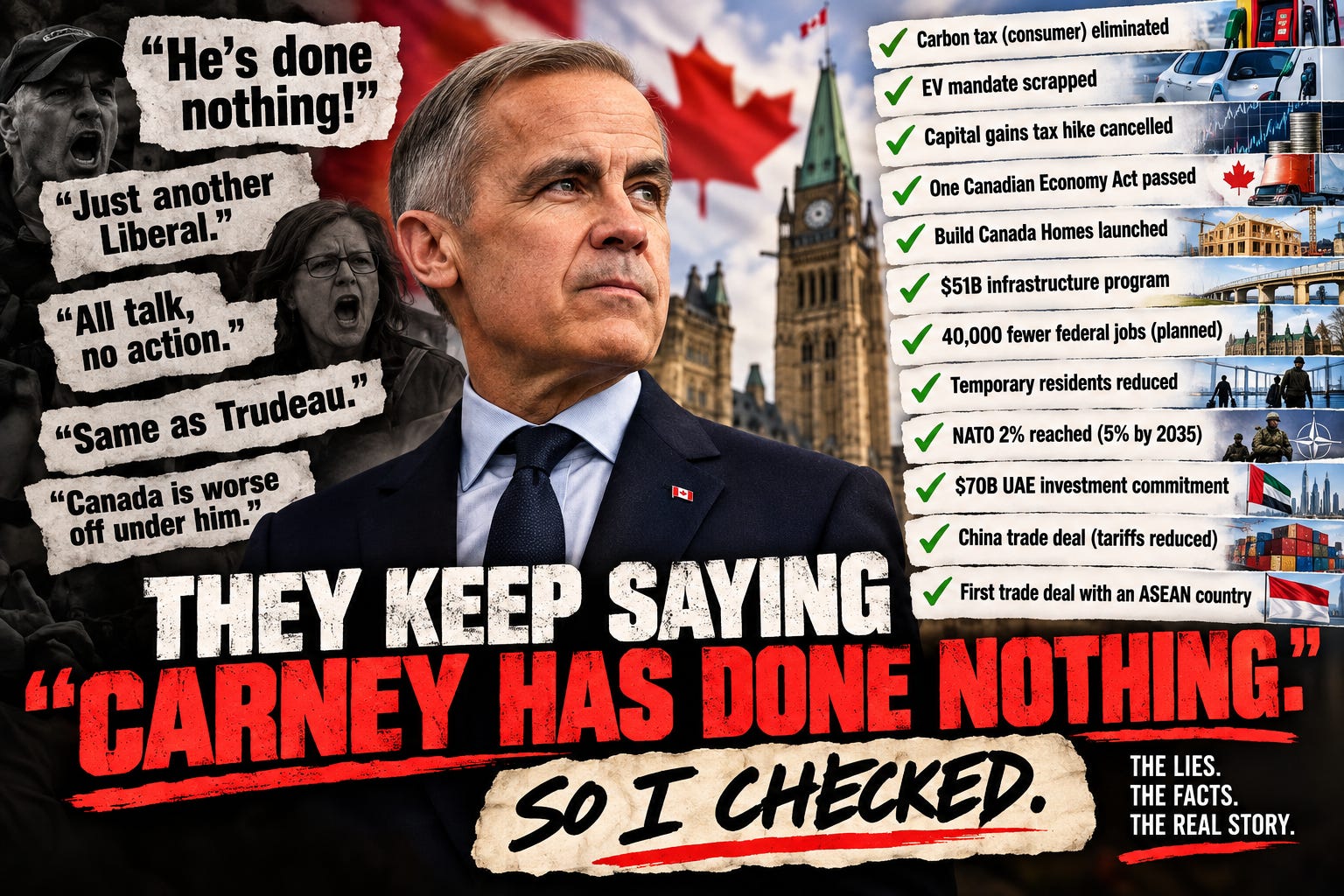
There is one political line I keep seeing over and over again…
“Mark Carney has done nothing.”
Nothing?
That’s a pretty easy thing to type on Facebook.
So I decided to do something terribly old-fashioned.
I checked.
Not Liberal Facebook pages. Not Conservative Facebook pages. Not somebody’s meme.
Government records. Parliamentary records. Actual programs. Actual legislation.
And here’s what I found.
1. The consumer carbon tax is gone.
One of Mark Carney’s first actions after becoming prime minister was to eliminate the federal consumer fuel charge, effective April 1, 2025.
That’s the carbon price Canadians paid directly on gasoline and home heating fuel.
Industrial carbon pricing still exists, so saying Carney “eliminated the carbon tax” without that qualification isn’t quite accurate.
But the consumer carbon tax?
Gone.
That happened.
2. The federal EV sales mandate is being repealed.
The government changed course on the Electric Vehicle Availability Standard.
Instead of requiring manufacturers to meet the previous EV sales mandate, the government announced tougher vehicle-emissions standards that allow manufacturers more flexibility in how they comply.
At the same time, Ottawa launched a new five-year EV affordability program offering incentives of up to $5,000 on qualifying battery-electric and fuel-cell vehicles.
In plain English…
The government changed from primarily mandating EV sales percentages to using emissions rules and incentives to encourage adoption.
You can argue whether that’s better policy.
You can’t argue that nothing changed.
3. Carney cancelled the proposed capital-gains tax increase.
This one isn’t ambiguous.
On March 21, 2025, Carney’s government cancelled the proposed increase in the capital-gains inclusion rate.
The proposed change would have increased the inclusion rate from one-half to two-thirds for corporations and trusts and for individuals on annual gains above $250,000.
It didn’t happen.
Carney cancelled it.
4. Parliament passed the One Canadian Economy Act.
Bill C-5 received Royal Assent on June 26, 2025.
Among other things, it created a framework for reducing federal barriers to interprovincial trade and labour mobility.
And here’s an interesting little detail.
The legislation received overwhelming support in Parliament. Part 1 passed third reading in the House 335 to 1.
CMHC later estimated that eliminating interprovincial trade barriers across Canada could eventually encourage more than 30,000 additional housing starts every year.
That’s not a slogan.
That’s legislation.
5. Build Canada Homes actually exists.
Here’s where some of the stuff circulating online gets exaggerated.
Build Canada Homes has not already built 45,000 houses on federal land.
But it isn’t imaginary either.
The federal government launched Build Canada Homes with an initial $13-billion investment over five years.
By February 2026, it had advanced six direct-build projects in Dartmouth, Longueuil, Ottawa, Toronto, Winnipeg and Edmonton and secured four major partnerships.
Together, those initiatives represented more than 7,500 homes.
The first six federal-land projects themselves are expected to deliver up to about 4,000 homes.
Still substantial.
And unlike the inflated number floating around Facebook, these numbers have receipts.
6. There’s a $51-billion infrastructure program.
Budget 2025 created the Build Communities Strong Fund.
The commitment is $51 billion over 10 years beginning in 2026-27, followed by $3 billion annually on an ongoing basis.
We’re talking water systems.
Transit.
Roads.
Hospitals and health infrastructure.
Universities and colleges.
Community infrastructure.
The original claim I saw said Carney had already “dropped $51 billion on infrastructure.”
Not quite.
The accurate statement is actually more useful…
Canada has established a decade-long $51-billion infrastructure program.
7. The federal public service is being reduced.
Here’s another one where wording matters.
Carney hasn’t simply walked into Ottawa and fired 40,000 people.
Budget 2025 projects the federal public service falling to roughly 330,000 employees by 2028-29.
That would be approximately 40,000 fewer positions than the 2023-24 peak, with attrition accounting for part of the reduction.
The government also set a fiscal anchor of balancing day-to-day operating spending with revenues by 2028-29.
Again…
Planned reduction, not 40,000 pink slips already handed out.
Facts matter both ways.
8. Temporary-resident targets were sharply reduced.
This one is substantial.
The previous plan set a target of 673,650 new temporary-resident arrivals for 2025.
The Carney government’s 2026-28 plan lowered that to 385,000 in 2026 and 370,000 in both 2027 and 2028.
Those numbers cover new temporary workers and international students—not tourists and not every temporary resident already living in Canada.
That’s an important distinction.
But 673,650 to 385,000 is still a major policy shift.
9. Canada finally reached NATO’s 2% defence benchmark.
For years Canadian governments talked about NATO’s defence-spending target.
In fiscal 2025-26, Canada actually reached it.
Carney’s government added more than $9 billion in defence spending to get there, bringing total eligible defence spending above $63 billion.
And at NATO, Canada joined the new commitment to reach 5% of GDP by 2035—3.5% for core defence and another 1.5% for broader defence and security-related investment.
Whether you think that’s too much, too little or exactly right is a political argument.
But “nothing happened” isn’t much of an argument.
10. The UAE committed $70 billion to Canada.
During Carney’s November 2025 visit to the United Arab Emirates, the UAE announced a $70-billion Canadian investment commitment… US$50 billion.
Canada and the UAE also signed a Foreign Investment Promotion and Protection Agreement.
That’s a commitment, not $70 billion sitting in a Canadian bank account the next morning.
Again, precision matters.
But $70 billion in committed foreign investment is hardly nothing.
11. Canada and China struck a significant trade arrangement.
This one deserves especially careful wording.
Canada and China reached an agreement addressing several trade disputes.
China reduced its tariff on Canadian canola seed from roughly 84% to about 15%.
Canada, in return, allowed an annual quota of 49,000 Chinese electric vehicles to enter at the regular 6.1% most-favoured-nation tariff rate rather than the previous 100% surtax.
Other Canadian agricultural products also received tariff relief.
That’s called negotiation.
Canada gave something.
China gave something.
You can debate whether Canada got the better end.
But there was a measurable negotiated result.
12. Canada signed its first bilateral trade agreement with an ASEAN country.
On September 24, 2025, Canada and Indonesia signed the Canada-Indonesia Comprehensive Economic Partnership Agreement.
Indonesia has nearly 300 million people and is Southeast Asia’s largest economy.
More importantly, this was Canada’s first bilateral trade agreement with an ASEAN country.
For a country trying to become less dependent on one enormous customer south of the border, that matters.
So let’s go back to the original claim.
“Mark Carney has done nothing.”
You don’t have to support him.
You can oppose the spending.
You can oppose his immigration policy.
You can oppose his defence policy.
You can think the China deal was lousy.
You can think the housing program won’t work.
Those are legitimate political arguments.
But they’re different from saying nothing happened.
Because things happened.
Some were completed.
Some are underway.
Some are commitments whose results won’t be known for years.
And some deserve criticism.
That’s politics.
But pretending the record doesn’t exist isn’t political analysis.
It’s just pretending.
And I think this is where Canadians of every political stripe need to become a little more stubborn about facts.
I’m 74 years old.
I spent most of my life leaning Conservative.
I don’t need a politician to be wearing my team’s jersey before I’ll acknowledge something he actually did.
And I don’t need to pretend every decision Mark Carney makes is brilliant either.
That’s the deal I’m making with readers here…
When he gets something right, I’ll tell you.
When he screws something up, I’ll tell you that too.
But when somebody tells me he’s “done nothing,” I’m going to start asking one very inconvenient question:
Compared with what?
Because from now on, whenever another claim about Carney starts bouncing around social media, I think I’m going to do exactly what I did here.
Take the claim.
Find the receipt.
And put the two beside each other.
FACTS, NOT FABLES.
If you enjoy thoughtful conversations, Canadian stories, and the occasional smart-ass observation about the world we’re living in, you’re in the right place.
Subscribe free and get new stories, insights, and observations delivered directly to your inbox.
No paywall.
No spam.
No nonsense.
Leave anytime with a single click.
I promise not to take it personally.
MARK CARNEY IS DOING GREAT AND HE IS TRYING TO HELP CANADA YOU CANNOT FIX ALL PROBLEMS AT ONCE IT TAKES TUNE AND I FOR ONE THINK MARK CARNEY IS DOING ALOT OF GOOD THINGS AND HE IS HELPING US HAVE BETTER OPTIONS GETTING AWAY FROM U.S CAPTIVE MARKET THAT CANADA WAS STUCK IN FOR THE LAST 70 YEARS IS TERRIFFIC ALL.CHANGES AND NEW DEVELOPMENTS TAKE TIME AND HE HAS DONE MORE FOR CANADA OVER THE LAST 19 MONTHS THAN ANY OTHER P.M. HAS MARK CARNEY IS CHANGING OPTIONS TO A FAST TRACK AND ADVANCING CANADA'S OPTIONS SO CANADA WILL PROSPER.BE PATIENCE AND HE WILL COME THOUGH FOR CANADA.THANK YOU MARK CARNEY FOR ALL YOUR HARD WORK I REALLY SUPPORT YOU 100% TAKE CARE STAY SAFE AND DO WHAT YOU CAN FOR CANADA
Other notables, I think:
EU's SAFE inclusion. Okay, we only have one small deal out of it so far, but without Carney's push on that, there would be none (and in the spirit of your "tell the whole story", that deal was in the works before SAFE. But SAFE just made it easier for Poland to say "yes."
The OTHR-A initiative (though, you might be counting that as part of the NATO 2%), along with the subs (though those started under Trudeau, I believe. Carney just pushed it along and refined it).
And I guess all of the lightspeed trade negotiations -- India & Mercosur, specifically -- these aren't finalized (though should be shortly). Still, the speed at which things are happening (and other ones in progress as well). So, maybe not "done something" but certainly "doing something" (and irons in fire with Japan, Australia, S. Korea and others).
Plus the various security arrangements (perhaps less tangible at present).
So, definitely "doing things", even if not all things are at fruition yet.