

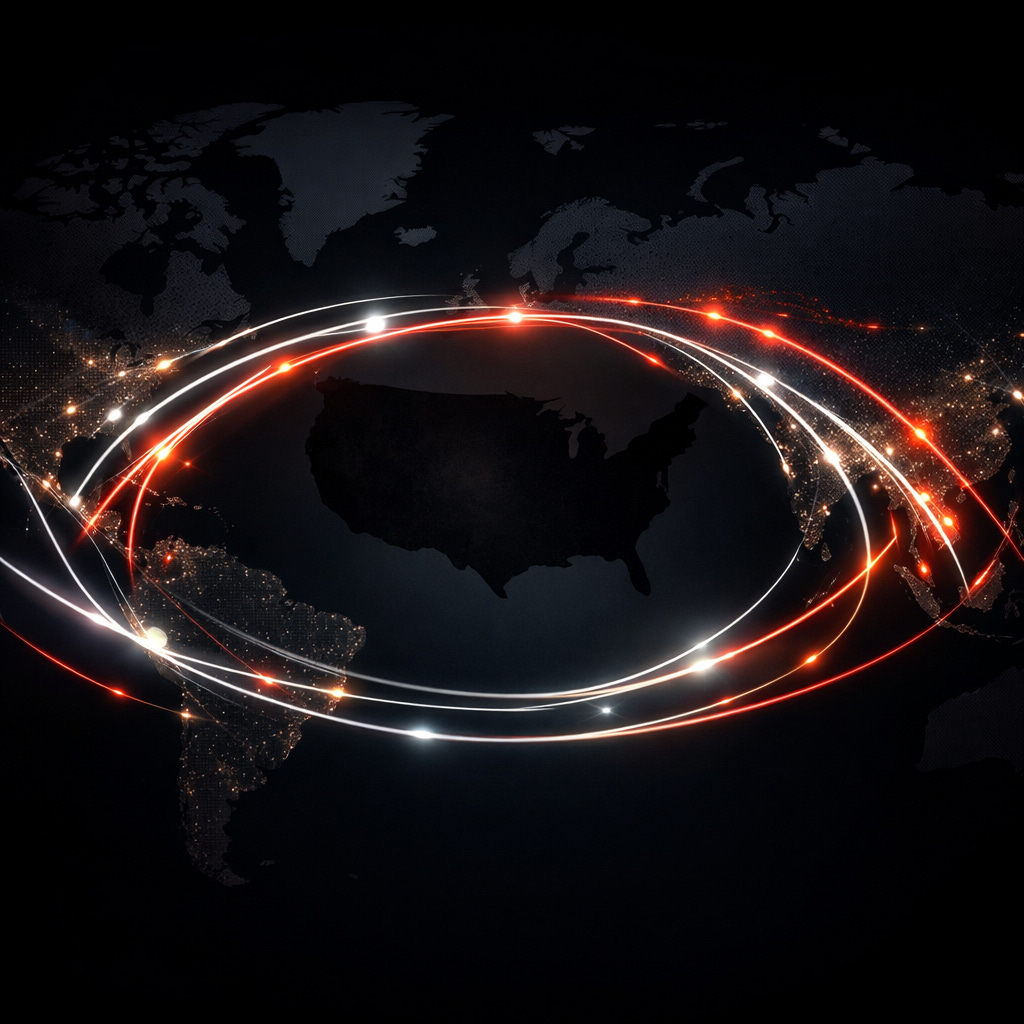
For most of the last 80 years, global trade had a simple rule…
If you wanted access to the world… you went through the United States.
That wasn’t just economics.
It was leverage.
Standards.
Power.
And now that system is starting to change.
Not with speeches.
Not with headlines.
With paperwork.
Tariffs Were Supposed to Be Pressure. They Became Motivation.
When tariffs started getting thrown around like political confetti, the intended message was clear…
Stay in line, or lose access to the American market.
But markets don’t respond well to uncertainty.
If rules can change overnight… companies stop trusting the system.
And once trust breaks, alternatives start getting built.
That’s exactly what happened.
Countries didn’t coordinate because they wanted to challenge the U.S.
They coordinated because they needed stability.
There’s a difference.
Canada Stepped Into a Role Nobody Expected
Canada isn’t a superpower.
It doesn’t dominate militarily.
It doesn’t control global finance.
It doesn’t throw its weight around.
What Canada does have is credibility.
Under Mark Carney’s leadership, Ottawa leaned into something far more powerful than confrontation…
connection.
Canada began linking existing trade relationships across Europe, Asia, and the Americas… acting as a bridge between systems that already existed but weren’t fully integrated.
Meanwhile, Europe had reached its own conclusion…
If U.S. trade policy can swing every election cycle, dependency becomes risk.
So diversification accelerated.
Canada and Europe found common ground quickly…
Export-driven economies
Middle-power diplomacy
A need for predictable rules
Move together… and you don’t have to wait for Washington anymore.
The Most Important Part Nobody Talks About
This isn’t really about tariffs.
It’s about rules of origin… the technical definitions that determine where a product “belongs.”
That sounds boring.
It isn’t.
Because those rules decide whether something moves freely across borders… or gets taxed at every step.
The innovation now being pushed is called trade accumulation.
In simple terms…
If something is made anywhere inside the partner network, it’s treated as local everywhere inside the network.
A component from Quebec.
Processing in Japan.
Assembly in Mexico.
Sale in Germany.
No penalties.
No friction.
No U.S. involvement required.
That’s not just a trade agreement.
That’s an ecosystem.
Nearly 40 Countries. About 1.5 Billion People.
Link the European Union with members of the Trans-Pacific partnership… Canada, Japan, Australia, Mexico, Vietnam, and others… and you create something massive.
Add ongoing negotiations with India, and the scale grows even further.
From a business perspective, the calculation becomes obvious…
Would you rather depend on one unpredictable market…
or operate inside a stable network spanning continents?
Predictability wins.
Every time.
Supply Chains Move First… And They Rarely Move Back
Companies don’t wait for political threats to become reality.
They reposition early.
Factories get built where rules are reliable.
Standards get set where markets are accessible.
Investment flows toward stability.
Once supply chains shift… they tend to stay shifted.
That’s how influence erodes… slowly, then suddenly.
This Isn’t Anti-American. It’s Self-Preservation.
The United States isn’t losing power because it’s weak.
It’s losing leverage because unpredictability creates risk.
From Canada’s perspective, this is survival.
From Europe’s perspective, risk management.
From business perspective, rational decision-making.
And from a global perspective?
Adaptation.
The Quiet Reality
Global trade is reorganizing itself.
Not dramatically.
Not loudly.
But structurally.
Canada isn’t waiting anymore.
Europe isn’t waiting anymore.
And the world isn’t organizing itself around Washington the way it once did.
History doesn’t always move with explosions.
Sometimes it moves with spreadsheets.
The Recap…
For decades, the U.S. was the center of global trade.
Now nearly 40 countries are quietly building a system that works without it.
This isn’t politics.
It’s economics.
And Canada is right in the middle of it.
The Gut Punch…
Power doesn’t disappear overnight.
It leaks away when people stop needing you.
Source Credit:
Source inspiration: Europe Curious analysis and international trade policy developments.
🔎 The GeezerWise Standard
This space is built on disciplined thinking.
Facts over spin.
Verification before amplification.
Good-faith discussion over tribal noise.
I use AI tools to help shape my spoken drafts into clear writing.
The judgment, conclusions, and final message are mine.
If you’re new here, this explains how I decide what’s worth sharing:
How I Decide What’s Worth Sharing → [link]
💌 Subscribe at GeezerWise.com to receive future letters:
www.geezerwise.com/subscribe
— Fred Ferguson
GeezerWise
#CanadaStrong
Elect a leader who thinks and acts like a banker, not a bank robber.
🇨🇦💙 Carney is a macro economist not a politician. He’s planning 20-30 years of global trade. His secret weapon? Objectivity is an C Suite skill. Excellent article! Thx.