

The Last Plane
By Sunday, the end was finally in sight.
Not just for the passengers.
For Gander too.
The schools were emptying.
The church halls were quiet.
The shelters that had been overflowing with strangers only days earlier were slowly returning to normal.
One by one, the last loose ends were being tied up.
For Roxanne and Clark Loper, the moment arrived at a small border crossing in Maine.
After days of airplanes.
Buses.
Ferries.
Rental vans.
Hurricanes.
Detours.
And uncertainty.
They were finally about to cross back into the United States.
But for Roxanne, the border meant more than simply going home.
Their daughter Alexandria had traveled halfway around the world to join their family.
The moment she crossed that line, her future would become official.
She would become an American citizen.
Clark carried her toward the border.
Halfway across, he stopped.
One tiny foot stood in Canada.
The other stood in America.
Roxanne grabbed the camera.
They wanted to remember the moment.
After everything they had been through, Alexandria had earned her citizenship the hard way.
Not many babies could say they arrived in America by plane, bus, van, ferry, and sheer determination.
Back in Newfoundland, Rabbi Leivi Sudak was still trying to get home.
Once again, it was the people of Gander who stepped forward.
Carl and Eithne Smith refused to let him face the challenge alone.
When flights out of Gander became impossible, they found another route.
When transportation became a problem, they offered a ride.
When accommodations became uncertain, they opened their home.
Five hours across Newfoundland.
A hotel room.
A final meal.
One last goodbye.
And eventually a flight that would get the rabbi home in time for the Jewish New Year.
Before leaving, he asked Eithne for the names of her family members.
He wanted to pray for them.
Not because he had to.
Because he wanted to.
The kindness he had received deserved to be remembered.
Even the animals were finally heading home.
The bonobo monkeys were gone.
The epileptic cat was gone.
And Ralph the puppy was feeling much better after a much-needed nap.
It turned out there was never anything seriously wrong with him.
He was simply exhausted.
Apparently being the most popular puppy in Newfoundland is hard work.
The volunteers who had cared for the animals all week finally returned to their normal lives.
They had spent six straight days feeding, medicating, comforting, and protecting creatures that weren’t theirs.
Nobody asked them to do it.
Nobody ordered them to do it.
They simply saw living things that needed help.
And helped.
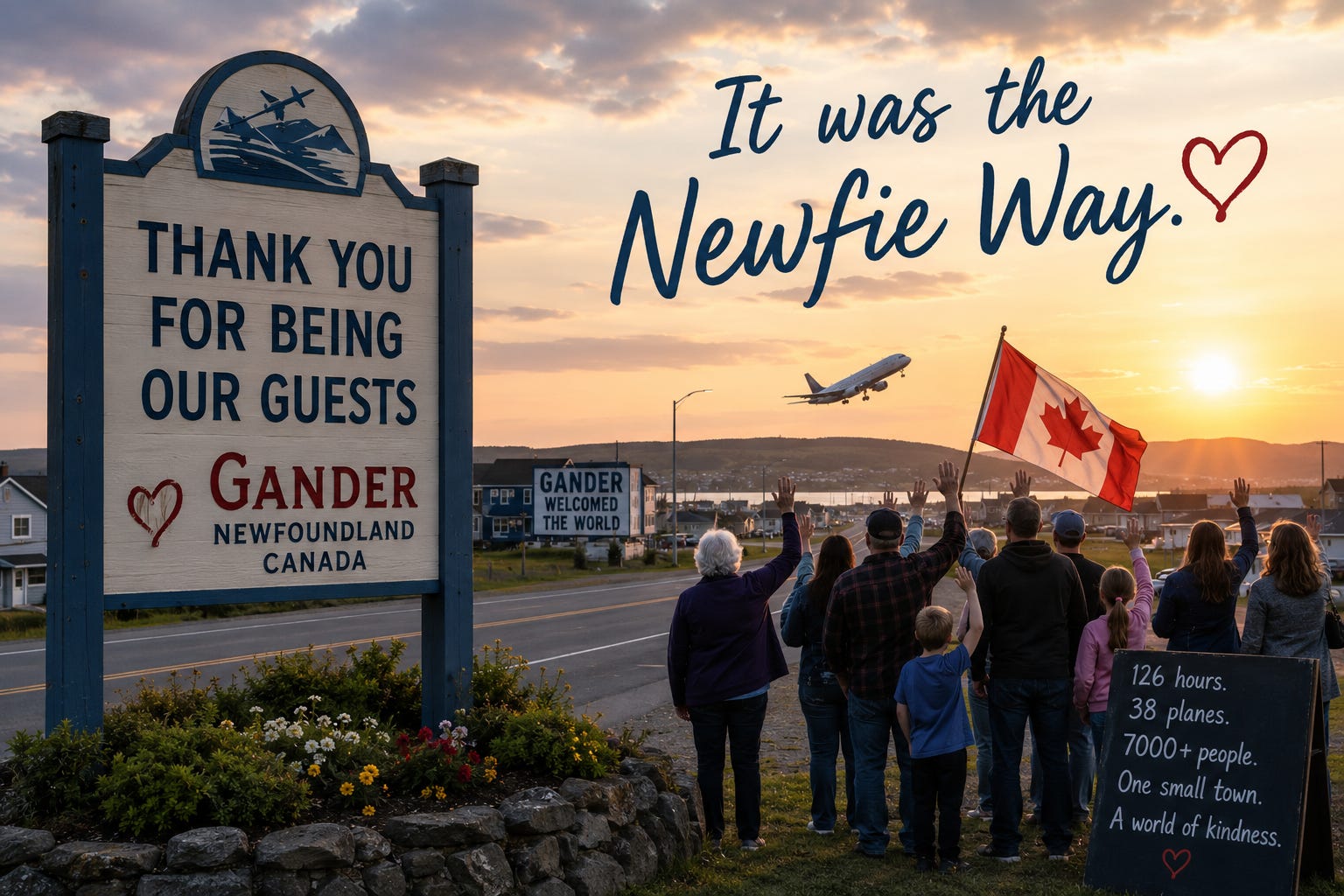
One hundred and twenty-six hours after the first diverted aircraft landed in Gander, the last plane finally departed.
Just like that, it was over.
Or at least the busy part was.
Now came the harder part.
Thinking about it.
The volunteers had been so focused on helping others that many hadn’t really processed what had happened in New York and Washington.
The grief arrived late.
The anxiety arrived late.
The sadness arrived late.
Students struggled to sleep.
Adults found themselves emotionally exhausted.
For nearly a week they had carried the weight of thousands of frightened strangers.
Now the strangers were gone.
And the silence felt strange.
Yet beneath the exhaustion was something else.
Satisfaction.
Not pride.
Not self-congratulation.
Something quieter.
The feeling that when the moment came, they had done the right thing.
Eventually the provincial government offered to throw a giant celebration for the volunteers.
A thank-you party.
A reward.
A chance to recognize everything the people of Gander had accomplished.
The town thought about it.
Then they declined.
Not because they weren’t grateful.
Not because they didn’t appreciate the gesture.
Because they didn’t think they deserved a party.
That may be the most Newfoundland moment in this entire story.
These people had fed thousands.
Opened their homes.
Given away clothes.
Shared cars.
Shared churches.
Shared schools.
Shared food.
Shared their lives.
And when someone suggested they should be celebrated for it?
They looked around and wondered why.
From their perspective, there had never been another option.
People needed help.
So they helped.
What else were they supposed to do?
That’s the lesson I keep coming back to.
Not the planes.
Not the logistics.
Not even the extraordinary scale of what happened.
The lesson is much simpler than that.
When the world showed up at their doorstep scared, confused, and far from home...
they opened the door.
No committee.
No strategic plan.
No public relations campaign.
Just people helping people.
For six days, the world came to town.
And when it left, the people of Gander went back to their lives.
They didn’t ask for recognition.
They didn’t ask for applause.
They didn’t ask for statues or headlines.
They simply did what they believed was right.
As Mayor Claude Elliott later explained, there was no reason for a celebration.
They did what they did for one reason only.
It was the Newfie way.
For six days, a small Newfoundland town became home to thousands of strangers.
This was their story.
And it is Canada’s story too.
Thank you for taking this journey with me.
Missed the beginning? Read Part 1 here: The Day the World Came to Town
#TheWorldCameToTown #GanderSeries #GeezerWiseSays
Source: The Day the World Came to Town by Jim DeFede
Enjoying this story?
Join thousands of readers who get my articles delivered free to their inbox.
No paywall. No spam. No algorithms deciding what you should see.
Just straight-talk Canadian commentary, interesting stories, and the occasional rabbit hole worth exploring.
And if it’s not for you?
One click and you’re gone.
Enter your email below and I’ll see you in your inbox.
I know it's 25 years now since 9/11 but what's the passengers life now and how are the people of Gander doing.
It has been a brilliant read.
Thank you.
Very nice work, Fred. It’s a relief to read something uplifting and uniquely Canadian. 🇨🇦