

Some Journeys Take Longer Than Others
By Saturday morning, the great exodus had begun.
The planes were leaving.
The buses were rolling.
The schools and churches that had been filled with stranded passengers for nearly a week were slowly emptying.
One by one, people were finding their way home.
For some, home was still a long way away.
Roxanne Loper and the other families who had refused the Lufthansa flight finally made it to the ferry terminal after driving through the night.
The hurricane that had threatened to derail everything had drifted harmlessly away.
The ferry was running.
Barely.
The seas were rough.
The ship pitched and rolled.
One pregnant passenger spent most of the crossing getting sick.
The children had to hold onto their cafeteria trays so their breakfasts wouldn’t slide across the tables.
But nobody cared.
They were moving again.
After days of uncertainty, movement felt like victory.
In Gambo, another group was waking up with sore heads and tired eyes.
The Beatle Boys.
The Nigerian princess.
The pub crowd.
The people who had spent the previous evening singing, dancing, laughing, and becoming honorary Newfoundlanders.
Now it was time to leave.
The buses were waiting.
The airport was calling.
And just like that, the little world they had created together was coming to an end.
Some goodbyes were harder than others.
Deb Farrar and Greg Curtis had spent almost every waking moment together during their unexpected stay.
What started as two strangers sharing an adventure had become something more.
Maybe.
Neither of them knew.
Real life was waiting back home.
Texas.
North Carolina.
Jobs.
Responsibilities.
Distance.
The kind of things that have a way of testing vacation romances.
They exchanged phone numbers.
Shared one final kiss.
And climbed onto different buses.
Sometimes life gives you a week that feels like a lifetime.
Then it asks you what you’re going to do with it.
Not everyone was leaving.
Olesya Buntylo thought she was finally headed to America.
The buses took the Moldovan families to the airport.
They said tearful goodbyes to the people who had cared for them.
Especially Clark Piercey.
By now he wasn’t just a volunteer.
He was family.
Then came another twist.
Their immigration papers only allowed them to enter the United States through New York.
Their flight was now heading to Atlanta.
That meant they couldn’t go.
Not yet.
Instead of flying to America, they were sent back into town to wait for another solution.
Most people would have been frustrated.
Clark Piercey had a different reaction.
He was glad they were staying.
It meant he got a few more days with his adopted family.
Back in New York, Hannah and Dennis O’Rourke finally arrived home.
The week had felt endless.
The uncertainty even longer.
When their children met them at the airport, Hannah immediately searched their faces for answers.
Was there news about Kevin?
Had they found him?
Was everyone protecting her from the truth?
There was still no news.
Which meant there was still hope.
When the family gathered together at Kevin’s home, nobody knew what the future held.
But for the first time since September 11, they were facing it together.
Sometimes that’s enough.
Sometimes that’s everything.
By Saturday afternoon, Lakewood Academy had become strangely quiet.
Only three passengers remained.
Rabbi Leivi Sudak.
Baila Hecht.
And Esther Hecht.
Everyone else had gone.
For days the school had been filled with voices.
Children.
Families.
Volunteers.
Laughter.
Questions.
Stories.
Now there was silence.
And in that silence, something remarkable happened.
A fax arrived.
It was from one of the passengers who had already made it home.
The message thanked the people of Newfoundland for what they had done.
Then came a line that stopped everyone in the room.
The passenger explained that only once before had he been treated with such kindness.
When he was liberated in Holland in 1945.
“You wonderful Canadians have not changed.”
The teacher reading the message began to cry.
After days of exhaustion and emotion, the words broke through.
The rabbi comforted her.
But another visitor was already on his way.
And that visit would change everything.
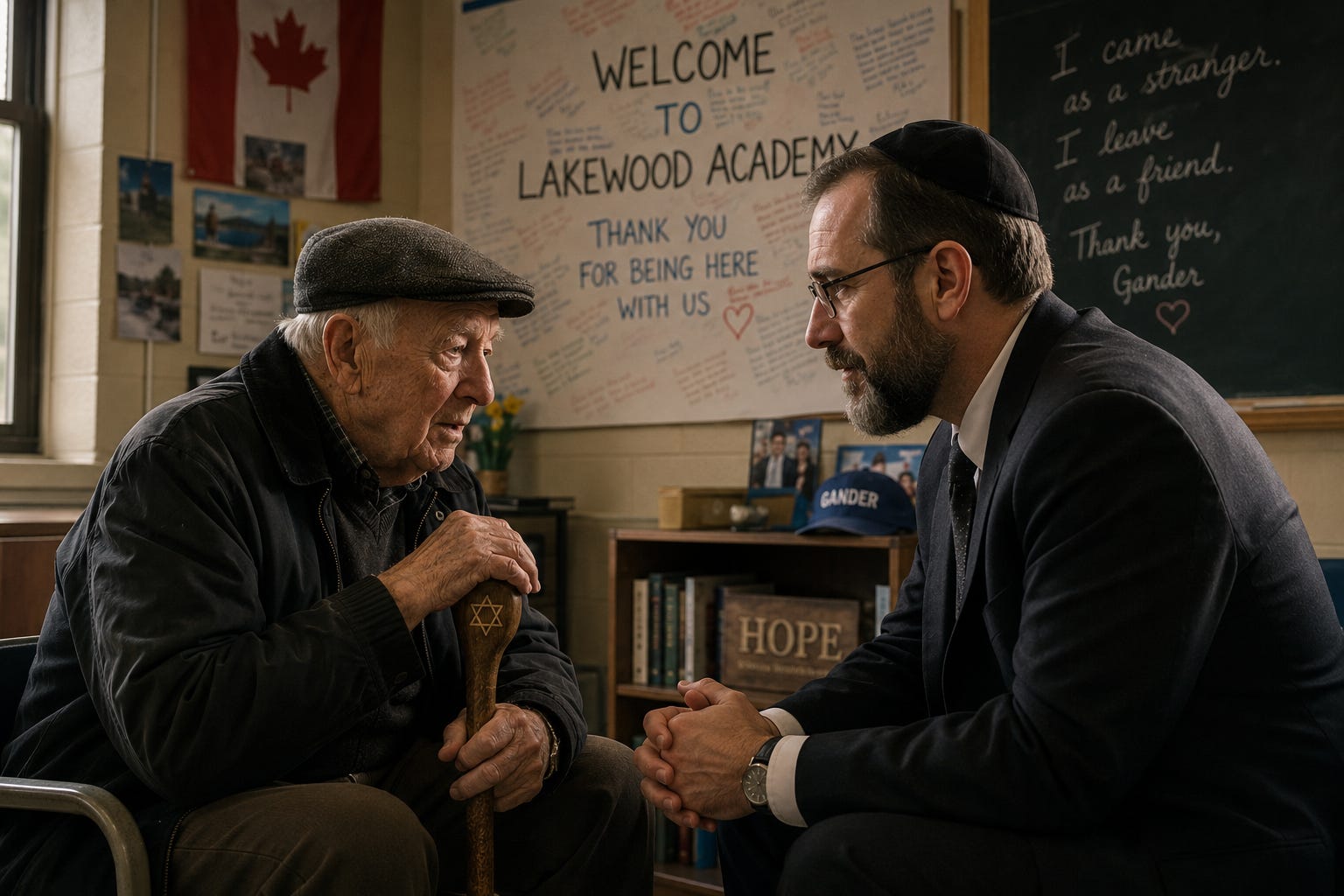
His name was Ed Brake.
Most people in Gander knew him as a salesman.
A neighbour.
A familiar face around town.
Very few knew his secret.
Not even his wife had known for most of their marriage.
Not even his children.
For decades, Ed Brake had carried a story he rarely told.
A story that began in Poland.
A story that began before the war.
A story that began with a frightened Jewish child being sent away by his parents in hopes of saving his life.
He never saw them again.
As a boy, he had been smuggled out of Europe.
Eventually he found his way to Newfoundland.
There he was raised by another family.
He was taught never to talk about being Jewish.
Never ask questions.
Never discuss the past.
Over time, silence became a habit.
Then it became a way of life.
Years turned into decades.
The secret stayed buried.
But it never disappeared.
Even after all those years, he still thought of himself as Jewish.
He carried a walking stick engraved with a tiny Star of David.
He dreamed about the songs he remembered hearing as a child.
Sometimes he dreamed about his mother.
Sometimes he woke up in the middle of the night remembering a world that no longer existed.
When he heard there was a rabbi in town asking if any Jewish people lived nearby, something stirred inside him.
Maybe it was time.
Maybe after all these years, it was finally time.
For nearly two hours, Ed Brake talked.
He spoke about Poland.
About fear.
About beatings.
About scars.
About losing his family.
About spending a lifetime carrying memories nobody else knew.
The rabbi listened.
The teachers listened.
Nobody interrupted.
Nobody hurried him.
For the first time in decades, someone was hearing his story.
Really hearing it.
The rabbi encouraged him to tell others.
Children.
Schools.
Communities.
People needed to hear what happened.
People needed to understand.
People needed living witnesses while they still could.
Ed wasn’t sure.
He had spent a lifetime staying quiet.
Stepping into the light felt unnatural.
But he was glad he had come.
Glad he had spoken.
Glad someone now carried the story besides him.
Eventually it was time to leave.
Ed picked up his walking stick.
The one with the tiny Star of David carved into the handle.
He thanked everyone for listening.
Then he slowly made his way home.
And as the door closed behind him, Rabbi Sudak finally understood something.
For days he had wondered why his journey had been interrupted.
Why he had been sent to Newfoundland.
Why he had remained behind while everyone else left.
Now he knew.
It wasn’t about missed flights.
Or delayed schedules.
Or being stranded.
It was about a story.
A story that had waited more than sixty years to be told.
And a man who needed someone to hear it.
For five days, a small Newfoundland town became home to thousands of strangers.
This is their story.
And it is Canada’s story too.
Next… the “Last segment” in the series: Part 11 – Home, But Not The Same
Missed the beginning? Read Part 1 here: The Day the World Came to Town
#TheWorldCameToTown #GanderSeries #GeezerWiseSays
Source: The Day the World Came to Town by Jim DeFede
Enjoying this story?
Join thousands of readers who get my articles delivered free to their inbox.
No paywall. No spam. No algorithms deciding what you should see.
Just straight-talk Canadian commentary, interesting stories, and the occasional rabbit hole worth exploring.
And if it’s not for you?
One click and you’re gone.
Enter your email below and I’ll see you in your inbox.
Thank you so much, Fred, for these wonderful stories. We all need a good dose of love and kindness with so much hate and rage farming going on these days.
I love this. True story teller