

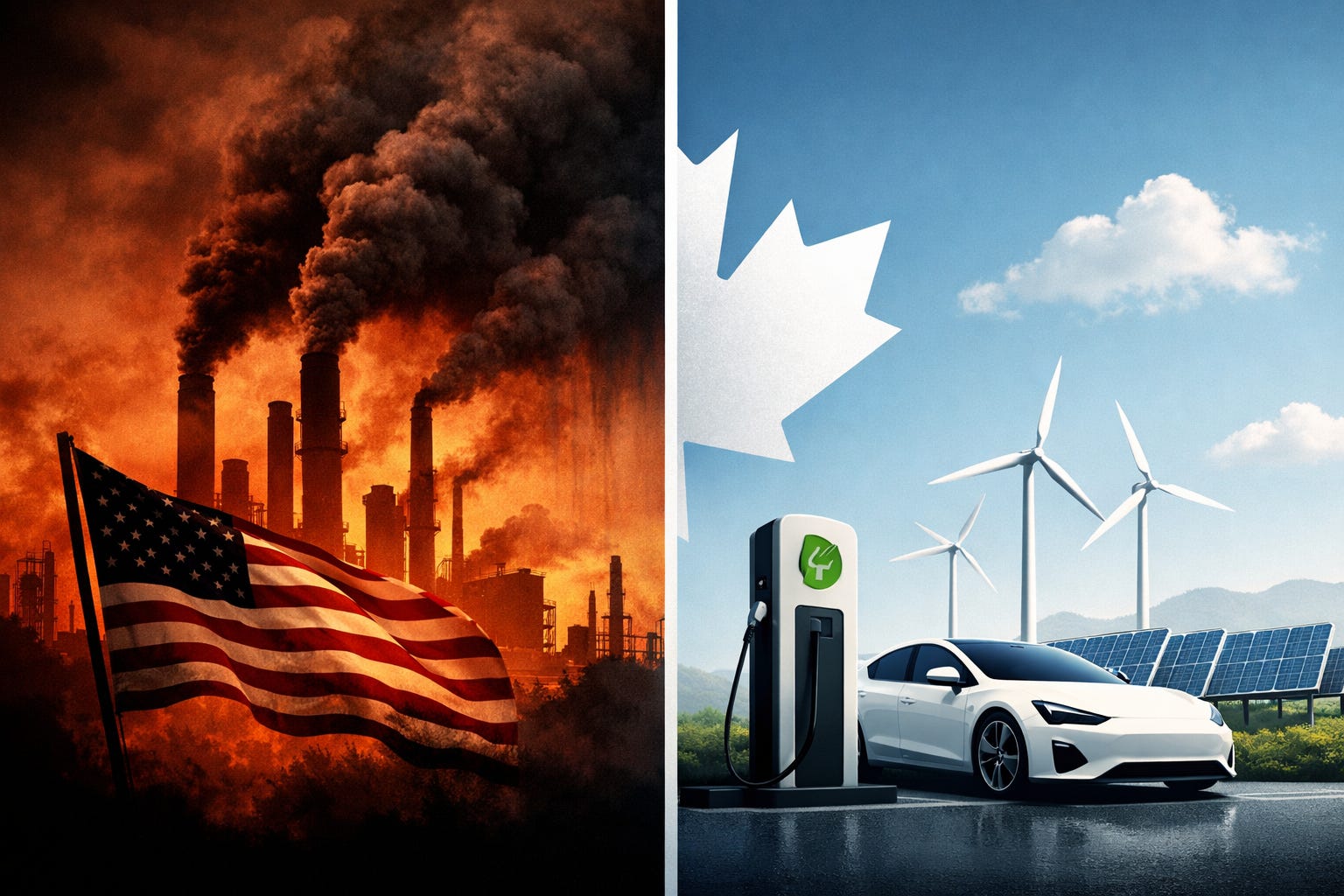
Let’s start with one simple fact… smoke doesn’t need a passport.
The United States administration has just erased the federal government’s legal authority to regulate greenhouse gases under the Clean Air Act.
Specifically, it moved to repeal the EPA’s long-standing “endangerment finding”… the scientific determination that greenhouse gases threaten public health and welfare.
That finding has been the backbone of U.S. climate regulation for nearly 17 years.
Without it?
Carbon dioxide, methane, and other greenhouse gases from tailpipes, oil and gas wells, and smokestacks are no longer federally regulated.
That’s not symbolic. That’s structural.
What Changes
The repeal dismantles the legal justification for limiting emissions from vehicles and heavy industry.
According to the Environmental Defense Fund, this shift could…
Increase U.S. greenhouse gas emissions by 10% over the next 30 years
Contribute to 58,000 premature deaths
Trigger 37 million additional asthma attacks
Lead to wildfire smoke exposure that could kill 70,000 Americans per year by 2050
And before anyone says “that’s their problem,” let’s remember something obvious…
Atmospheric systems don’t stop at the 49th parallel.
Canada shares the same air mass. So does Europe. So does Asia.
You can’t deregulate physics.
The Sales Pitch
At a White House event on February 12, the president called this move “the single largest deregulatory action in American history.”
He claimed it would save Americans $1.3 trillion and reduce vehicle costs by nearly $3,000 per car, citing an EPA study.
Let’s translate that.
If emissions standards are relaxed, automakers can use older, cheaper technology. That lowers compliance costs. Whether consumers see those savings? That’s a different question.
What’s more likely is higher margins for manufacturers.
And when asked about environmental and public health concerns?
The message was simple: “Don’t worry about it.”
That’s not policy. That’s a shrug.
Courts Will Fight It… But Time Isn’t Neutral
States like California have already indicated they’ll challenge the repeal.
But court cases drag. Years pass. Meanwhile, emissions continue.
Science doesn’t pause for litigation.
The Global Split
Here’s where it gets interesting.
While the U.S. rolls back environmental standards, the rest of the world is tightening them.
The European Union mandates a 15% reduction in fleetwide CO₂ emissions from 2021 levels between 2025 and 2029 for new passenger vehicles.
If American-built vehicles don’t meet those standards, they won’t be competitive in Europe.
Now look north.
Canada’s Move
Just days after the U.S. decision, Canada unveiled a new automotive strategy focused on clean technology and EV manufacturing.
Key measures include…
Productivity Super Deduction: accelerated capital write-offs for manufacturers
Clean Technology Manufacturing Tax Credit: refundable credit for EV and battery production equipment
$2 billion Critical Minerals Investment Fund
Critical mineral exploration incentives
A new 5-year EV affordability program
Consumer incentives for EVs priced up to $50,000
No price cap for Canadian-made EVs
Translation?
Canada is positioning itself as a clean-tech manufacturing hub.
And companies are watching.
BYD… one of the world’s largest EV manufacturers… can now export up to 49,000 EVs to Canada without the previous 100% tariff barrier.
If Canadian demand grows, the incentive to build here grows with it.
Where would a company looking to serve global markets rather build?
In a country aligning with European and global emissions standards?
Or in one stepping away from them?
The Long Game
Here’s the risk for the United States…
If domestic policy favors older fossil-fuel-heavy technologies while global markets demand cleaner vehicles, U.S. manufacturers may find themselves producing products the rest of the world won’t buy.
That’s not environmental idealism. That’s trade math.
Short term, this policy loosens rules and cuts costs.
Long term, it may isolate American industry from major export markets.
Meanwhile, the environmental consequences are shared globally.
This isn’t a culture war story.
It’s an industrial strategy story.
It’s a public health story.
And for Canadians?
It’s a reminder that what happens south of the border doesn’t stay there.
We’re downwind.
The Recap…
The U.S. just scrapped the legal foundation for regulating greenhouse gases.
They call it deregulation.
The numbers call it 58,000 premature deaths and 37 million asthma attacks.
Canada, meanwhile, is betting on EVs and clean tech.
Smoke doesn’t recognize borders. Neither do consequences.
The Gut Punch…
You can repeal a law.
You can’t repeal the atmosphere.
Source: Reporting from The New York Times, Detroit News, Environmental Defense Fund, and official Government of Canada automotive strategy releases.
🔎 The GeezerWise Standard
This space is built on disciplined thinking.
Facts over spin.
Verification before amplification.
Good-faith discussion over tribal noise.
I use AI tools to help shape my spoken drafts into clear writing.
The judgment, conclusions, and final message are mine.
If you’re new here, this explains how I decide what’s worth sharing:
How I Decide What’s Worth Sharing → [link]
💌 Subscribe at GeezerWise.com to receive future letters:
www.geezerwise.com/subscribe
— Fred Ferguson
GeezerWise
#GeezerWiseSays
Living in the Maritimes, we’ve been talking about the effects of Acid Rain on our forestry industry since the late 80s when I was in high school! It’s not gotten better.
It seems to me that US manufacturers will adopt technologies they can sell. Those wishing to sell outside the US fossil fuel permissive market will have to produce product that will sell in loss emission markets. Those lower emission products will slowly but surely infiltrate the US market, just as lowly and surely displacing higher emission products.