

There’s an old rule in geopolitics…
Blowing something up is easy.
Controlling what happens next…
that’s the hard part.
Right now the United States is learning that lesson the expensive way.
After a series of coordinated strikes with Israel, Washington declared that Iran’s military capability had been effectively destroyed.
The attacks reportedly killed Iran’s Supreme Leader and targeted multiple military installations across the country.
On paper, it looked like a decisive show of force.
But wars aren’t decided on paper.
Within days, the situation began to look very different.
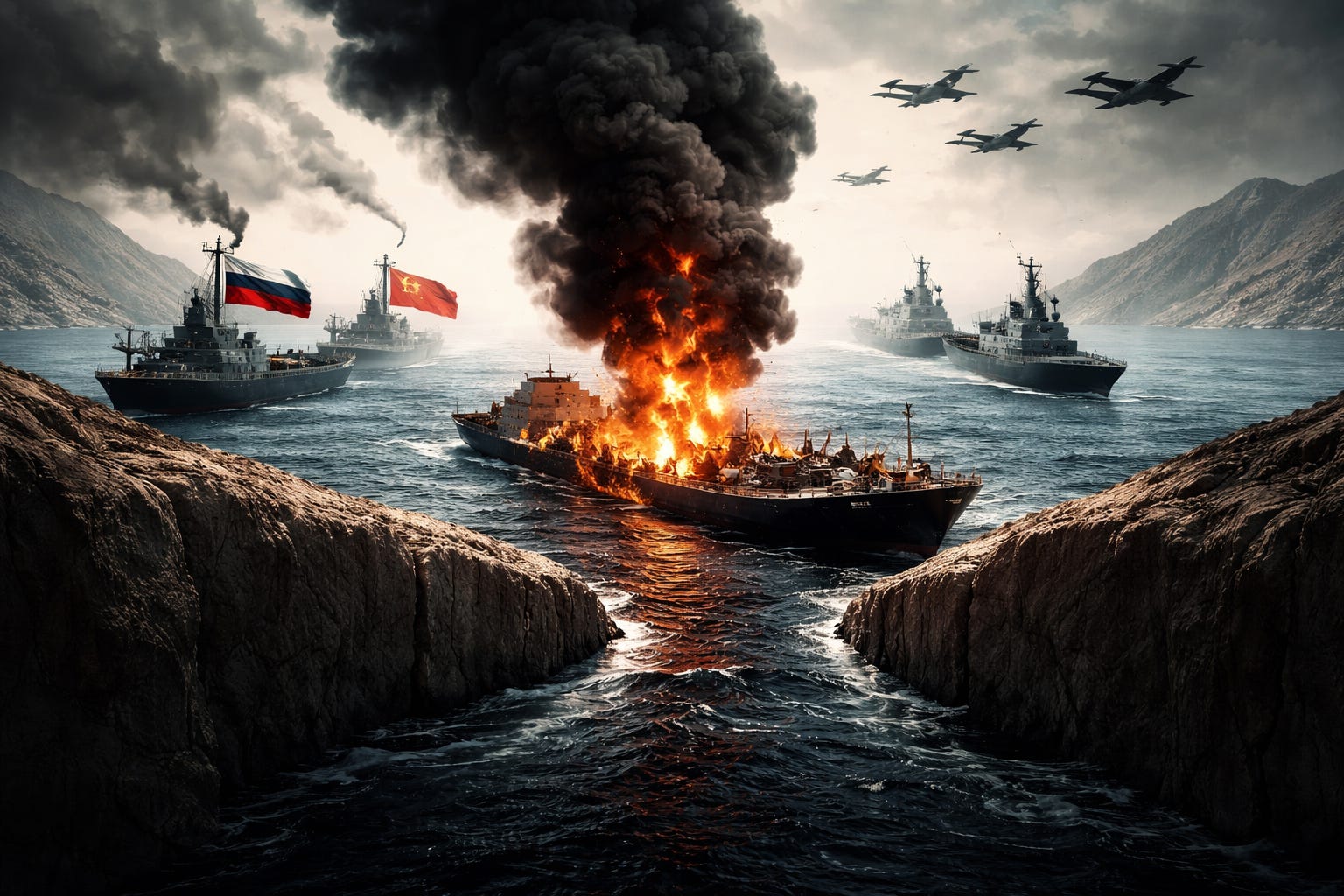
Iran closed the Strait of Hormuz to Western shipping… the narrow waterway through which roughly one-fifth of the world’s oil supply normally passes.
The move immediately sent shockwaves through global energy markets.
Oil prices jumped above $100 per barrel, even after the United States released large volumes from its strategic petroleum reserves in an attempt to stabilize markets.
That alone would have been serious.
But the bigger development came a few days later.
Iran’s foreign minister publicly confirmed that Russia and China are providing military support to Tehran… including political, economic, and defense cooperation.
In other words, the regional strike instantly became part of a much larger geopolitical contest.
And that changes everything.
The Intelligence Layer
According to multiple intelligence assessments, Russia has been supplying Iran with satellite-based surveillance data, including information on the locations of American naval forces and key shipping routes.
Russia has also reportedly provided S-400 air defense components, strengthening Iran’s ability to defend against future air strikes.
China’s support appears to be different but equally significant.
Reports indicate Beijing has provided financial assistance, military spare parts, and missile components that help sustain Iran’s military capacity.
Chinese naval surveillance vessels have also been observed near the Strait of Hormuz, monitoring the situation and mapping the maritime environment.
None of this involves Russian or Chinese troops entering the conflict directly.
It doesn’t need to.
Modern geopolitical competition often works through support systems rather than direct combat.
Information, logistics, financing, and technology can keep a regional power operational indefinitely.
The Timeline That Matters
The sequence of events tells the real story.
February 28: U.S. and Israeli forces launch coordinated strikes against Iran.
March 2: Iran closes the Strait of Hormuz to Western shipping.
March 14: Washington asks multiple countries — including China — to assist in reopening the strait.
March 15: Iran publicly confirms Russian and Chinese military support.
That timeline reveals a basic strategic problem.
Military dominance does not automatically translate into strategic control.
The United States demonstrated overwhelming air power.
Iran demonstrated control over a critical chokepoint in global energy infrastructure.
Those are two very different kinds of power.
The Hormuz Strategy
Iran does not need to defeat the U.S. Navy in open combat.
It only needs to make the Strait of Hormuz too dangerous for commercial shipping.
Even limited drone attacks, naval mines, or missile threats can drive insurance companies out of the market.
Once insurers refuse coverage, shipping companies stop moving oil through the region. regardless of naval escorts.
The result is economic disruption without a conventional naval battle.
It’s classic asymmetric strategy.
And it works.
The Financial Shock
There is another layer to this conflict that most people are missing.
Some oil shipments passing through the region are now reportedly being priced in Chinese yuan instead of U.S. dollars.
If that trend expands, it could weaken the long-standing petrodollar system that has dominated global energy trade for decades.
Meanwhile, higher oil prices create different incentives around the world.
Europe accelerates investment in renewable energy and alternative supply routes.
Asian importers negotiate direct energy agreements with Iran.
Gulf producers move oil through pipeline routes to Red Sea ports instead of the Persian Gulf.
Every workaround built today reduces the long-term importance of the Strait of Hormuz tomorrow.
Which means the geopolitical landscape is slowly reorganizing itself.
The Diplomatic Door
Despite the tension, there are signs that diplomacy is still possible.
Iran has indicated that the strait is not closed to all shipping.
Countries such as Turkey and India have reportedly secured safe passage through negotiated agreements.
Oman has repeatedly offered to act as a mediator between the parties.
That suggests the blockade is partly a negotiating tool rather than a permanent policy.
But any diplomatic solution would require something Washington has historically struggled with:
Acknowledging limits.
Military power can destroy infrastructure.
It cannot easily force political surrender…
Especially when rival global powers are quietly backing the other side.
The Bigger Picture
Russia and China do not need Iran to win a war.
They simply need Iran to remain standing long enough for the global system to adjust.
If trade routes shift…
If energy markets diversify…
If alternative currencies gain traction…
then the strategic environment gradually moves away from the system that dominated the last forty years.
That process doesn’t happen overnight.
But history shows it can start with moments exactly like this.
A narrow waterway.
A few tankers stopped.
And the sudden realization that the world no longer runs on a single country’s timetable.
The Recap…
The U.S. declared victory after striking Iran.
Days later the Strait of Hormuz was closed, oil jumped above $100, and Iran confirmed military support from Russia and China.
The lesson?
Winning the first battle doesn’t mean controlling the outcome.
Sometimes the real war begins after the headlines.
The Gut-Punch…
Military power can blow up targets.
It can’t always control the map that forms afterward.
Source Credit:
Source House of El: Public statements from Iranian officials, global energy market data, and international intelligence reporting on the Strait of Hormuz crisis.
🔎 The GeezerWise Standard
This space is built on disciplined thinking.
Facts over spin.
Verification before amplification.
Good-faith discussion over tribal noise.
I use AI tools to help shape my spoken drafts into clear writing.
The judgment, conclusions, and final message are mine.
If you’re new here, this explains how I decide what’s worth sharing:
How I Decide What’s Worth Sharing → [link]
💌 Subscribe at GeezerWise.com to receive future letters:
www.geezerwise.com/subscribe
— Fred Ferguson
GeezerWise
#CanadaStrong
Another very informative, & in some ways, exciting post Fred. Thank you :)
The view from the kiddies table is not clear.
There are grownup diplomats in the world who fix things. Iran will ship oil bought in yuan to China, who will be the unofficial distributor of oil that goes to Asia.