

Most political stories move slow.
This one didn’t.
The latest national polling shows something pretty clear… the ground under Canadian politics has shifted… and not in the way most people expected.
Let’s start with the numbers.
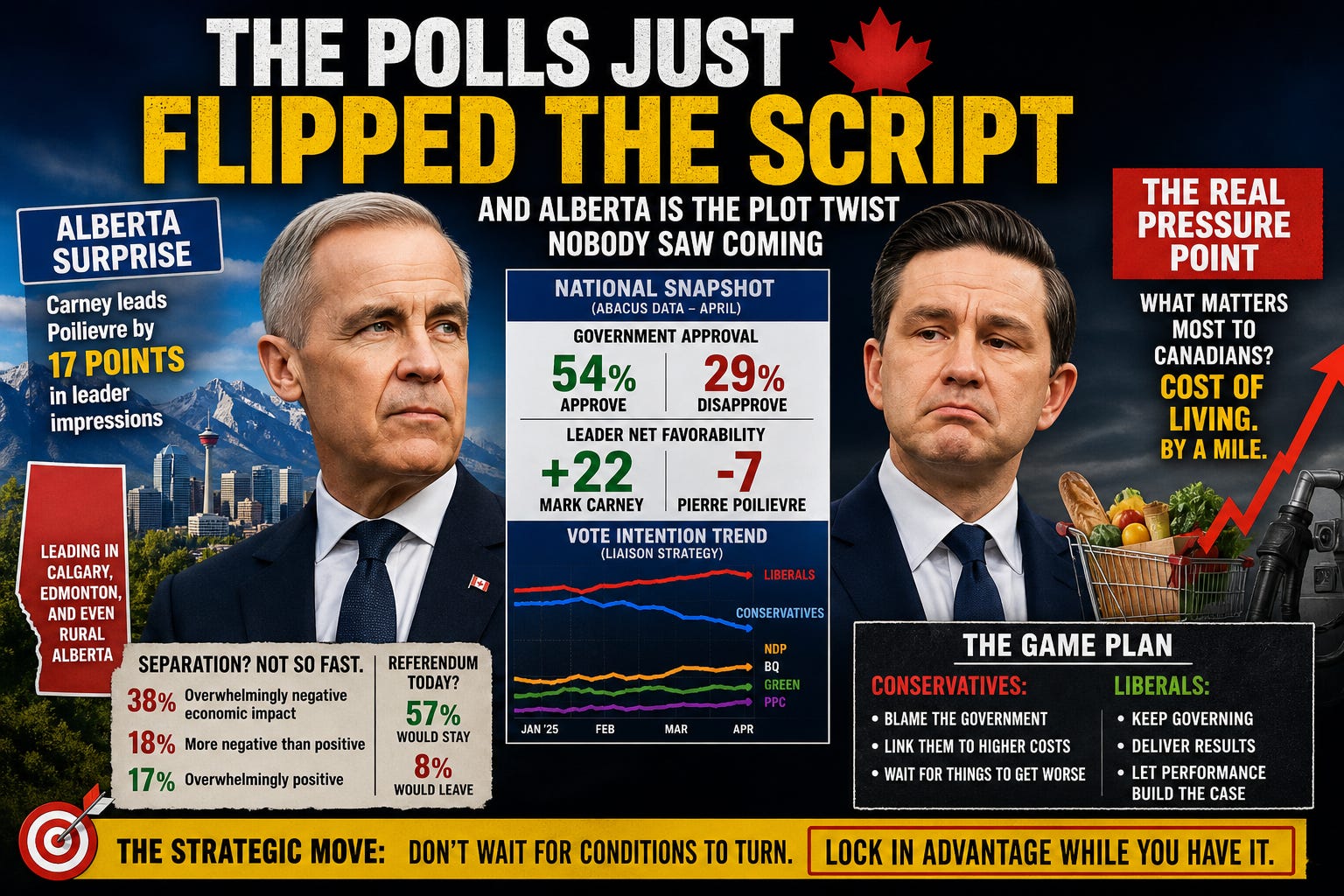
Across the country, the current government is sitting at 54% approval, with 29% disapproval. That’s not squeaking by… that’s solid footing.
On leadership, the gap widens.
Mark Carney sits at a +22 net favourability.
Pierre Poilievre? –7.
That’s not a small difference. That’s a perception gap you can drive a truck through.
And if you think that’s predictable… here’s where it gets weird.
Alberta.
Yes, that Alberta.
A regional poll shows Carney leading Poilievre by 17 points in leader impressions — including leads in both Calgary and Edmonton.
Even rural Alberta, the last place you’d expect it, shows them essentially tied.
Now let’s be clear… this doesn’t mean Alberta suddenly turns Liberal in an election.
Rural seats don’t flip easily. They’d vote for a fence post before they vote red.
But cities?
Different story.
And in modern elections, a handful of urban seats can change everything.
So What Changed?
It’s not federal policy alone.
It’s spillover.
Provincial politics in Alberta has been flirting with separation talk… loud enough to grab headlines, but not nearly popular enough to win.
When Albertans were asked what separation would actually do to their economy…
38% said it would be overwhelmingly negative
Another 18% said more negative than positive
Only 17% saw it as overwhelmingly positive
And when pushed to a real decision?
57% would vote to stay in Canada
Just 8% would definitely leave
That’s not a movement. That’s a minority with a microphone.
Here’s the problem for conservatives…
That rhetoric plays well in rural strongholds… but it lands like a lead balloon in cities.
And politics doesn’t stay neatly separated anymore.
What starts as provincial noise spills into federal perception.
So now you’ve got a situation where:
The base is being kept happy
But the middle is drifting away
That’s not a stable strategy.
Meanwhile… the Real Pressure Point
None of this matters if people can’t afford groceries.
When Canadians were asked what matters most right now, the answer wasn’t subtle:
Cost of living.
By a mile.
And this is where the entire political chessboard resets.
Because while polling looks good today… reality has a nasty habit of showing up later.
Fuel prices rising.
Global supply disruptions.
Food costs climbing.
That’s not theoretical. That’s already happening.
And both parties know it.
Two Strategies. Opposite Directions.
The conservatives are betting on deterioration.
Their approach is simple…
Hammer the message that everything is broken.
Tie rising costs directly to government decisions.
Wait for things to get worse… and let frustration do the work.
It’s not subtle… but it doesn’t have to be.
Because if prices keep climbing, that message writes itself.
The liberals are taking the opposite approach.
Govern. Deliver. Push policy forward.
The assumption is: if results come, the narrative will follow.
That’s the technocrat play.
And it works… right up until it doesn’t.
Here’s the Move Nobody Wants to Talk About
If you strip the politics out and look at this purely as strategy…
There’s an argument sitting in plain sight:
Call an election early.
Not because people want one.
Not because it feels right.
Because the timing makes sense.
Right now:
Polls are strong
Opposition is struggling
Public perception is favourable
A year from now?
Maybe not.
If inflation bites harder…
If grocery bills spike again…
If global instability drags on…
You don’t want to be explaining that away while your opponents point at your record and say, “See?”
That’s a losing conversation.
So the strategic play is simple:
Don’t wait for conditions to turn.
Lock in advantage while you have it.
Turn a narrow majority into a comfortable one.
Buy yourself five years instead of scrambling in eighteen months.
Will It Happen?
Probably not.
Because this requires thinking like a strategist… not just a leader.
And most governments prefer to believe they can ride things out.
Sometimes they can.
Sometimes they get blindsided.
The Recap…
Polls just dropped… and Alberta flipped the script.
Carney’s ahead. Poilievre’s slipping.
But none of it matters if groceries keep climbing.
This isn’t about ideology anymore…
It’s about timing.
The Gut-Punch…
Elections aren’t won when things are good.
They’re won before things get bad.
Source Credit:
Polling data from Abacus Data, Liaison Strategy, CBC regional polling, and Angus Reid Institute.
🔎 The GeezerWise Standard
This space is built on disciplined thinking.
Facts over spin.
Verification before amplification.
Good-faith discussion over tribal noise.
I use AI tools to help shape my spoken drafts into clear writing.
The judgment, conclusions, and final message are mine.
If you’re new here, this explains how I decide what’s worth sharing:
How I Decide What’s Worth Sharing → [link]
💌 Subscribe at GeezerWise.com to receive future letters:
www.geezerwise.com/subscribe
— Fred Ferguson
GeezerWise
#CanadaStrong
Elections are expensive and Carney has a majority now and 4 years of run time to see new peojects being developed. Significant new economic investments and activity and if I was a betting man a renewed CAMUSA this fall including the removal of all tariffs. Trump's economy is in a dhambles and the auto industry in the US is demanding the removal of tariffs and the return of stability to the industry provided by CAMUSA. So Carney not doing a bad deal will be the master strategist. No need for an election to slow the momentum. Too much work still to be done.
Agree with most of what is said here - except with the early election call. Carney now has his majority, albeit slim, let’s see what he can accomplish with it. If he continues building relationships, great. But if he calls another election it might be seen as trying to take advantage of a political situation and people on the fence may not like it. Besides, if Pierre keeps shooting himself in the foot, why not keep letting him do it?