

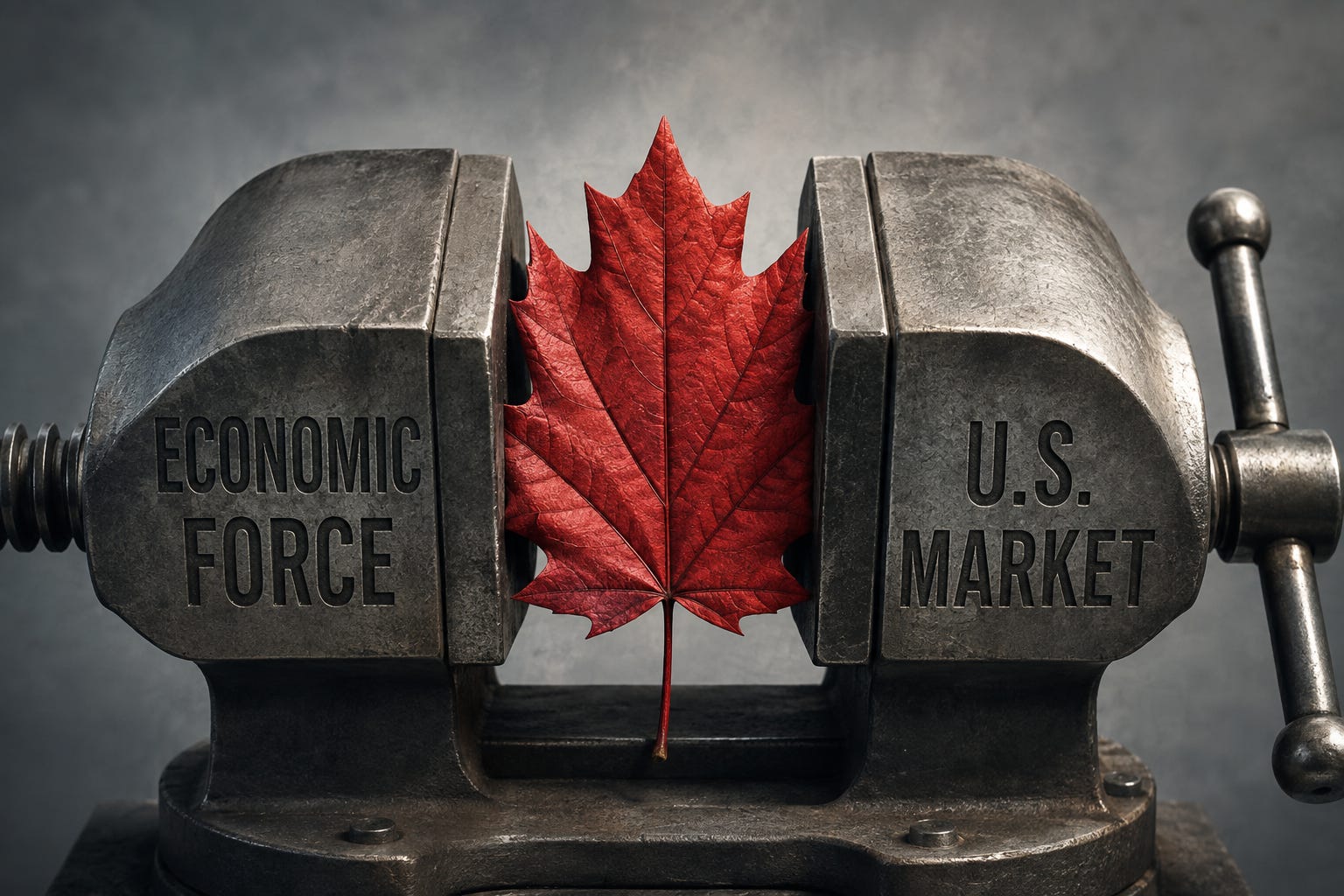
Donald Trump said something about Canada that I don’t think Canadians have taken seriously enough.
When he was asked whether he would use military force to make Canada part of the United States, he didn’t say yes.
He said…
“No… economic force.”
Those may be the two most important words in this entire Canada-U.S. fight.
Because once you understand what economic force means, a lot of what we’ve been watching starts making considerably more sense.
Trump doesn’t need American tanks rolling across the Ambassador Bridge.
He doesn’t need soldiers marching into Ottawa.
He already has something much more useful.
The American market.
Canada has spent decades building an economy enormously dependent upon selling things to the United States.
Oil.
Lumber.
Steel.
Aluminum.
Cars and auto parts.
Minerals.
Agricultural products.
Thousands of other goods and services.
Trump understands that dependency.
So let’s strip away all the political noise and imagine the negotiation in the simplest possible terms.
Trump says…
You want access to my enormous market? Fine. There are things I want.
And that’s where this stops being merely another argument about tariffs.
First, America Wants Preferential Access to What Canada Has
Canada possesses things the United States needs.
Energy.
Oil.
Uranium.
Potash.
Critical minerals.
Electricity.
Industrial capacity.
Increasingly, access to those resources isn’t merely an economic question.
It’s strategic.
If Washington can determine where important Canadian resources may be sold… or restrict Canada’s ability to develop competing relationships elsewhere… Canada may still technically own those resources.
But our freedom to decide what to do with them has been reduced.
That’s the first piece.
Second, America Wants Influence Over Canada’s Other Relationships
This is where Canadians should pay very close attention.
Suppose Canada remains free to trade with the United States… but maintaining that access requires Washington to have a say in relationships Canada develops elsewhere.
Think about what that means.
Canada can still call itself an independent country.
We can keep Parliament.
We can keep the flag.
We can keep singing O Canada before hockey games.
But if another country can effectively tell us…
You can’t make that trade agreement.
You can’t sell those resources there.
You can’t build that relationship with them.
Then exactly how sovereign are we?
That isn’t an ordinary trade negotiation anymore.
That’s a sovereignty question.
And That Brings Us to the Third Piece
Trump doesn’t necessarily need Canada to literally become the 51st state.
That’s the part I think many people are missing.
He doesn’t need to change the signs at the border.
He doesn’t need to replace our flag.
He doesn’t even need Canada to officially stop being Canada.
If the United States gains enough economic control over Canadian decisions, it gets much of what it wants without formally owning the country.
Canada remains Canada on the map.
But increasingly important Canadian decisions have to be made with one question in mind…
Will Washington allow it?
There’s an old word for that kind of relationship.
Vassal.
The smaller country governs itself internally, but the larger power determines the boundaries within which it can operate.
I’m not saying Canada is there.
I’m saying that’s the line Canadians need to watch.
Because sovereignty usually isn’t lost in one dramatic afternoon.
Sometimes it’s surrendered one concession at a time.
Now Trump’s “Economic Force” Makes Sense
Think about tariffs differently.
They’re not just taxes.
Used this way, they’re pressure.
Canada needs access to the American market.
Trump controls access to the American market.
So he can make that access increasingly painful until the political and economic cost of saying no becomes greater than the apparent cost of saying yes.
Businesses hurt.
Workers lose jobs.
Investment slows.
Governments come under pressure.
Canadians become frightened.
Eventually somebody says…
For God’s sake, just make a deal.
And that’s when the most important question becomes…
What exactly are we agreeing to?
Because a tariff can eventually be removed.
A factory can reopen.
A market can recover.
But surrendering Canada’s ability to make its own decisions is something entirely different.
That’s Why “No Deal Is Better Than a Bad Deal” Matters
This isn’t simply about getting the tariff number down.
If this were only about whether the tariff is 10%, 20% or 50%, Canadians could argue about numbers until the cows come home.
The real question is much simpler.
What does Canada have to surrender in exchange?
Market access?
Negotiate it.
Tariff rates?
Negotiate them.
Border rules?
Negotiate those too.
But Canada’s ability to choose its trading partners, develop its resources and determine its own foreign and economic policy?
That’s different.
Those aren’t bargaining chips.
That’s the country.
And perhaps that’s the easiest way to understand what this fight is actually about.
Donald Trump doesn’t have to invade Canada.
He already told us the weapon.
Economic force.
The question facing Canada isn’t whether we can avoid economic pain.
We probably can’t avoid all of it.
The question is whether we’re willing to endure some economic pain today so Canadians still get to decide what Canada does tomorrow.
Because we can rebuild trade.
We can find customers.
We can develop new markets.
We can build pipelines, ports, railways and relationships around the world.
But there’s one thing we should never have to rebuild.
Our sovereignty.
Tariffs are negotiable.
Sovereignty isn’t.
If you enjoy thoughtful conversations, Canadian stories, and the occasional smart-ass observation about the world we’re living in, you’re in the right place.
Subscribe free and get new stories, insights, and observations delivered directly to your inbox.
No paywall.
No spam.
No nonsense.
Leave anytime with a single click.
I promise not to take it personally.
Thank the gods we got the PM we did at the right time. Even though I suspect JT would have done much the same he d have been beset by such fervent opposition that we d have been in danger of caving. Support would have been fragmented.
I am so proud of Canadians today for seeing the threat and responding as we have.
And we ll find ways through, just like Ukraine.
And maybe be the better for it on the other end in so many ways.The American Empire is corrupt within and we were going hand in hand. There will be short term pain but a better future without them as they are today.
Has anyone written thoughtfully about the political scenarios if the US balkanizes? I d like to read something smart but dont have time or enegry to go through all the scifi options myself any more. But I wonder who would be the allies of a stalwart Canadian federation?
Correct! "Sovereignty isn't negotiable."
And as Ukraine shows us, it's worth fighting for!
Your point here is valid, Fred and for today, without question. I believe Canadians have the courage to sustain the fight.
"The question is whether we’re willing to endure some economic pain today so Canadians still get to decide what Canada does tomorrow."
Be like Ukraine! 🇺🇦
❤️🇨🇦