

There’s something remarkable about watching a corporate executive explain himself on national television…
and realizing he’s just given the Canadian government another reason to call its lawyers.
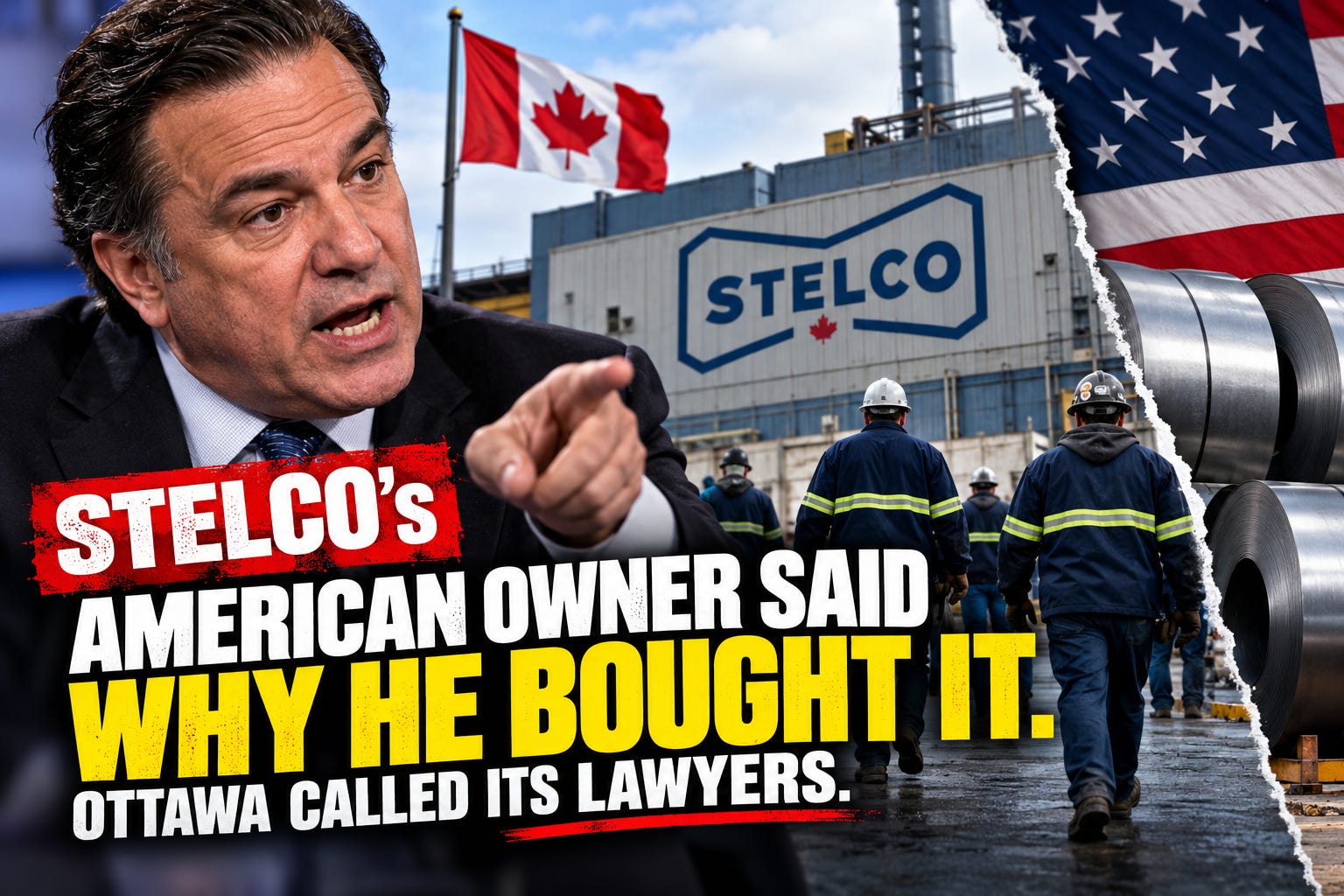
That’s what happened this week when Cleveland-Cliffs CEO Lourenco Goncalves appeared on CBC’s Power & Politics.
Goncalves runs the American steel company that bought Canada’s Stelco in 2024.
And he explained why he bought it.
Not because Canada needed another American investor.
Not because Stelco was struggling and needed rescuing.
He bought it because Stelco was competing with his American business.
His words, not mine.
“I bought Stelco because I could not afford anymore having Stelco flooding the market here in the United States to the detriment of my own company.”
Well, there’s an interesting reason to spend billions buying a Canadian steelmaker.
Stelco was apparently doing its job too well.
It was producing steel competitively and selling it into the American market.
And Cleveland-Cliffs didn’t particularly appreciate the competition.
Now, buying a competitor isn’t automatically illegal. Companies do it all the time.
But there’s another little detail here.
Cleveland-Cliffs made promises to Canada before it was allowed to buy Stelco.
In October 2024, Ottawa approved the acquisition under the Investment Canada Act.
The approval came with 34 legally binding undertakings, including five-year commitments covering Canadian employment and trade advocacy.
Those promises mattered.
They were part of the reason the Canadian government allowed the sale.
Fast-forward two years.
Stelco has laid off approximately 175 workers in Hamilton, with potential cuts reaching about 500 across its Ontario operations.
And the Canadian government says Cleveland-Cliffs is failing to honour its commitments.
Industry Minister Mélanie Joly has issued a formal demand and warned that the company could face legal action, financial penalties and potentially a forced sale of its Canadian assets.
Then Goncalves went on television and explained that protecting his American business from Stelco’s competition was a reason for buying it.
Joly subsequently said his remarks prompted her department to contact its lawyers.
I can understand why.
Here’s where it gets interesting.
Cleveland-Cliffs insists it has done nothing wrong.
On October 26, the company issued a statement declaring itself in full compliance with all 34 undertakings.
It even supplied numbers.
The company says it expects an annual average of at least 1,879 unionized full-time-equivalent employees, compared with a required level of 1,766.
It also expects salaried employment to exceed its required threshold.
Those figures matter because the precise employment obligations, how they’re measured and whether temporary layoffs violate them are now part of the dispute.
Ottawa says the company isn’t complying.
Cleveland-Cliffs says it is.
That’s something the legal process will have to sort out.
But here’s what bothers me.
We have an American company that bought a successful Canadian competitor, made legally binding commitments to our government, and is now laying off Canadian workers while its CEO publicly describes the acquisition as a way to protect his American operations.
Even if every employment number Cleveland-Cliffs provides turns out to be accurate, Canadians are entitled to question what this takeover has accomplished for Canada.
Goncalves says weak demand and imports are hurting Stelco’s business.
Those are real issues in the steel industry.
But the company’s position becomes particularly difficult to swallow when Cleveland-Cliffs openly supports American Section 232 steel tariffs while Canada is fighting to protect its own steel industry.
The company argues that its trade advocacy remains consistent with its commitments.
Ottawa disagrees.
And that disagreement matters far beyond Hamilton.
Because this isn’t just about Stelco anymore.
For decades, Canada has allowed foreign companies to purchase Canadian businesses on the understanding that investment would bring benefits.
Jobs. Production. Technology. Growth.
Sometimes those benefits materialize.
Sometimes the promises look considerably better on paper than they do on a factory floor.
The Stelco dispute raises a question we should have been asking much more aggressively long before Donald Trump returned to the White House.
What happens when a foreign company buys a Canadian business primarily because that business is competing successfully against its own operations?
And what happens when protecting the foreign owner’s interests conflicts with protecting Canadian jobs?
That’s not an argument against every foreign investment.
It’s an argument for making sure the commitments attached to those investments mean something.
Prime Minister Mark Carney addressed the dispute on October 29.
Asked whether allowing Cleveland-Cliffs to purchase Stelco had been a mistake, he said the mistake would be the company failing to respect its obligations.
I agree with that distinction.
The government approved the transaction based on commitments.
Now it has to enforce whatever those commitments legally require.
Not because the CEO is American.
Not because he’s particularly charming or otherwise.
Because an agreement with Canada is supposed to mean something.
Goncalves has suggested Stelco could eventually be sold, although he says it isn’t for sale right now.
He’s also said the 175 laid-off workers might return before Christmas if Canadian steel sales improve.
I’d be delighted to see those workers back on the job.
But Canadians shouldn’t have to rely on a CEO’s changing predictions about Christmas to know whether the commitments made to their country will be honoured.
There’s a legal process underway.
Let it work.
And if Cleveland-Cliffs has broken its undertakings, Ottawa should use the enforcement powers Parliament gave it.
Because Canadian steelworkers shouldn’t discover that the price of being competitive was having their company purchased by the competition.
The Recap…
Stelco’s American owner says he bought the Canadian steelmaker partly because it was competing too successfully against his U.S. business.
Now Canadian workers are facing layoffs, and Ottawa says Cleveland-Cliffs isn’t honouring its takeover commitments.
The company denies wrongdoing.
The government has called its lawyers.
This is one worth watching.
The Gut-Punch…
If a Canadian company is successful enough that an American competitor wants to buy it, Canada had better make damn sure the buyer intends to keep it successful.
Source credit
Government of Canada — October 30, 2024 approval of Cleveland-Cliffs’ Stelco acquisition
CBC Power & Politics — October 27, 2026 interview with Lourenco Goncalves
Global News — October 29, 2026 Carney comments and Joly’s compliance concerns
If you enjoy thoughtful conversations, Canadian stories, and the occasional smart-ass observation about the world we’re living in, you’re in the right place.
Subscribe free and get new stories, insights, and observations delivered directly to your inbox.
No paywall.
No spam.
No nonsense.
Leave anytime with a single click.
I promise not to take it personally.
As for this mornings article you wrote it was very well written as usual. I always come away from your articles knowing something more than what I had known previously. On a side note, frankly I’m sick and tired of our country being taken advantage of by so-called friends and neighbours. Thank you for your reporting.
Hi Fred, this question is a little off topic. I read last evening that a few more Canadians were arrested in conjunction with midterm election interference. How far do you think the people who are already gearing up to blame anyone or anything for poor results will go and if the accusations can hold water?