

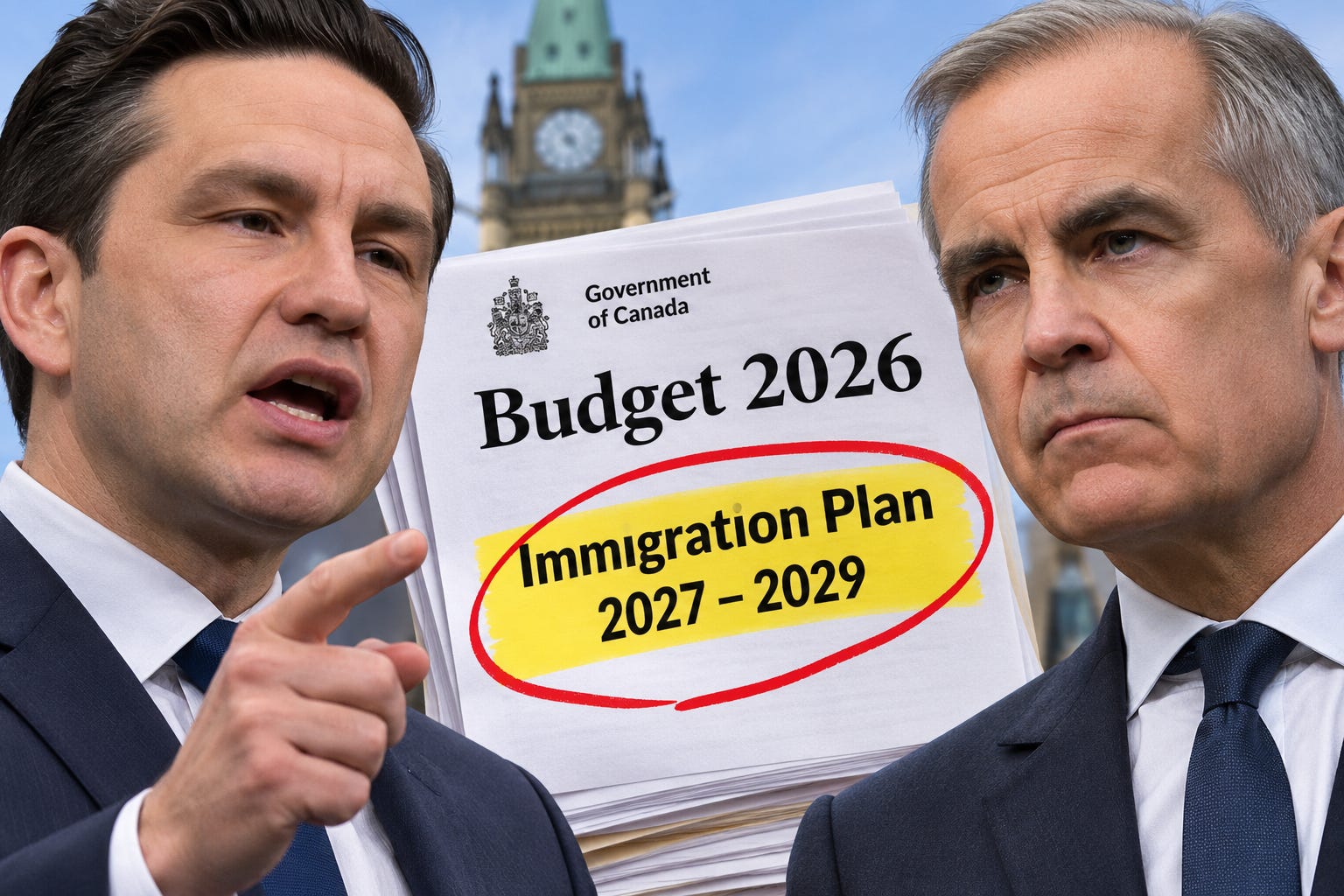
I’ve been around long enough to know that when a politician tells me something is being hidden, the first thing I should do is look for it.
So when Pierre Poilievre started warning Canadians about immigration numbers supposedly buried in Mark Carney’s federal budget, I went looking.
Didn’t need a shovel.
Didn’t need a whistleblower.
Didn’t even need a particularly good pair of reading glasses.
The numbers are in the budget, available to anyone with an internet connection.
And they’re worth reading.
Because there’s something going on here that neither political party should get away with oversimplifying.
First, the numbers
Canada’s 2026 federal budget includes the immigration targets for 2027, 2028 and 2029.
Here they are.
In 2023, Canada recorded 971,815 new temporary resident arrivals.
In 2024, that number was 686,010.
The government’s annual target for 2027 through 2029 is 370,000.
That’s a planned reduction of about 62% from the 2023 figure.
Permanent immigration tells a similar story.
Canada admitted 483,655 permanent residents in 2024.
The annual target for the next three years is 380,000.
That’s about 21% lower.
Those are the government’s published numbers.
Not a secret Liberal memo. Not something slipped under Parliament’s door after midnight.
They’re right there in the budget.
Now, targets aren’t guarantees. Governments can miss them, change them or announce exceptions.
And that last word is where this story gets interesting.
There’s another 200,000 people in the picture
Carney’s government has announced a one-time measure that could allow up to 200,000 temporary residents already living in Canada to become permanent residents by the end of 2027.
That’s in addition to the regular immigration plan.
And it’s a legitimate subject for political debate.
But there’s a distinction worth understanding.
These are people already living in Canada.
They aren’t necessarily 200,000 new people arriving at our airports, crossing our borders and looking for somewhere to live.
They’re people who may already have jobs, apartments, children in Canadian schools and lives established in this country.
Changing someone’s immigration status doesn’t automatically add another person to Canada’s population.
That doesn’t mean the decision has no consequences.
Permanent residency affects long-term population planning, access to programs, labour markets and the government’s future obligations.
Canadians are entitled to know how those decisions are being made.
And the government should explain exactly how its additional admissions fit with the regular targets.
No political gymnastics required.
Just tell us what the total is expected to be.
Here’s where Poilievre loses me
The Conservative argument about additional permanent residents deserves scrutiny.
But describing the immigration announcement as something hidden or secretly slipped into the budget is another matter.
The federal government published the numbers.
Immigration, Refugees and Citizenship Canada published the detailed plan.
News organizations reported the announcement when the budget came out on November 5.
You can disagree with the policy without pretending nobody was supposed to find out about it.
And frankly, I’d rather hear the Leader of the Opposition explain why he believes the additional permanent-residency program is wrong than spend his time telling Canadians the government is hiding something that’s available on a public website.
That’s not holding the government accountable.
That’s making the argument harder to take seriously.
And Carney doesn’t get a free pass
I’ve supported Mark Carney’s approach to a number of issues.
That doesn’t mean I’m going to pretend his government can’t be questioned.
The regular immigration targets are lower than the earlier numbers.
That’s a fact.
The government is also creating additional pathways to permanent residence.
That’s another fact.
And the total number of people receiving permanent status in 2027 could be substantially higher than the headline target of 380,000.
That deserves a straightforward explanation from Ottawa.
Canada has real housing shortages. Real pressure on healthcare. Real questions about whether communities have the infrastructure to support population growth.
Those problems don’t disappear because a Liberal government announces a reduction in immigration targets.
But neither do they justify treating every immigrant as the cause of Canada’s problems.
We need workers. We need skilled tradespeople. We need people willing to build lives and contribute to this country.
We also need governments capable of matching immigration policy to housing, infrastructure and the services Canadians depend on.
Those two ideas aren’t enemies.
They’re supposed to work together.
Maybe we could try discussing the actual policy
Here’s what bothers me most about this whole business.
Canada has an important immigration debate to have.
How many people can we accommodate responsibly?
Which skills do we need?
What happens to temporary workers who’ve spent years contributing to our economy?
How do we reduce pressure on housing without creating new labour shortages?
And how do we make sure the government reports immigration numbers in a way ordinary Canadians can understand?
Those are serious questions.
Instead, we’re being invited to argue about whether a publicly released budget was secretly hiding information.
Good grief.
Pierre Poilievre doesn’t need to manufacture a mystery to challenge Mark Carney.
There are legitimate questions sitting right there in the government’s own documents.
Ask them.
And Mr. Carney, answer them.
Canadians deserve a proper immigration debate.
Not another political magic show where everybody points at the curtain and nobody explains what’s happening on the stage.
The Recap…
Poilievre says Carney buried immigration numbers in the federal budget.
The published targets show lower regular immigration levels than in 2023 and 2024.
But the government is also planning additional permanent-residency admissions for people already living in Canada.
Both sides have something worth explaining.
The Gut-Punch…
When the numbers are already public, the scandal isn’t that they’re hidden. It’s that politicians would rather argue about the hiding place than explain what the numbers mean.
Source Credit
Government of Canada… 2026 Annual Report to Parliament on Immigration
Bloomberg reporting, November 7, 2026… One-time permanent-residency measure
If you enjoy thoughtful conversations, Canadian stories, and the occasional smart-ass observation about the world we’re living in, you’re in the right place.
Subscribe free and get new stories, insights, and observations delivered directly to your inbox.
No paywall.
No spam.
No nonsense.
Leave anytime with a single click.
I promise not to take it personally.
I wish that we had a serious, functional, opposition leader and party. We certainly don't under Poilievre.
I'm mostly behind Carney on his path and plan, but an opposition that is actively trying to work for the country is important. There are real questions to be asked. Real policies that should have legitimate debate. This performative culture war grandstanding does nothing to help anyone. PP & crew don't seem to have learned the lesson that the majority of Canadians simply aren't interested in the MAGA style politics of the US.
Stop screaming about everything and show us the plan for what you would do instead.
I wish Jack Layton was still with us. Or that we might be able to tempt Wab Kinew to throw his hat into the federal ring. He's who I'm watching.
Excellent article, as always, Fred.
To me, there should be some logical flow to the numbers:
- How many immigrants do we need to replace workers who are retiring, etc.? We need those workers to a) do the work and b) to pay taxes, etc. so that people can actually retire (the new workers building the infrastructure that will allow the retirements, etc. So we might need something like 10 new workers for every person retiring (I have no idea what's needed, but for me, that's the starting point here).
- Once we know how many people are needed -- and I suspect that's the basis for the 380,000 + 200,000 (and I'm not sure where the "reverse brain-drain" campaign - where Canada is trying to attract (American) knowledge workers/academics to Canada - fits into these numbers -- or are they another pool on top of these?), then the next question is "what infrastructure/support is needed for these new permanent residents?
- What's the Federal (then Provincial, then Municipal) plan to get that infrastructure built? Houses are relatively easy (can be built in less than 6 months - though who's paying for it, etc., etc.?). But sewers, water, electricity, etc. might take five years or so to be put in place, if it doesn't exist already.
So the discussion isn't just simply "why are we letting in more people?" The answer is in my first bullet (and the CPC's know this, they just don't like immigrants for some reason. And we can't wait 20 years for non-immigrant kids to grow up). We need to see budgets actively financing the infrastructure, along with the economic pivots, etc.