

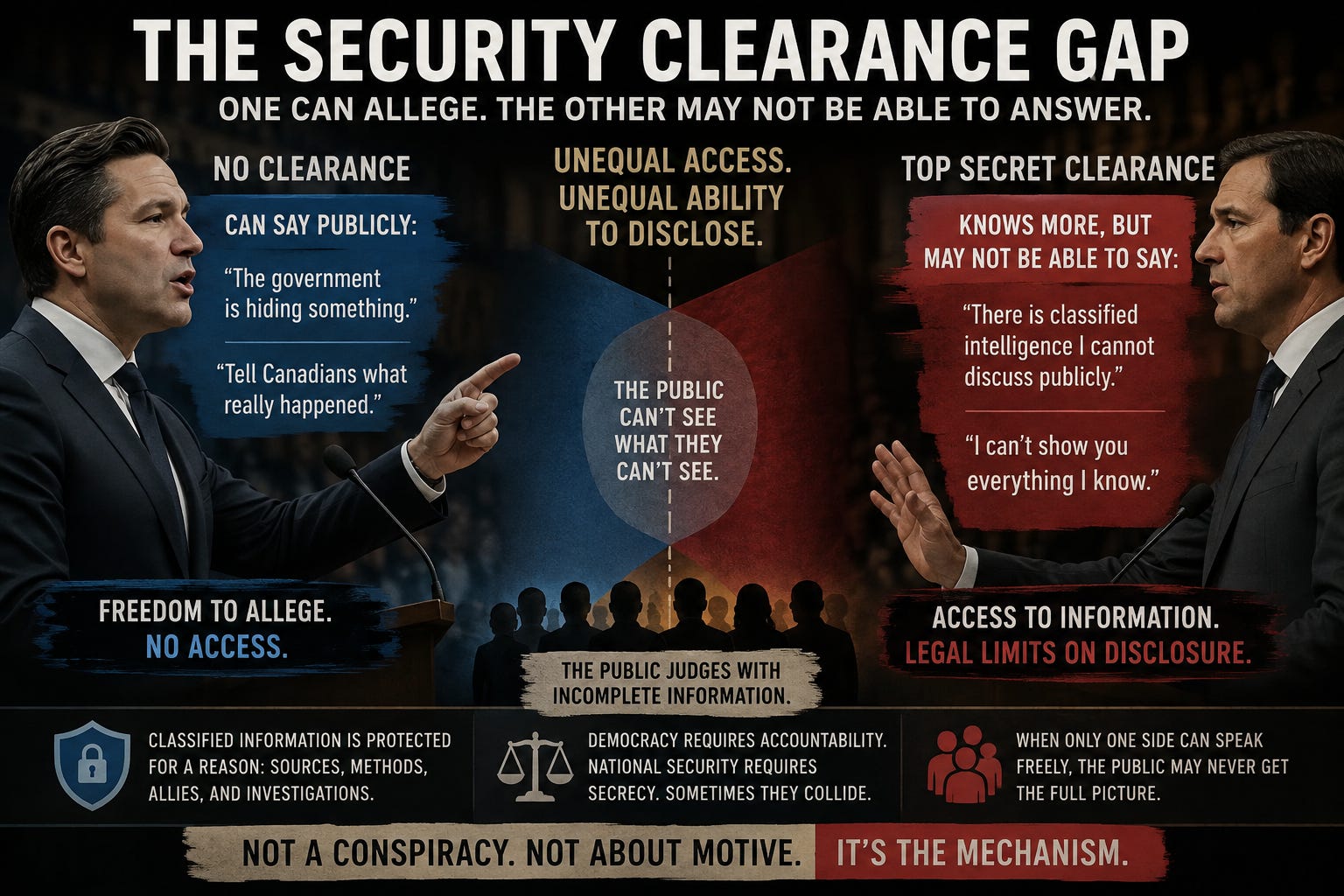
Pierre Poilievre has given Canadians a pretty straightforward reason for refusing the top-secret security clearance…
that would allow him access to highly classified national-security intelligence.
He says it would muzzle him.
He has argued that accepting classified briefings would restrict what he could subsequently say publicly and interfere with his ability to hold the government accountable.
There’s some truth buried in there.
Classified information is classified for a reason.
People who receive it don’t get to wander outside afterward and tell reporters everything they just heard.
But that’s where this story gets more interesting.
Because everybody keeps asking…
Why won’t Pierre Poilievre get the clearance?
I’m becoming more interested in another question.
What happens when the Leader of the Opposition can publicly make allegations about national security while the people who possess the classified intelligence behind the issue may be unable to tell Canadians everything they know?
That changes the conversation considerably.
First, Let’s Get the Rules Straight
Canada has a body called the National Security and Intelligence Committee of Parliamentarians… NSICOP.
Its members are MPs and senators entrusted with examining some of the most sensitive national-security and intelligence material in the country.
They hold Top Secret security clearances.
They meet privately.
And they are permanently bound to secrecy regarding protected information they receive through their work.
That’s not my interpretation.
That’s how the Government of Canada describes the committee.
That secrecy is precisely what allows members to see material the rest of us can’t.
Intelligence sources.
Methods.
Assessments.
Information supplied by allies.
Investigations that could be damaged if details became public.
There is a trade involved.
You get access to information most Canadians will never see. In return, you accept restrictions on what you can reveal about it.
That’s not particularly sinister.
That’s how classified information works.
And Poilievre Has a Point… Up to a Point
This is where I want to be fair.
Poilievre hasn’t simply said, “Nah, don’t feel like it.”
His argument has consistently been that receiving classified intelligence could restrict his ability to speak publicly about information covered by secrecy obligations.
His position has been reported repeatedly.
There was also testimony before the Foreign Interference Commission explaining the Conservative concern.
Conservative MP Michael Chong said the clearance process could prevent a recipient from sharing classified information with caucus members and potentially limit what could be done with information received through that process.
So let’s grant the legitimate part of the argument…
Yes, receiving classified intelligence creates responsibilities about what you can disclose.
It bloody well should.
But now we get to the part that interests me.
The Restriction Doesn’t Only Affect Pierre
Imagine two politicians arguing publicly about a national-security issue.
Politician A has not received the classified intelligence.
Politician B has.
Politician A says:
The government is hiding something.
Politician B knows information that could potentially explain why something happened, why certain details cannot be released, or why Politician A’s characterization is incomplete.
But Politician B cannot necessarily dump the classified file onto the floor of the House of Commons or hand it to a reporter.
That creates something political strategists understand very well…
an information asymmetry.
One side can make a public argument using publicly available information.
The other may possess additional information but be restricted from revealing it.
And here’s the important part…
That does not mean the first politician is wrong.
It means the public may not have access to all the evidence necessary to determine who is right.
That’s a very different thing.
Now Think About the Political Advantage
Suppose Poilievre says…
“Tell Canadians what really happened.”
A minister responds…
“There is classified intelligence that I cannot discuss publicly.”
What’s the easier political message?
The careful explanation about intelligence protocols, allied information-sharing agreements and national-security restrictions?
Or…
“See? They won’t answer the question.”
Come on.
One fits on a bumper sticker.
The other requires a seminar.
And Pierre Poilievre didn’t become one of Canada’s most effective political communicators because he doesn’t understand the difference.
Again, I don’t have to tell you what his motive is.
I don’t know.
Neither do his critics.
We don’t need to know.
We only need to understand the mechanism.
There’s Another Detail Worth Knowing
Poilievre hasn’t been completely cut off from Canada’s intelligence community.
His chief of staff has held top-secret clearance and received classified briefings.
And this whole debate didn’t begin because somebody suddenly decided opposition leaders should be dragged into a secret room.
The government had offered opposition leaders classified national-security briefings.
A 2023 letter from then-prime minister Justin Trudeau specifically offered recognized party leaders quarterly classified briefings covering national-security threats and foreign interference. Receiving those briefings required security clearance.
Other political leaders have wrestled with the same problem.
Before obtaining clearance, then-NDP leader Jagmeet Singh explicitly sought assurances about how freely he could speak after reviewing classified intelligence.
That’s useful context.
The tension Poilievre describes isn’t imaginary.
But neither is it unique to Pierre Poilievre.
And That’s Why This Matters
Canada is dealing with foreign interference, cyber threats, hostile-state activity and increasingly complicated relationships with powerful countries.
Some information simply cannot be public.
We might wish otherwise.
But intelligence shared by an ally doesn’t suddenly become ours to broadcast on Facebook.
An intelligence source inside a hostile government can’t be exposed because somebody wants a better Question Period clip.
National security sometimes requires secrecy.
Democracy requires accountability.
And those two things occasionally collide.
That’s precisely why political leaders entrusted with sensitive intelligence carry responsibilities the rest of us don’t.
Here’s the Question I Think Canadians Should Be Asking
Forget the conspiracy theories.
Forget trying to psychoanalyse Pierre Poilievre.
Forget asking whether he’s “afraid” of getting clearance.
Ask something much simpler…
Does refusing classified intelligence give a politician greater freedom to attack people who possess information they cannot fully disclose?
The answer isn’t automatically yes in every case.
But the possibility is built directly into the situation.
One participant can say…
“Prove me wrong.”
The other may sometimes have to answer…
“I can’t show you everything I know.”
And in modern politics, guess which sentence makes the better 15-second video?
That’s the part of the security-clearance debate I don’t think Canadians have talked about nearly enough.
Not what Pierre Poilievre might discover if he gets the clearance.
But what political advantage may exist in not knowing what the other side knows.
Because sometimes ignorance isn’t merely a lack of information.
Sometimes it leaves you considerably freer to talk.
The Recap…
Pierre Poilievre says top-secret security clearance could muzzle his ability to hold the government accountable.
There is a legitimate issue underneath that claim… classified information comes with restrictions.
But there’s another side Canadians should understand.
A politician without the classified information can make allegations publicly.
A politician who knows more may sometimes be legally unable to reveal the evidence needed to fully answer them.
That’s not a conspiracy theory.
That’s an information problem.
And once you see it, this entire debate looks different.
The Gut-Punch…
It’s easy to demand somebody “tell Canadians everything” when you know national security may prevent them from doing exactly that.
Source credit: Government of Canada… National Security and Intelligence Committee of Parliamentarians; Foreign Interference Commission records; Privy Council Office correspondence; reporting by Global News and The Canadian Press.
If you enjoy thoughtful conversations, Canadian stories, and the occasional smart-ass observation about the world we’re living in, you’re in the right place.
Subscribe free and get new stories, insights, and observations delivered directly to your inbox.
No paywall.
No spam.
No nonsense.
Leave anytime with a single click.
I promise not to take it personally.
I don’t think it’s as simple as PP not wanting to be muzzled. I do believe there has to be another reason why he does not want security clearance. Having security clearance means your background is thoroughly vetted. Just saying…
Bravo, Fred!
Well-covered, and thoroughly explored.
Regarding the rules, this is why things blew up on Maxime Bernier when he was a minister in Harper's government: He had the clearance, had classified papers in his briefcase, took them with him on vacation (with a girlfriend who most definitely was NOT cleared for anything), and was reading away at the cabin's kitchenette over breakfast or some such. Point was, she could easily have checked the material while he was sleeping, in the bathroom/shower, etc. Or the cleaning staff could, etc., etc.
I think that every time PP raises his "no security clearance" argument, others in the House should push back, saying it is irresponsible of him. He's just showing that he would be an inadequate leader, because he can't demonstrate that he can handle sensitive information/issues.