

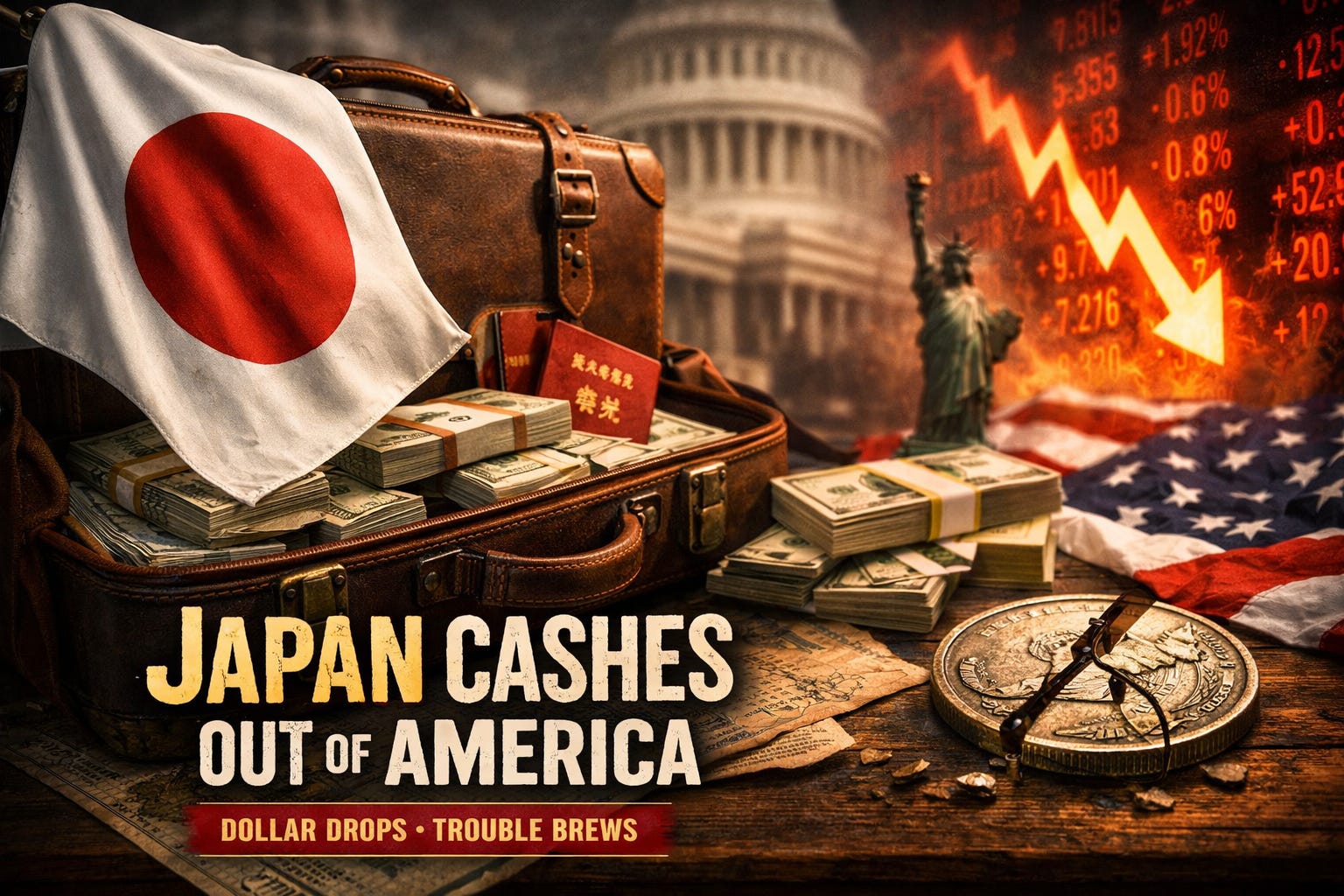
And the Dollar Is Feeling It
This didn’t start with a crisis.
It started with a quiet decision.
Japan looked at the math, looked at the risks, and decided it was time to stop babysitting America’s balance sheet.
Over the past year, the U.S. dollar has slid more than 10%. That’s not a blip… that’s a signal. And one of the biggest reasons sits across the Pacific.
Japan has roughly $5 trillion invested outside its borders. For decades, a big chunk of that money flowed into U.S. debt. Not because Japan loved America’s deficits… but because it was profitable and stable enough… until it wasn’t.
Now the incentives have flipped.
The Old Deal Is Dead
For years, Japan played a simple game:
Borrow at near-zero interest at home
Invest overseas at higher yields
Pocket the spread
That quiet trade helped keep U.S. borrowing cheap for a generation.
But recently, Japanese government bond yields jumped 0.25% in a single session… a move that normally takes months. That wasn’t market noise. That was a structural shift.
Japan’s bond market is massive… over $7 trillion… and it sits at the heart of global finance. When it moves fast, things break elsewhere.
Why the shift?
Inflation in Japan has run above target for four straight years
Voters are fed up with rising costs
The government responded with more spending
Japan’s debt already sits near 230% of GDP
More spending means more bonds.
More bonds mean higher yields.
And once Japanese bonds start paying real returns again, suddenly they look a lot more attractive than foreign risk.
Translation… Japanese money is heading home.
Think of It Like This
For decades, the U.S. treated Japan like a long-term roommate who always covered rent when things got tight.
Japan didn’t complain.
Now they’ve started moving furniture.
Not storming out.
Just… reclaiming their stuff.
The Yen Problem Forces Their Hand
Higher bond yields don’t just affect investors… they hit currencies too.
A weaker yen makes imports more expensive, which pours gasoline on inflation. Japan can’t let that spiral.
So how do you defend your currency?
You sell foreign assets.
Including U.S. Treasuries.
And you buy your own currency back.
That’s how a Japanese domestic problem turns into an American headache.
There’s an estimated $450 billion tied up in yen carry trades… strategies that only work when Japanese rates stay ultra-low. As rates rise, those trades unwind.
Unwinding means…
Selling U.S. assets
Buying yen
Repatriating capital
Every step tightens financial conditions in the U.S.
Goldman Sachs estimates that for every 10 basis-point move in Japanese bond stress, U.S. yields rise 2–3 basis points. That’s not theoretical… it’s mechanical.
When the Fed Gets Nervous, Pay Attention
Recently, the U.S. Federal Reserve quietly checked in with banks about yen exchange rates.
That’s unusual.
It strongly suggests U.S. officials are worried Japan might be forced to dump Treasuries to defend its currency… and they’re trying to prevent it.
Let that sink in.
The supposed world financial anchor is now leaning on its biggest creditor to not sell.
That’s not strength.
That’s dependency.
The Dollar’s Safe-Haven Aura Is Fading
Money flows tell the real story.
$43.2 billion exited global equity funds in a single week
$16.8 billion specifically fled U.S. markets
Gold punched through $5,000/oz, peaking above $5,100
Silver ripped past $100/oz
This is new behaviour.
In the past, geopolitical stress pushed money into the dollar.
Now it’s pushing money away from it.
The dollar fell over 9% in 2025, its worst year since 2017, and dropped another 2%+ early in 2026. The dollar index is down 10.78% over 12 months and flirting with bear-market territory.
Capital is rotating… not vanishing.
Toward resource-heavy countries like Canada
Toward undervalued European financials
Away from U.S. political and fiscal risk
This Won’t Be a Crash… It’ll Be a Grind
Japan isn’t trying to blow up global markets. This won’t be dramatic or sudden.
But slow, steady capital repatriation changes everything.
Expect…
Higher U.S. borrowing costs
A weaker dollar over time
Less automatic foreign demand for U.S. debt
Japan’s upcoming February 8 snap election matters. If fiscal spending continues, domestic yields likely rise further… pulling more capital home.
Watch Japanese yields.
Watch the dollar index.
Watch gold.
This isn’t a tantrum.
It’s a realignment.
America’s biggest creditor isn’t rebelling… it’s rebalancing.
And the system was never built for that.
Source Credit…
Source notes: Based on publicly available market data and a YouTube analysis used strictly as background research. Facts retained; structure and wording rebuilt from scratch.
Canada Strong Movement… House Rule & Disclosure
Canada Strong exists to defend Canadian sovereignty, democratic norms, and economic independence… without imported talking points or borrowed outrage.
House rule… Facts and good-faith discussion are welcome. I use AI tools to help turn my spoken drafts into clear writing. I’m 73, my hands shake, and I type with two fingers… so I speak first, then edit.
The ideas, positions, and final message are mine.
💌 If you enjoyed this, subscribe at GeezerWise.com to get future Unlearn letters straight to your inbox: www.geezerwise.com/subscribe ✌️
#CanadaStrongMovement #CanadaStrong
Do you think it is the start of the US failing? I watch their stock market. With other countries pulling away, that could be a signal.
Trump seems very focused on Canada failing. I heard him say today that Canada is not doing very well. He sites our relationship with China now being a bad sign. He tries to cause problems with our Quebec Bombardier made aircraft and not certifying them. Just got to love that man Trump!!! Other countries are moving away from the US as trade partners. I think our PM Carney is just the leader we need now. Thanks Fred