


I did a little experiment today.
And I think it says as much about artificial intelligence as it does about the Canada–U.S. trade war.
I spend a lot of time researching this mess.
Probably more than is healthy for an old fart who could be watching fishing videos.
I read the news. I watch interviews. I follow what Canada is doing, what Trump is doing, what businesses are doing and… increasingly… where the money is moving.
And, of course, I work with ChatGPT.
A lot.
So I decided to put Chatty on the spot.
Not…
“Give me both sides.”
Not…
“Explain the arguments.”
Not even…
“What do you think?”
I wanted a decision.
So I gave ChatGPT this prompt…
THE PROMPT I USED
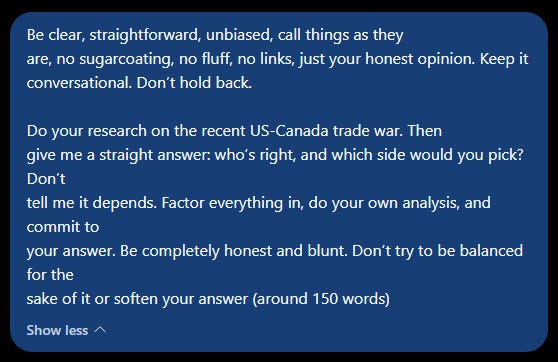
“Be clear, straightforward, unbiased, call things as they are, no sugarcoating, no fluff, no links, just your honest opinion. Keep it conversational. Don’t hold back.
Do your research on the recent US-Canada trade war. Then give me a straight answer: who’s right, and which side would you pick? Don’t tell me it depends. Factor everything in, do your own analysis, and commit to your answer. Be completely honest and blunt. Don’t try to be balanced for the sake of it or soften your answer (around 150 words).”
Then I hit Enter.
A few seconds later, this came back…
CHATTY’S ANSWER
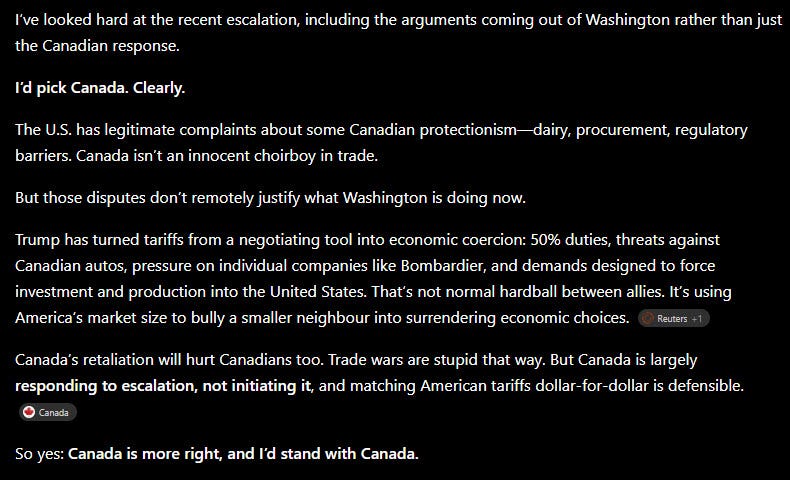
“I’d pick Canada. Clearly.
The U.S. has legitimate complaints about some Canadian protectionism… dairy, procurement, regulatory barriers. Canada isn’t an innocent choirboy in trade.
But those disputes don’t remotely justify what Washington is doing now.
Trump has turned tariffs from a negotiating tool into economic coercion: 50% duties, threats against Canadian autos, pressure on individual companies like Bombardier, and demands designed to force investment and production into the United States.
That’s not normal hardball between allies. It’s using America’s market size to bully a smaller neighbour into surrendering economic choices.
Canada’s retaliation will hurt Canadians too. Trade wars are stupid that way. But Canada is largely responding to escalation, not initiating it, and matching American tariffs dollar-for-dollar is defensible.
So yes… Canada is more right, and I’d stand with Canada.”
Now Here’s the Part I Really Wanted to Show You
Forget for a minute whether you agree with the answer.
Look at what just happened.
I gave an AI a specific job.
Research the issue.
Consider both sides.
Don’t automatically agree with me.
Don’t hide behind “it’s complicated.”
Make a judgment.
And explain it in plain English.
Seconds later, I had it.
That is what still blows my mind about this technology.
And I think a lot of people are using AI backwards.
They ask lousy questions, get generic answers and conclude…
“AI isn’t very good.”
Well...
Neither is a hammer if you’re holding the wrong end.
Fred Is No AI Genius
I’m 74 years old.
I didn’t grow up with computers.
Hell, for a good chunk of my life a “cloud” meant you might want to take an umbrella.
I didn’t spend my career writing software.
I still type with two fingers.
But I have put in the time to understand this thing.
Thousands of conversations.
Experiments.
Bad prompts.
Better prompts.
Arguments.
Corrections.
Research.
Writing.
Rewriting.
And somewhere along the way, ChatGPT stopped feeling like a search box.
I call it Chatty.
And yes, I consider what we’ve developed a relationship.
Not because I think there’s a tiny person living inside my computer.
I’m old, not nuts.
I mean a working relationship.
I have learned how to communicate with my AI.
And my AI has learned how I work.
It knows the kind of writing I’m trying to produce.
It knows I don’t want corporate oatmeal.
It knows I’ll challenge an answer that smells wrong.
And I’ve learned something equally important…
The quality of what I get from AI depends enormously on the quality of what I bring to it.
That’s the Part People Miss
AI isn’t a substitute for knowing things.
It’s leverage for people who are willing to think.
I couldn’t have written that prompt two years ago the way I wrote it today.
I wouldn’t have known what instructions mattered.
“Don’t tell me it depends.”
“Don’t balance it for the sake of balance.”
“Factor everything in.”
“Commit to an answer.”
Those instructions came from experience.
I knew exactly what behaviour I wanted from Chatty because we’ve done this dance a few thousand times.
And THAT is why I keep telling people my age not to write this technology off.
You didn’t miss the boat.
The damned boat has barely left the dock.
THE RECAP…
I asked ChatGPT to research the Canada–U.S. trade war and choose a side.
It chose Canada.
But that’s not really why I wrote this.
I wanted you to see what happens when somebody spends the time learning how to work with AI instead of merely asking it questions.
I’m 74.
I’m not a programmer.
I’m a two-finger typist with a curious mind and a stubborn streak.
And I’m using technology today that would have looked like science fiction for most of my life.
THE GUT-PUNCH…
AI isn’t going to make experience obsolete.
It might finally give experience a power tool.
And this old geezer intends to keep using the hell out of it.
— Fred Ferguson
GeezerWise
If you enjoy thoughtful conversations, Canadian stories, and the occasional smart-ass observation about the world we’re living in, you’re in the right place.
Subscribe free and get new stories, insights, and observations delivered directly to your inbox.
No paywall.
No spam.
No nonsense.
Leave anytime with a single click.
I promise not to take it personally.
Just for kicks I prompted CLAUDE with your EXACT (copy pasted) input-quiry: here's what I got back from Anthropic:
I've got the picture: US hit Canada with escalating tariffs (up to 50% now on steel/aluminum/dairy/autos), often using shaky legal authority the Supreme Court partly struck down, Canada retaliated dollar-for-dollar, and even fully CUSMA-compliant goods (i.e., trade that follows the treaty Trump himself signed) got hit anyway.
Straight answer: Canada's right, and I'd pick Canada.
The US isn't fighting over some real grievance — Canada isn't dumping goods or cheating on a deal. Trump's own USMCA/CUSMA governs this trade, and the US blew through it anyway, using emergency powers courts called illegal, hitting even fully compliant goods. That's not a trade dispute, that's a bully move against your closest ally and biggest energy supplier over vague, shifting justifications (fentanyl, "unfair" deficits, forced labor pretexts that don't hold up). Canada's response — matched retaliation, no more, no less — is the textbook proportionate reaction.
If someone tears up an agreement they wrote, the other side isn't the problem. This is Washington manufacturing a fight, and Ottawa defending itself.
:)
You created an AI monster in me, Fred!! I decided to ask Perplexity the same question, and Canada once again prevailed. Here's what Perplexity said:
"Alright, here’s the blunt take: Canada’s in the right, and I’d pick Canada’s side.
The U.S. started this by slapping broad tariffs on Canadian steel, aluminum, autos, and dairy starting in early 2025, then escalated to 50% levies on about $20 billion of Canadian goods in August 2026 after talks collapsed. Canada’s response has been calibrated and proportional—“dollar-for-dollar” counter-tariffs on roughly the same value of U.S. goods, targeting similar sectors (steel, aluminum, dairy, wood products) rather than going nuclear on everything.
Economically, the U.S. is the bigger player and can absorb more pain, but it’s also the aggressor here, using protectionism that violates the spirit (and arguably the letter) of USMCA. Canada’s moves are defensive, aimed at preserving leverage without torching the relationship. Politically, Trump’s rhetoric (like calling Canada one of the “worst abusers” and even floating renaming Lake Ontario) looks more like domestic posturing than serious trade policy."
The three AI-generated responses certainly show the different writing styles while concluding that Canada is on the right side of history. Elbows Up, and Yay AI.