

Politician doesn’t need statistics if he has a story.
That’s the lesson from a recent Pierre Poilievre exchange that deserves a closer look.
The story itself was simple…
Note: Poilievre’s words used to create drama/fear “LET THAT SINK IN”
The video quickly becomes an unsubstantiated list of grievances that he suggests requires the Poilievre’s Conservatives to fix it.
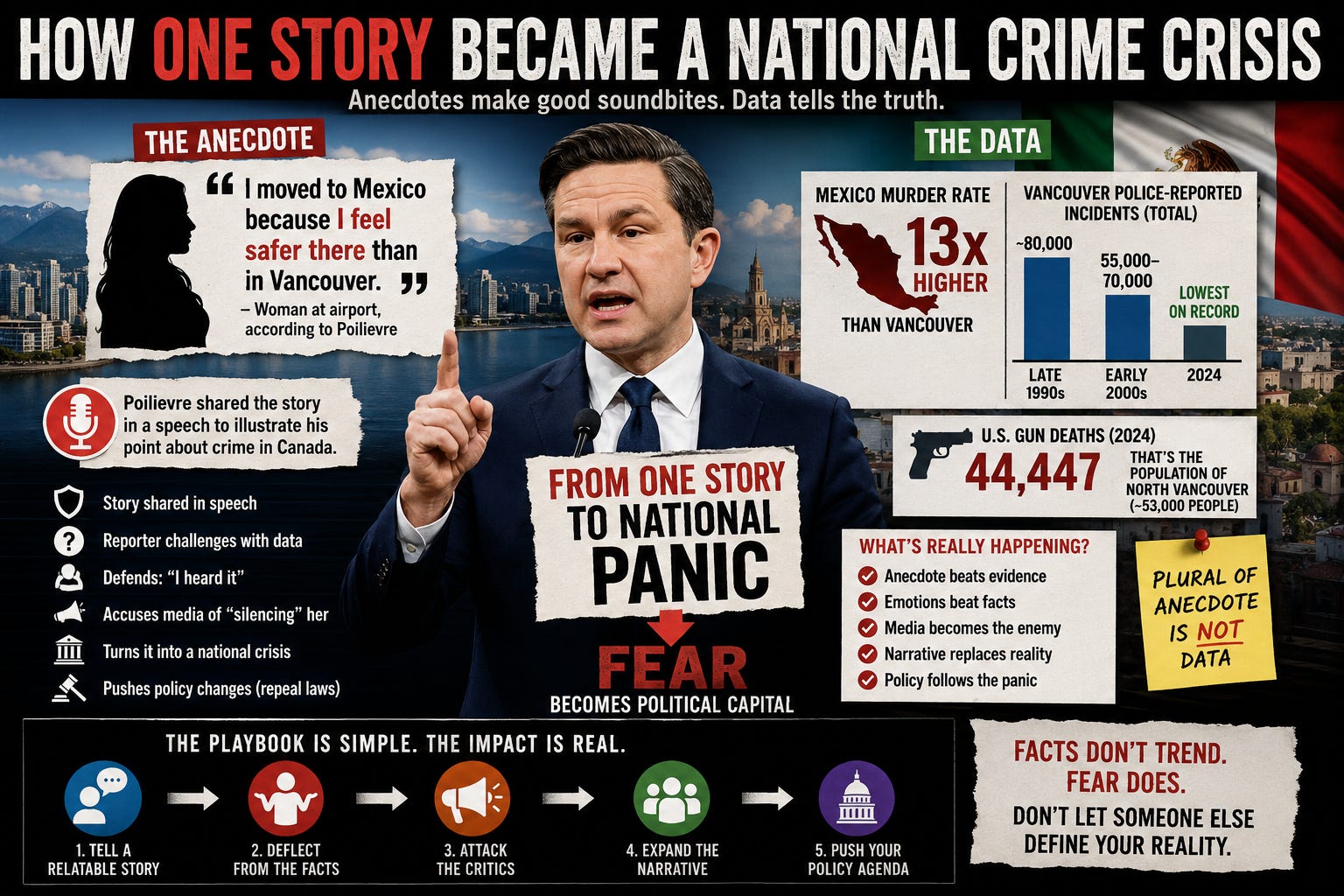
The story: A woman reportedly told him she had moved to Mexico because she felt safer there than she did in Vancouver.
That’s a powerful image.
It’s also where the trouble begins.
Because once you move beyond the emotional punch of the anecdote and start looking at actual crime data, the foundation starts to wobble.
Mexico’s homicide rate is roughly 13 times higher than Vancouver’s.
Vancouver’s police-reported crime numbers have been trending downward for years.
In fact, 2024 recorded the lowest level of police-reported incidents in the city’s history.
Compare that to the late 1990s, when Vancouver regularly saw around 80,000 incidents annually, and the difference is hard to ignore.
Yet the story wasn’t presented as one person’s opinion.
It quickly became evidence of something much bigger.
A single airport conversation was transformed into proof that Canada is facing a nationwide crime crisis.
And that’s where this stops being about one woman and starts becoming about political strategy.
The pattern is surprisingly simple.
Step one: tell a relatable story.
Step two: when challenged with facts, defend the story rather than the claim.
Step three: accuse critics of attacking ordinary people.
Step four: broaden the narrative into a larger political argument.
Step five: use that argument to justify policy changes.
By that point, the original story almost doesn’t matter anymore.
The emotional reaction has already done its job.
When reporters questioned the claim using publicly available crime statistics, the response wasn’t to provide evidence that Mexico is safer than Vancouver.
Instead, the conversation shifted.
The focus became whether the woman was being respected.
Then whether the media was trying to silence her.
Then whether critics cared about public safety.
The debate moved away from data and toward identity.
That’s a much easier battlefield to fight on.
Facts require proof.
Feelings only require repetition.
This is hardly unique to Canada.
We’ve watched versions of the same playbook unfold throughout American politics for years.
A single dramatic story becomes a symbol.
The symbol becomes a movement.
The movement becomes a policy argument.
Anyone questioning the facts is portrayed as being against the people represented by the story.
Meanwhile, the underlying numbers rarely receive equal attention.
Consider another statistic.
The United States recorded 44,447 gun deaths in 2024.
That’s roughly the population of an entire city the size of North Vancouver disappearing in a single year.
Yet many of the same political voices that portray Canadian cities as dangerously out of control often point south as a model for tougher crime policies.
That contradiction rarely gets discussed.
Because statistics don’t travel as fast as fear.
A chart doesn’t go viral.
A story does.
A spreadsheet doesn’t trigger emotion.
A frightened citizen does.
This isn’t an argument that crime doesn’t exist.
It does.
Every victim matters.
Every violent crime matters.
Every community deserves safety.
But if we’re going to build public policy around crime, we should probably start with crime data instead of airport conversations.
Otherwise, any politician can manufacture a crisis whenever it’s politically useful.
One anecdote becomes ten headlines.
Ten headlines become public anxiety.
Public anxiety becomes political capital.
And before long, people are debating a version of Canada that doesn’t actually exist.
That’s the real issue here.
Not whether one woman preferred Mexico.
Not whether one politician repeated what he heard.
The issue is whether Canadians still expect evidence before accepting sweeping claims about the country they live in.
Because once stories become more powerful than facts, the loudest voice usually wins.
Not the most accurate one.
The Recap…
A woman said she felt safer in Mexico than Vancouver.
That story became a political talking point.
The problem? The crime data points in the opposite direction.
When anecdotes replace evidence, fear becomes easier to sell than facts.
The Gut-Punch…
Anecdotes have value.
They help us understand people’s experiences.
But one person’s story is not a country’s reality.
The moment politicians start using isolated stories as substitutes for evidence, they’re no longer describing the world as it is.
They’re trying to convince you it looks different than it does.
And that’s a habit Canadians should be wary of… regardless of which party is doing it.
Source Credit:
Publicly available crime statistics, Vancouver Police Department reporting trends, homicide rate comparisons, and public statements made during media exchanges regarding crime, public safety, and political messaging.
If you enjoy thoughtful conversations, Canadian stories, and the occasional smart-ass observation about the world we’re living in, you’re in the right place.
Subscribe free and get new stories, insights, and observations delivered directly to your inbox.
No paywall.
No spam.
No nonsense.
Leave anytime with a single click.
I promise not to take it personally.
Sorry but the maple MAGA woman at the airport…really? PP is using her story as a legitimate reason to move to Mexico because she feels unsafe in Canada? Never have I ever heard such BS. Good luck to her in Mexico.
Just have to remember that Pp lies as he breathes.