

Most Canadians think countries fall apart with tanks, riots, or dramatic speeches.
Usually?
It starts with paperwork.
Quiet rule changes.
Small political groups.
And leaders too nervous to upset the people who helped put them in power.
That’s why the Alberta separation story suddenly feels different.
Not because Alberta is packing its bags tomorrow.
But because what used to sound like angry political theatre is starting to look a little more organized.
And a little more dangerous.
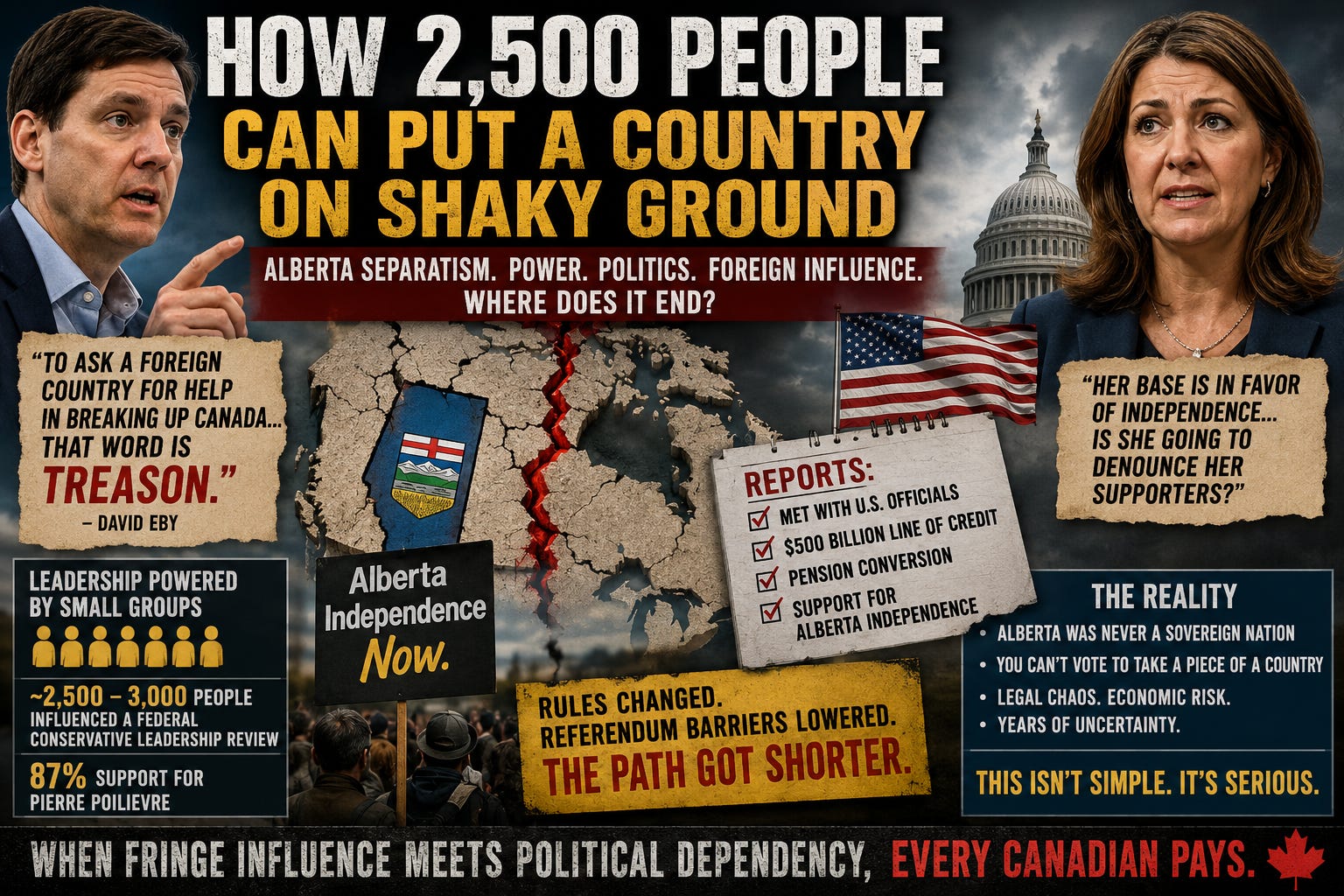
The temperature jumped this week when BC Premier David Eby used a word most politicians avoid like week-old sushi…
Treason.
Eby was reacting to reports that Alberta separatist figures had discussions with American officials about what Alberta independence could look like.
Not just vague coffee-shop fantasies.
Talks reportedly included ideas around outside financial backing, pension restructuring, and even a proposed $500 billion line of credit if Alberta ever tried to split from Canada.
That’s where the whole thing crossed into different territory.
Because disagreeing with Ottawa?
Perfectly fair.
Wanting more provincial power?
Also fair.
Even talking about separation?
In a democracy, people are allowed to argue for big ideas.
But asking another country for help breaking up your own country?
That hits differently.
Eby basically said what a lot of Canadians were already thinking: where exactly is the line?
And here’s where things get awkward.
Alberta Premier Danielle Smith still won’t clearly condemn the separatist movement orbiting around her government.
Why?
Politics.
Simple as that.
Some separatist organizers openly claim they helped bring Smith to power after Jason Kenney stepped down. One of the loudest voices, Jeff Rath, has publicly suggested that independence supporters played a role in her leadership win.
Whether people like hearing that or not, it matters.
Because if part of your political base wants separation, condemning them outright becomes politically expensive.
So instead, you get hesitation.
Careful wording.
A lot of dancing around the issue.
Meanwhile, Alberta changed referendum rules… twice… making it easier to trigger province-wide votes.
That matters more than people realize.
Because movements don’t suddenly explode.
They build infrastructure first.
Rules.
Processes.
Petitions.
Political leverage.
The frustrating part?
Most Canadians still think major political decisions are shaped by millions of people.
Sometimes they are.
Sometimes they’re shaped by a tiny, highly motivated crowd.
Here’s the uncomfortable truth nobody likes talking about…
Canadian leadership systems can be influenced by very small groups of people.
In one recent federal Conservative leadership review, roughly 2,500 to 3,000 members had outsized influence over a national political direction.
Think about that for a second.
A few thousand highly motivated people can end up steering conversations that affect 40 million Canadians.
That doesn’t mean democracy is broken.
But it does mean motivated minorities can punch way above their weight.
And that’s exactly how fringe ideas sometimes move into the mainstream.
Not through massive public support.
Through organization.
Through loyalty.
Through controlling who gets into the room.
Meanwhile, the legal side of Alberta separation remains wildly misunderstood.
There’s this fantasy floating around that Alberta could simply vote one afternoon and walk away with oil fields, pensions, federal assets, and a neat goodbye card.
That’s not how countries work.
You can’t just cut a chunk out of a federation and call dibs.
Alberta wasn’t an independent nation before joining Canada.
It’s a province inside a constitutional framework.
Any attempt to leave would trigger legal chaos, negotiations, court fights, Indigenous treaty questions, economic uncertainty, and likely years of political trench warfare.
And yes… investors would notice.
Fast.
Markets hate uncertainty more than politicians hate direct answers.
The irony here is rich.
The same people yelling about democracy are often operating inside systems where tiny internal party groups hold enormous influence.
That should concern everyone.
Left.
Right.
West.
East.
Because this story isn’t really about Alberta.
It’s about incentives.
If political systems reward the loudest, angriest, or most organized fringe groups…
guess who keeps gaining power?
The people willing to push hardest.
That doesn’t mean Alberta separatism wins.
Personally, I still think most Albertans want a stronger Alberta inside Canada, not outside it.
But pretending this is nothing?
That feels naïve.
Especially when national leaders seem oddly allergic to saying anything clearly.
If there are allegations of foreign involvement in conversations about breaking up the country, Canadians deserve transparency.
Not awkward silence.
Not political tap dancing.
Clear answers.
Because once people stop trusting the system…
they stop trusting each other.
And countries don’t usually break all at once.
They fray.
Quietly.
At the edges.
Until one day everyone looks around wondering when the stitching started coming loose.
The Recap…
Alberta separation talk just got more serious.
BC Premier David Eby called seeking foreign help to break up Canada “treason” — while Danielle Smith still refuses to clearly condemn separatists tied to her political base.
The bigger story?
A few thousand highly motivated party members can shape leadership, policy, and national direction.
This may be less about Alberta leaving…
and more about how fragile political systems become when fringe leverage starts paying dividends.
The Gut-Punch…
Countries rarely fall apart because everybody suddenly agrees.
They weaken when enough people stop believing anyone’s steering the damn bus.
Source credit:
Public reporting, political commentary, leadership vote data, constitutional analysis, and statements from Canadian political figures regarding Alberta separatism and referendum changes.
🔎 The GeezerWise Standard
This space is built on disciplined thinking.
Facts over spin.
Verification before amplification.
Good-faith discussion over tribal noise.
I use AI tools to help shape my spoken drafts into clear writing.
The judgment, conclusions, and final message are mine.
If you’re new here, this explains how I decide what’s worth sharing:
How I Decide What’s Worth Sharing → [link]
💌 Subscribe at GeezerWise.com to receive future letters:
www.geezerwise.com/subscribe
— Fred Ferguson
GeezerWise
#CanadaStrong
The road from Pierre Laporte School. Those terrorists did not succeed in Separation, and some people feel they had good reasons to Separate. When I think of Alberta separating, there are no good reasons I know of. It seems to be motivated by unending GREED. I am horrified by the avarice of the entitled in our world. It is not Canadian to be driven by unending megalomaniac wealth and monumental greed, while the rest of Canada, The World can be left with penury.
Based on what you're saying, it sounds as though a vocal majority screaming like hell against the minimal separatist forces is what should be happening next.
And Smith needs to grow a pair and stand up for a united Canada instead of kissing up to the drooling unibrow Maple MAGA horde.