

For years, Canada has been treated like the polite neighbour at the global barbecue.
Nice to have around. Not particularly important.
The Americans had the military. China had the factories. Europe had the market.
Canada had... manners.
Turns out that may have been a better long-term strategy than anyone realized.
We’re living through a period where the old rules are wobbling. Trade relationships are shifting. Alliances are being questioned. Countries that once looked stable now look unpredictable.
And when uncertainty rises, trust becomes valuable.
Very valuable.
For decades, Canada built a reputation that many Canadians barely noticed.
We became known as reliable. Cooperative. Predictable. A country that generally keeps its word and works with others instead of trying to push them around.
That reputation wasn’t built overnight.
It came from decades of diplomacy, multiculturalism, peacekeeping traditions, international cooperation, and a political culture that usually favoured negotiation over confrontation.
Nobody paid much attention when times were good.
Now they are.
The world is discovering that trust is not a personality trait.
It’s an asset.
And Canada has been quietly accumulating it for generations.
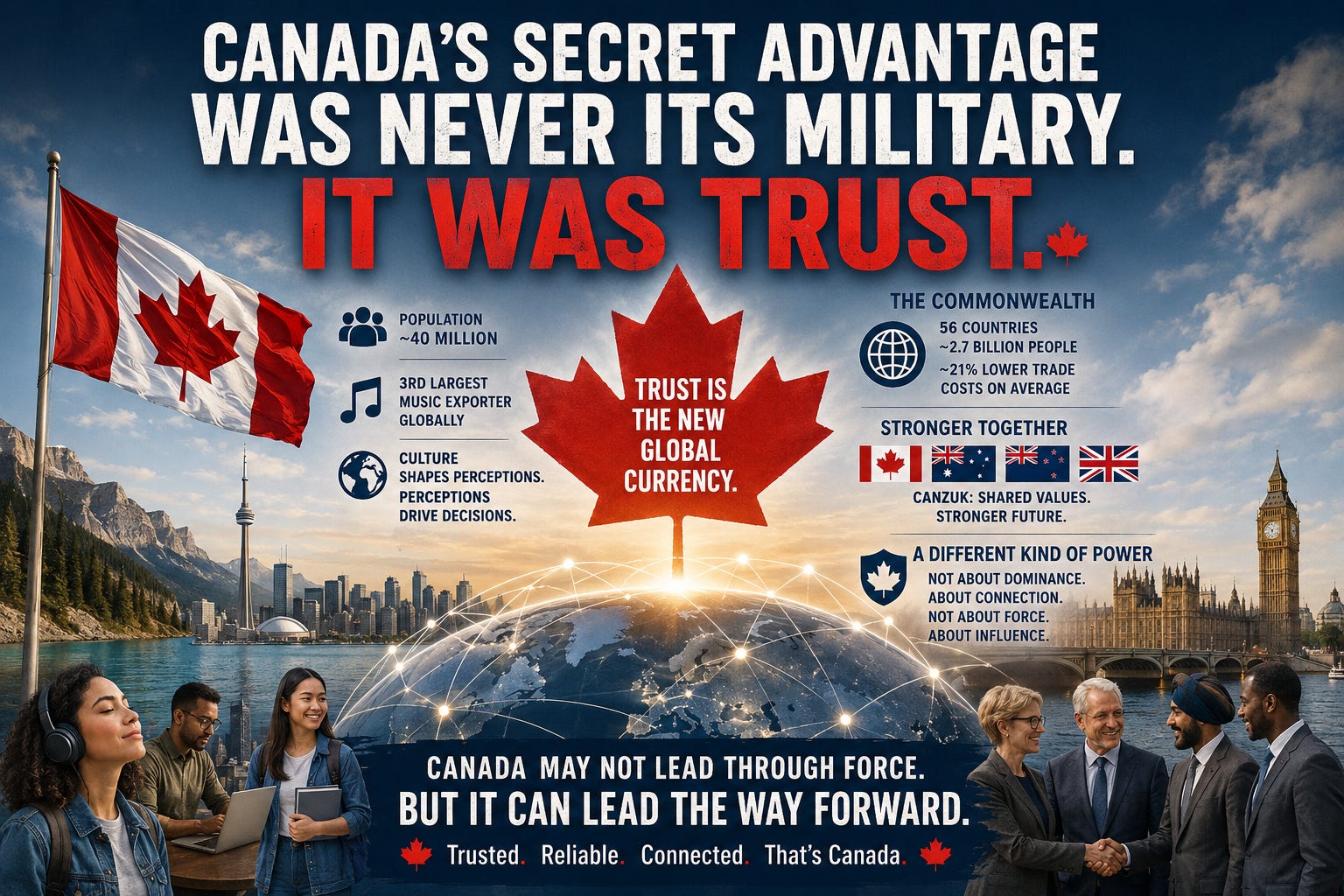
While our population sits around 40 million people compared to roughly 300 million in the United States, our influence often travels much farther than our size suggests.
Take culture.
Canada has become one of the world’s most successful cultural exporters.
In music alone, Canada ranks among the top global exporters despite having a fraction of the population of many competitors.
That matters more than people think.
Culture shapes perception.
People listen to Canadian artists. Watch Canadian performers. Consume Canadian content. Over time, that familiarity creates comfort. Comfort creates trust.
Trust influences decisions about where people study, invest, travel, work, and do business.
Influence doesn’t always arrive wearing a uniform.
Sometimes it arrives wearing headphones.
At the same time, Canada sits inside networks that many people have forgotten about.
The Commonwealth is one example.
Fifty-six countries. Roughly 2.7 billion people.
For years, many observers dismissed it as a ceremonial club left over from another era.
Today it looks a lot more interesting.
Research consistently shows that trade between Commonwealth nations benefits from shared legal systems, common language frameworks, and familiar business practices.
On average, trade costs are estimated to be about 21 percent lower than between comparable non-Commonwealth partners.
That’s not symbolism.
That’s money.
In a world where countries are scrambling to diversify supply chains and reduce dependence on any single market, existing trusted networks suddenly become strategic assets.
The same thing is happening with Canada’s relationships in Europe.
And with growing discussions around CANZUK cooperation involving Canada, Australia, New Zealand, and the United Kingdom.
A few years ago those conversations sounded theoretical.
Today they sound practical.
Countries are looking for dependable partners.
Canada keeps appearing on the shortlist.
What makes this moment different is that Canada seems increasingly willing to use those relationships strategically rather than simply maintaining them.
Prime Minister Mark Carney has repeatedly argued that middle powers need to become more active participants in shaping the global system instead of waiting for larger countries to make all the decisions.
That idea is gaining traction.
Not because Canada is trying to become a superpower.
But because the world may need more coordinators and fewer bosses.
The old model rewarded countries that could dominate.
The emerging model may reward countries that can connect.
That’s a very different game.
Canada is unlikely to lead through military force.
We are unlikely to outspend the major powers.
But we may be uniquely positioned to help bring countries together, build coalitions, facilitate trade, and strengthen institutions that are under increasing strain.
In other words, Canada may matter not because it controls the system.
But because it helps keep the system functioning.
For a country that has spent decades being underestimated, that’s not a bad place to be.
Especially when trust is becoming one of the world’s most valuable currencies.
The Recap…
For decades, Canada was viewed as the polite middle power.
Now that global trust is becoming scarce, that reputation is turning into an asset.
The world doesn’t just need bigger players.
It needs reliable ones.
And Canada may be better positioned than most people realize.
The Gut-Punch…
The biggest countries can force people to listen.
The most trusted countries make people want to.
As the old global order gets shakier, that difference could become Canada’s greatest competitive advantage.
Source credit:
Research compiled from Commonwealth trade studies, Canadian cultural export data, NATO/G7/Commonwealth participation records, public discussions surrounding CANZUK cooperation, and recent commentary on the growing role of middle powers in a more fragmented global economy.
🔎 The GeezerWise Standard
This space is built on disciplined thinking.
Facts over spin.
Verification before amplification.
Good-faith discussion over tribal noise.
I use AI tools to help shape my spoken drafts into clear writing.
The judgment, conclusions, and final message are mine.
If you’re new here, this explains how I decide what’s worth sharing:
How I Decide What’s Worth Sharing → [link]
💌 Subscribe at GeezerWise.com to receive future letters:
www.geezerwise.com/subscribe
— Fred Ferguson
GeezerWise
#CanadaStrong
If Gordon Lightfoot was alive he could write a song about the sinking of America.
Great post Fred! Yes, manners mean a lot in this world & especially during this time in history. I have always been the one standing next to someone being bullied, for instance, & if necessary, I definitely speak up. When we have a bully, constantly hammering at our country, I really would love to walk into that house & shut him down, politely at first, but if necessary, one can shove their own words back down their throat! Open sesame, say ahhhhhhhhhhhhh (awww) LOL Ya, but, we are normally the most polite & mannerly people on the planet. We never have to stoop to the level of depravity being slung in our direction. Canada Strong!