

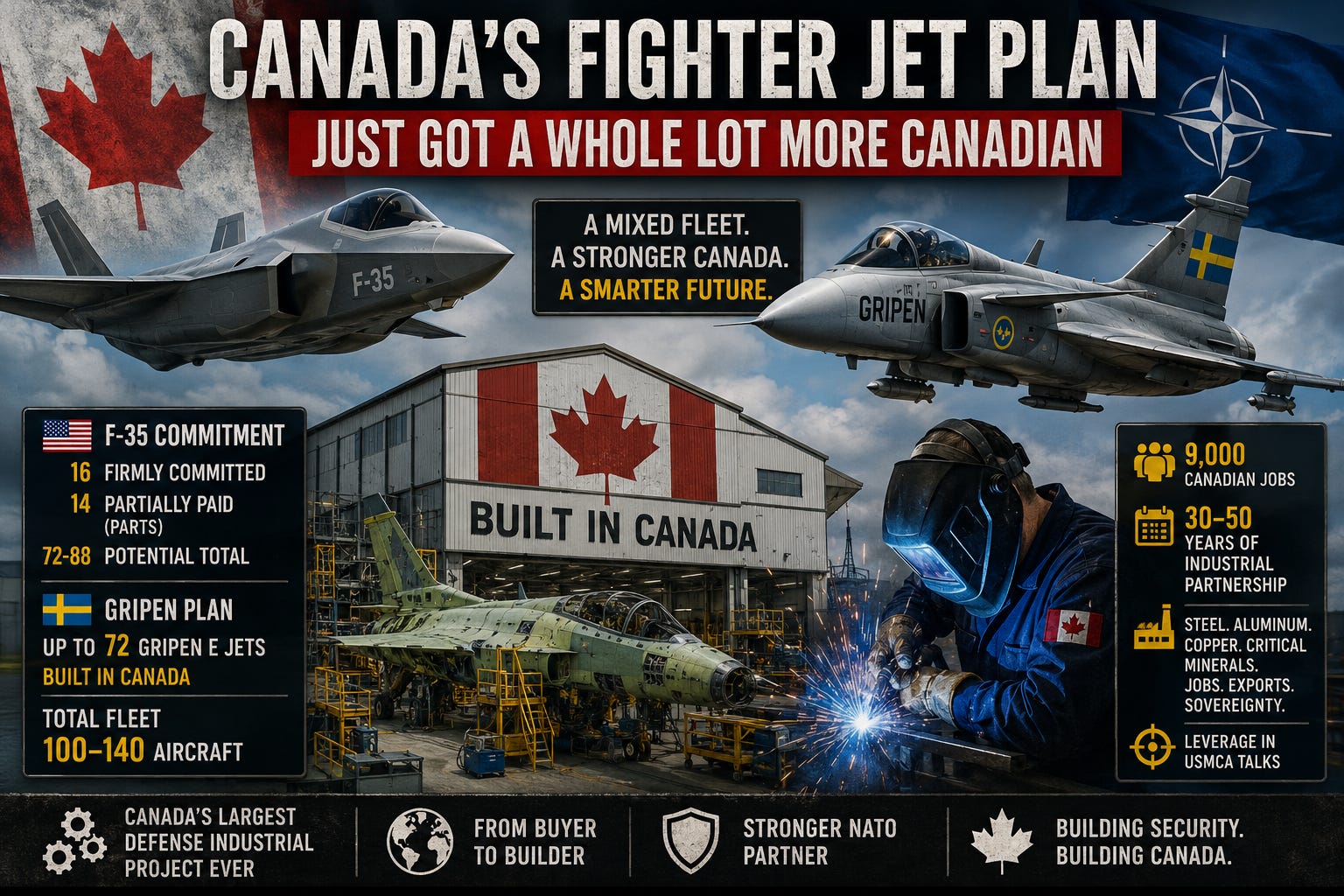
And for the first time in a long while, Ottawa appears to be asking a different question…
What if defense spending actually helped build Canada too?
For decades, Canada’s military shopping list worked a bit like this…
Need something big?
Call America.
Write cheque.
Hope for offsets.
Move on.
That may be changing.
Quietly… but in a very big way.
Canada originally planned to buy 88 American-made F-35 fighter jets. That was supposed to be the plan. Done deal. Box checked.
Except now, the box may be getting rewritten.
Instead of putting all our eggs in one American basket, Canada appears to be moving toward something far more strategic… a mixed fighter fleet that combines U.S.-built F-35s with Swedish-made Gripen E fighter jets.
And if the reports are accurate, this is not a small adjustment.
We could be looking at a total fighter fleet of more than 100 aircraft… potentially pushing toward 140.
That is a major rethink of Canadian defense.
More importantly?
It may also be a major rethink of how Canada spends its money.
Because this isn’t just about airplanes.
It’s about jobs.
Industry.
Leverage.
And sovereignty.
Here’s the part people are missing.
The Gripen proposal is not simply “buy Swedish jets.”
The bigger play is manufacturing.
The idea being discussed would see Gripen aircraft built in Canada… not just for Canada, but potentially for other NATO countries as well.
That changes the entire equation.
Instead of sending billions south and waving goodbye, Canada could end up building a long-term aerospace industry right here at home.
Steel.
Aluminum.
Copper.
Critical minerals.
Manufacturing.
Engineering.
Supply chains.
Thousands of jobs.
Some estimates suggest as many as 9,000 Canadian jobs tied to the program if it moves ahead at scale.
Not temporary jobs.
The kind of work that can last decades.
Thirty.
Forty.
Maybe fifty years.
That is not a procurement decision.
That is industrial policy wearing combat boots.
And timing matters here.
Because Canada’s relationship with the United States has become… complicated.
Tariffs.
Trade fights.
Diplomatic tension.
The growing realization that depending too heavily on one partner… even a close ally… carries risk.
Especially when politics south of the border can shift faster than prairie weather.
So Ottawa appears to be doing something Canadians have been asking for in other sectors…
Diversify.
Don’t stop working with America.
Just stop depending entirely on America.
And here is where things get politically interesting.
The fighter jet file may now be doing double duty.
Military decision?
Yes.
Trade leverage?
Also yes.
Canada is entering a major renegotiation period around CUSMA.
If Ottawa reduces its full F-35 commitment, Washington notices.
Fast.
Suddenly, fighter jets stop being just defense purchases.
They become bargaining chips.
That doesn’t mean Canada walks away from the F-35 entirely.
Far from it.
The likely outcome looks more practical than dramatic.
Canada already appears firmly committed to at least 16 F-35s, with another 14 partly locked in through purchased components.
The question now is scale.
Does Canada still go all-in?
Or does it build a smarter, more flexible fleet?
Stealth where stealth matters.
Gripens where cost, maintenance, domestic production, and sovereignty matter.
Because unlike many military purchases of the past, this one comes with something Canadians increasingly want to hear:
Build it here.
And this is bigger than jets.
Canada recently committed to six GlobalEye surveillance aircraft… systems built on Bombardier jets.
That matters.
It means Canada isn’t just buying equipment anymore.
We may finally be positioning ourselves inside the defense supply chain.
Builder.
Partner.
Exporter.
Not just customer.
That shift matters in a changing world.
Because whether we like it or not, the global mood has changed.
Countries are rearming.
Alliances are shifting.
Europe is moving faster.
NATO is evolving.
And Canada is slowly realizing that national security without industrial strength is a risky bet.
Especially when the world starts feeling less predictable.
Of course, none of this comes cheap.
Canada is already talking about boosting defense spending dramatically over the next decade… potentially climbing from the long-debated 2% NATO target toward 4% of GDP.
That number will make some taxpayers nervous.
Fair enough.
But there is a very different conversation when the money stays in Canada, supports Canadian jobs, and helps build long-term industries instead of simply cutting cheques abroad.
That’s the fork in the road here.
Old Canada bought.
New Canada might build.
And if this mixed-fleet strategy becomes reality, it may go down as one of the biggest defense pivots this country has made in decades.
Not because we bought fighter jets.
Because we finally asked…
Why not build something bigger while we’re at it?
The Recap…
Canada may be rethinking its fighter jet plan in a big way.
Less “buy everything from the U.S.”
More “build something here too.”
A mixed fleet of F-35s and Swedish Gripens could mean thousands of Canadian jobs, domestic manufacturing, and a very different relationship with NATO… and Washington.
This isn’t just about jets anymore.
The Gut-Punch…
For years, Canada acted like defense spending was money you mailed somewhere else.
Buy it. Sign it. Forget it.
Maybe the smarter question was never “What should we buy?”
Maybe it was:
“What should Canada become?”
Source credit:
This article was written using publicly discussed reporting, defense procurement timelines, and research notes. Analysis and opinions are my own. As always, I report the news… I don’t make it.
🔎 The GeezerWise Standard
This space is built on disciplined thinking.
Facts over spin.
Verification before amplification.
Good-faith discussion over tribal noise.
I use AI tools to help shape my spoken drafts into clear writing.
The judgment, conclusions, and final message are mine.
If you’re new here, this explains how I decide what’s worth sharing:
How I Decide What’s Worth Sharing → [link]
💌 Subscribe at GeezerWise.com to receive future letters:
www.geezerwise.com/subscribe
— Fred Ferguson
GeezerWise
#CanadaStrong
This is Canada doing what is best for *Canada*, not just the noisy neighbor downstairs
YES, that is the question. "What should Canada become?"
I remember 50-some years ago, saying to a group of friends at work, that Canada exports the raw materials and imports the finished product, and that is why we cannot get anywhere. If only I was in charge then, Ha Ha.