

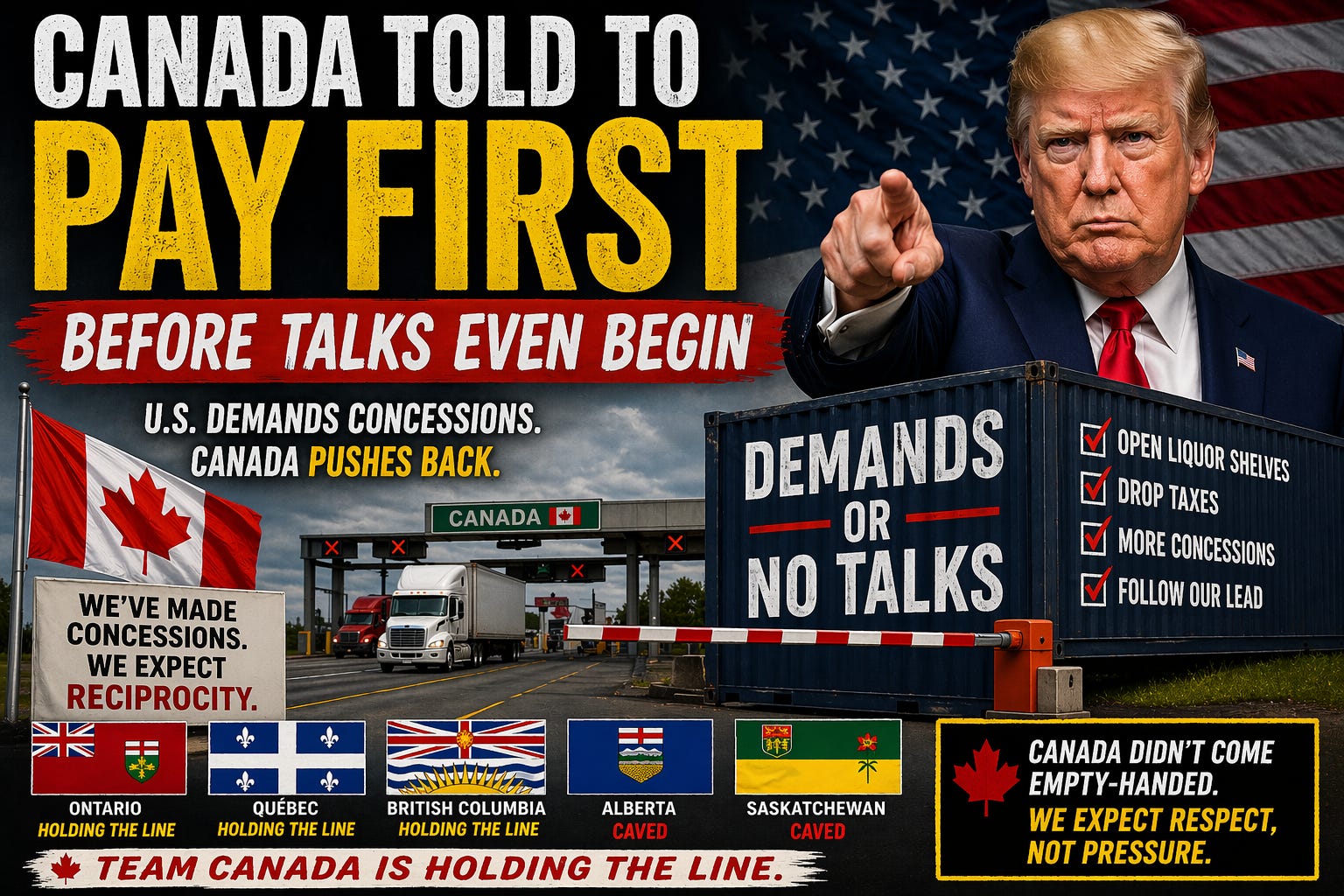
Before anyone even sits down at the table, the price tag is already on it.
That’s where things stand heading into the next round of Canada–U.S. trade talks.
According to multiple reports, Washington is demanding concessions from Canada before formal negotiations begin.
Not during. Not after. Before.
Call it what it is… a pre-negotiation toll booth.
One of the sticking points? Alcohol.
The U.S. wants Canadian provinces to put American wine, beer, and spirits back on store shelves.
Right now, most provinces aren’t playing along.
Only Alberta and Saskatchewan have eased off. The rest… especially Ontario, Quebec, and British Columbia… are holding the line.
That matters. Those three provinces represent the bulk of the market. And they’re not blinking.
So what’s happening here is simple… Washington sees a crack in Canada’s provincial unity and is trying to wedge it open.
Get a few provinces to cave, then pressure the rest to follow.
Classic divide-and-push.
Meanwhile, Canada’s position is just as clear… we’ve already given ground.
Ottawa has pointed to several concessions already made…
Dropping the digital services tax on U.S. tech companies
Rolling back retaliatory tariffs on compliant imports
Investing in border security changes
In other words… Canada didn’t show up empty-handed.
So when the U.S. asks for more before talks even start, the response from Canada’s lead negotiator has been blunt… there needs to be reciprocity.
Not pressure. Not posturing. Reciprocity.
And here’s where the tone of this whole thing shifts.
This isn’t just about trade anymore. There are signals coming out of Washington suggesting broader pressure tactics…
Talk of punishing allies who didn’t fall in line on recent geopolitical conflicts.
Whether Canada ends up on that list or not, the message is the same… loyalty is being measured, and leverage is being used.
That’s not partnership. That’s power politics.
Back home, Ottawa is preparing accordingly.
A chief negotiator has been appointed. An advisory panel has been assembled… pulling in voices from across industries and even across party lines.
Former political rivals are now sitting on the same team.
That’s not an accident.
It’s a signal… Canada is treating this as a national file, not a partisan one.
And while that’s happening, the domestic political noise hasn’t gone anywhere.
There’s still talk about “increasing leverage” against the U.S. a phrase that sounds good in a speech but gets a lot fuzzier when you try to define it.
Because here’s the uncomfortable truth…
You don’t “out-leverage” a partner who’s willing to ignore the rules when it suits them.
You manage risk.
You protect your position.
And you prepare for things to go sideways.
Which, frankly, is on the table.
There are formal exit rules in trade agreements. Timelines. Processes. Legal frameworks.
But those only matter if both sides respect them.
If one side decides to bypass the process… pull out abruptly, impose tariffs, and deal with the fallout later… then you’re not negotiating inside a system anymore.
You’re reacting to decisions made in real time.
That’s the wild card here.
Still, there’s a counterweight.
The U.S. depends heavily on trade with Canada too. Entire states rely on it. Supply chains are deeply integrated. Walking away clean isn’t as easy as a headline might suggest.
So where does that leave things?
Somewhere between structured negotiation… and controlled chaos.
Expect firm demands.
Expect public pressure campaigns.
Expect headlines designed to shape opinion before deals are even discussed.
And behind closed doors?
That’s where the real negotiation will happen.
The Recap…
The U.S. wants concessions before talks even start.
Canada’s already made some—and isn’t eager to give more for free.
This isn’t just negotiation… it’s pressure.
And the real story? It’s happening behind the headlines.
The Gut-Punch…
If you have to pay just to sit at the table… you’re not negotiating—you’re being tested.
Source Credit:
Transcript analysis based on reporting and commentary
🔎 The GeezerWise Standard
This space is built on disciplined thinking.
Facts over spin.
Verification before amplification.
Good-faith discussion over tribal noise.
I use AI tools to help shape my spoken drafts into clear writing.
The judgment, conclusions, and final message are mine.
If you’re new here, this explains how I decide what’s worth sharing:
How I Decide What’s Worth Sharing → [link]
💌 Subscribe at GeezerWise.com to receive future letters:
www.geezerwise.com/subscribe
— Fred Ferguson
GeezerWise
#CanadaStrong
So Turdump wants Canadas money upfront, somebody please roll their hand up over their chin to that disgusting orange ball. He starts a peace group that conned $2billion dollars out of each attendee & nothing has been heard about it since! Now Canada is supposed to fall for that crappola as well? Personally, I think he is looking for excuses to start some more wars to kill off more innocent people. I hope Carney won't tow the line, he is smarter than that.
I recall a time before NAFTA - it was good, no complaint from me.
I also recall how when it was being set up that it was sold as something each of us would benefit from, basically a load of bullshit. Such as, we could purchase vehicles on the cheap in the US and just drive them home, all duty free. That, and more asinine bs.