

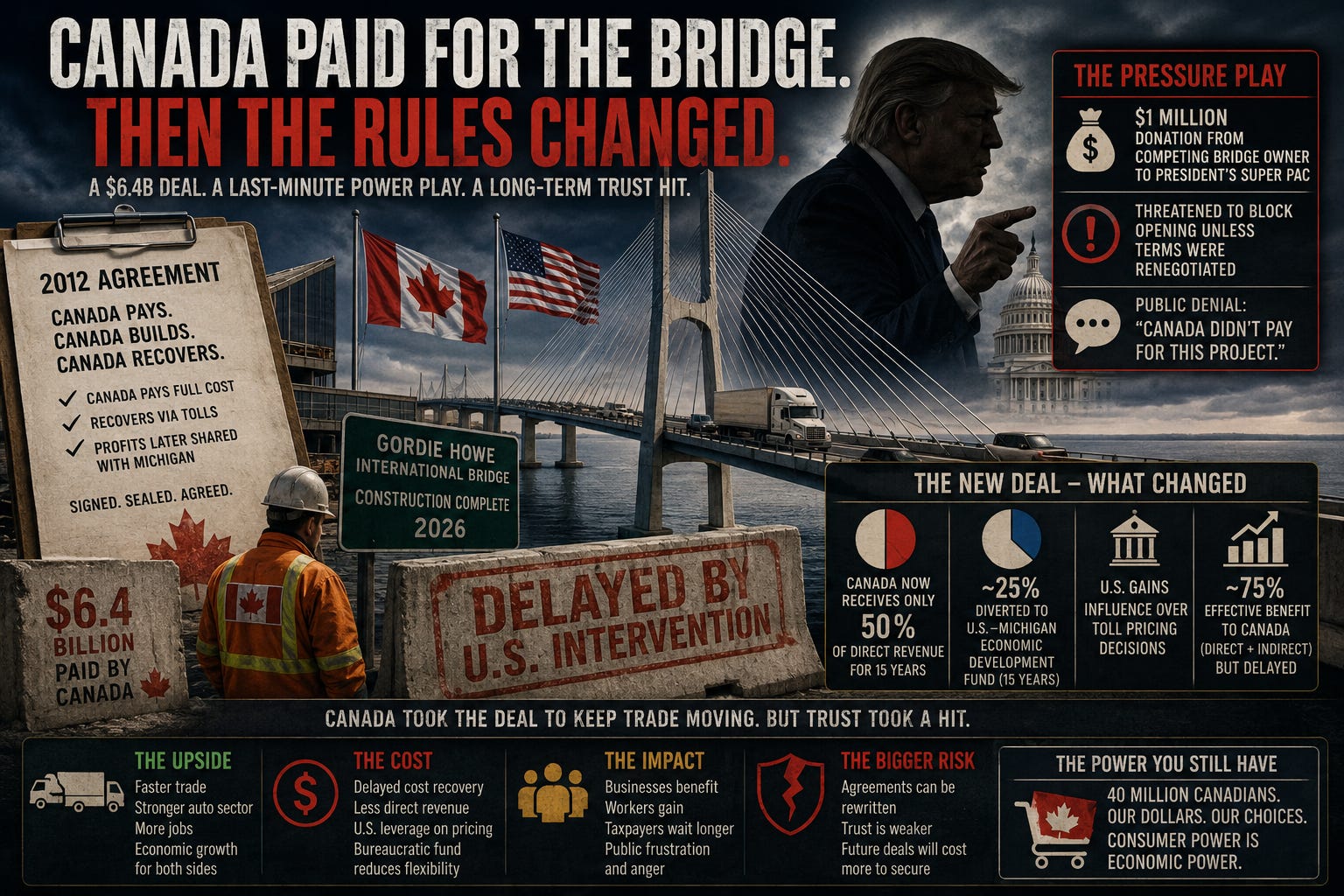
For fourteen years, this looked like one of those rare infrastructure projects that actually made sense.
Canada would build a new crossing between Ontario and Michigan. Canada would pay the bill. Canada would recover its costs through toll revenue. Once the investment was repaid, the benefits would eventually spread more broadly.
Simple.
The agreement was signed back in 2012.
Then reality showed up.
After Canada spent roughly $6.4 billion building the Gordie Howe International Bridge, and after construction was essentially complete,
the terms suddenly became negotiable again.
Not because Canada failed to meet its obligations.
Not because the bridge wasn’t finished.
Not because the original agreement was unclear.
Because one side discovered it had leverage.
And decided to use it.
For years, Canada carried the financial risk.
The bridge was built largely to improve one of the most important trade corridors in North America.
Every day, billions of dollars in goods move between Ontario and Michigan.
Auto manufacturing, agriculture, industrial components, and countless supply chains depend on that connection.
The economic argument was always strong.
A faster crossing means fewer delays.
Fewer delays mean lower costs.
Lower costs mean more competitive businesses on both sides of the border.
Everybody wins.
That was the theory.
Then, shortly before the bridge was set to open, political pressure emerged from the American side.
A competing bridge owner had reportedly donated $1 million to a presidential political organization only weeks before the dispute erupted.
Soon afterward, objections surfaced, approvals stalled, and the original arrangement suddenly became subject to renegotiation.
Coincidence?
People can decide that for themselves.
What matters is what happened next.
Canada had a choice.
Stand on principle and risk a prolonged fight that could delay opening one of the continent’s most important trade links.
Or accept a revised deal and get the bridge operating.
Ottawa chose the second option.
From a business perspective, the decision is understandable.
Every month of delay costs money.
Businesses need certainty.
Workers need the jobs.
Manufacturers need parts crossing the border.
The economy doesn’t care about political theatre.
It cares about whether trucks move.
So Canada swallowed hard and signed.
The revised arrangement changes the economics.
Instead of retaining full revenue control during the early years, Canada now receives only part of the direct revenue stream.
A new economic development fund will operate for fifteen years, diverting a significant portion of bridge revenue into jointly managed projects.
Some benefits will eventually flow back through economic activity.
Some won’t.
The result is that Canadian taxpayers will wait longer to recover their investment.
Meanwhile, the United States gains a greater role in decisions affecting future toll pricing.
That may sound like a technical detail.
It isn’t.
Control over pricing is control over revenue.
Control over revenue is influence.
Influence is power.
And power is usually what these fights are really about.
The bridge itself remains a major win.
That’s important to remember.
The crossing will improve trade efficiency.
Manufacturers will benefit.
Supply chains will move faster.
Workers on both sides of the border will see opportunities created by increased economic activity.
The bridge wasn’t a mistake.
Building it was probably the right call.
The problem isn’t the bridge.
The problem is the precedent.
For generations, Canada and the United States operated under a basic assumption.
You negotiate.
You sign.
You honour the deal.
You may not love every clause, but once the ink dries, the agreement means something.
That assumption looks a little shakier today.
If a project can be renegotiated after one side has already spent $6.4 billion and completed construction, future negotiators will notice.
Investors will notice.
Governments will notice.
Lawyers certainly will.
Trust is an economic asset.
Once it starts depreciating, rebuilding it is expensive.
This story isn’t really about concrete, steel, or toll booths.
It’s about reliability.
Canada took the practical route. It chose economic stability over a prolonged confrontation.
You can make a strong argument that it was the correct decision.
But Canadians are also justified in asking an uncomfortable question:
If a signed agreement can be rewritten at the finish line, what confidence should anyone have in the next one?
Because the biggest cost here may not be the lost revenue.
It may be the growing realization that future negotiations with our largest trading partner now require something extra.
Not better lawyers.
Not more studies.
Not thicker contracts.
A contingency plan for what happens when the rules change after the game has already started.
The Recap…
Canada spent $6.4 billion building the Gordie Howe Bridge.
Just before opening, the original revenue arrangement was reopened and renegotiated under pressure.
The bridge will still boost trade and jobs. But the bigger story may be what it says about trust, agreements, and doing business with a partner increasingly willing to revisit signed deals after the fact.
The Gut-Punch…
The bridge will carry trucks, cars, and billions in trade.
But the thing that didn’t make it across the river intact was trust.
And once trust becomes negotiable, every future deal gets more expensive.
Source credit:
Based on publicly reported information regarding the Gordie Howe International Bridge agreement, subsequent renegotiations, bridge revenue arrangements, political developments surrounding project approvals, and Canada–U.S. trade relations in July 2026.
If you enjoy thoughtful conversations, Canadian stories, and the occasional smart-ass observation about the world we’re living in, you’re in the right place.
Subscribe free and get new stories, insights, and observations delivered directly to your inbox.
No paywall.
No spam.
No nonsense.
Leave anytime with a single click.
I promise not to take it personally.
I think our PM should sell $7B of US debt to recoup our costs. That'll work.
Some of this is still vague -- I don't think we've heard all the details yet (or maybe I'm just hoping we haven't). The "50% split" happens "after costs to operate". Now, in government-speak, that usually means the routine daily type of things -- snowploughing, pothole fixing, painting, insurance, blah, blah, blah. But there COULD be a clause in here that's akin to "loan payment" or some such, that does give Canada a significant portion towards the capital cost, before they do the 50/50 bit on "whatever is left over."
And I'm seeing contradictions as to who controls that "economic development fund".
Put to your main contention: YES, even if this is a mafia-style shakedown, we do need the bridge open for all of the trade matters you point out.
And I agree with your basic question: What happens when ones "deal" gets renegotiated (at gunpoint, of sorts) by the other side?
My answer: This gets noted. And Canadians have long memories (well, most of the time). So if there ever is some other joint capital project, then we will be VERY wary about doing some similar arrangement. Or better yet, have something in our back pocket for "leverage" that would prevent this (if we had a monopoly on avocados, we would have the Americans grovelling at our feet! Hmm, once our herds are bigger, maybe we can dangle beef at them . . . .)