

For years, Canada’s energy debate has sounded like a broken record.
One side shouted, “Build the pipeline.”
The other side shouted, “Cut the emissions.”
Both sides acted as though those goals were mutually exclusive.
Now Ottawa, Alberta, and some of the country’s biggest oil producers appear to be testing a different idea…
What if you had to do both?
That is the significance of the latest Pathways agreement.
The deal is remarkably simple.
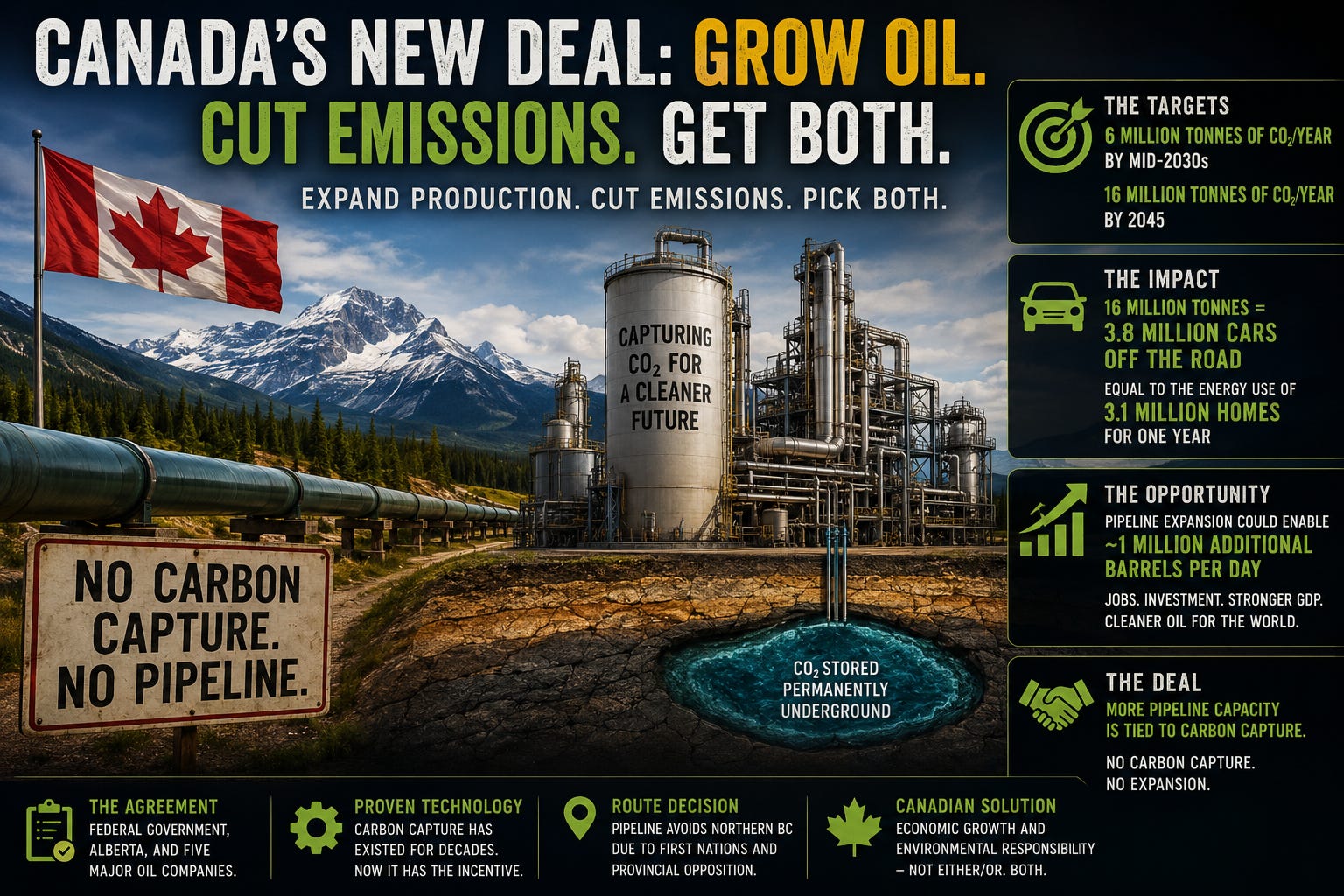
If the oil industry wants additional pipeline capacity and room to grow production, it must also capture and permanently store a significant portion of the carbon emissions that come with it.
No carbon capture.
No expansion.
That’s the trade.
And whether you love it or hate it, it may be one of the most Canadian solutions imaginable… a compromise that leaves everyone slightly annoyed.
Follow The Incentives
One of the great lessons of life is that people rarely change because they’re told to.
They change because the incentives change.
Carbon capture technology isn’t new.
Versions of it have existed for decades.
The oil industry has used captured carbon dioxide in various industrial processes, including enhanced oil recovery.
The problem was never whether the technology existed.
The problem was whether anyone had a good financial reason to deploy it at massive scale.
Now they do.
The federal government is effectively holding the keys to future expansion.
Oil companies want more export capacity.
Governments want lower emissions.
The bargain is obvious.
You can grow.
But you have to clean up a meaningful portion of the mess that comes with that growth.
This Isn’t A Small Side Project
The targets being discussed are substantial.
The initial goal is to capture roughly 6 million tonnes of carbon dioxide annually by the mid-2030s.
By 2045, the target rises to approximately 16 million tonnes per year.
That is a number so large most people simply tune out.
So let’s translate it.
Sixteen million tonnes of emissions is roughly comparable to taking 3.8 million cars off the road.
That’s not symbolic.
That’s real.
Whether the system ultimately achieves those numbers remains to be seen, but the scale of the ambition is difficult to dismiss.
The Pipeline Is The Leverage
What fascinates me isn’t the technology.
It’s the strategy.
Governments often try to regulate behaviour through penalties.
This time they’re using access.
The oil industry wants something extremely valuable… additional capacity to move product to world markets.
Government wants emissions reductions.
Instead of endlessly arguing, they tied the two together.
That changes the conversation completely.
The question is no longer…
“Should industry reduce emissions?”
The question becomes…
“How much expansion is worth paying for the cleanup?”
That’s a very different negotiation.
Why The Route Matters
Another overlooked part of the story is where the pipeline won’t go.
The proposed route avoids northern British Columbia, reflecting years of opposition from First Nations communities and the provincial government.
Whether people agree with that decision or not, it demonstrates something important.
Large infrastructure projects in Canada no longer happen by simply drawing a line on a map and telling everyone else to live with it.
Communities, provinces, and Indigenous nations now have real influence over how these projects evolve.
That reality isn’t going away.
The Politics Are Predictable
Of course, the political fight started immediately.
Supporters see a practical compromise.
Critics see either greenwashing or unnecessary costs.
That’s politics.
But much of the public debate misses the central point.
This isn’t really an argument about carbon capture technology.
It’s an argument about incentives.
For decades, environmental advocates struggled to get industry to reduce emissions because doing so cost money.
Now emissions reductions are being attached directly to future profits.
Suddenly everybody is paying attention.
Funny how that works.
What Happens If It Works?
If this succeeds, Canada could end up creating something more valuable than a pipeline.
It could create a model.
A framework where economic growth and environmental responsibility aren’t treated as mortal enemies.
Produce more.
Export more.
Create jobs.
Generate revenue.
But also take responsibility for part of the emissions created along the way.
That idea will offend purists on both sides.
Which may be the strongest evidence that it has a chance.
The Bigger Picture
The real story isn’t oil.
The real story is leverage.
Government figured out that companies move faster when environmental responsibility is connected directly to economic opportunity.
Industry figured out that environmental investments become easier to swallow when they unlock billions in future revenue.
Both sides got something they wanted.
Both sides gave up something they wanted.
That’s what a compromise looks like.
And in today’s political climate, compromise may be rarer than oil itself.
The Recap...
For years we were told Canada had to choose.
Oil or climate.
Jobs or emissions.
Growth or responsibility.
This new deal says something different:
You can have the pipeline… but only if you help clean up the exhaust.
The Gut-Punch...
The smartest part of this agreement isn’t the carbon capture.
It’s the leverage.
People rarely change because they’re convinced.
They change because the incentives change.
Canada may have just discovered that the fastest way to move Big Oil isn’t through ideology.
It’s through the profit column.
Source credit:
Research compiled from recent Canadian reporting and public discussion surrounding the Pathways Alliance carbon capture initiative, pipeline expansion negotiations, federal-provincial energy policy, and emissions reduction targets.
If you enjoy thoughtful conversations, Canadian stories, and the occasional smart-ass observation about the world we’re living in, you’re in the right place.
Subscribe free and get new stories, insights, and observations delivered directly to your inbox.
No paywall.
No spam.
No nonsense.
Leave anytime with a single click.
I promise not to take it personally.
Our man is a smart one isn’t he? In hindsight, it’s bloody obvious, it just took a financial mind to put it together. Now the cranky whiners will have much less to whine about. And PP - how will he spin this to make it sound like another great big mistake?
Having lived in Kitimat for 24 years and so glad to see that the north coast plan has been stopped. It is rugged land and I could never figure out where they wanted to put the pipeline. There are sections of the highway from Terrace to Prince Rupert that are Skeena River, highway and rail line. Then rock wall. No room for anything. And that highway is often closed due rockfall. Just a terrible area to build anything.