

Funny how some people say Canada can’t build anything…
right up until somebody signs a cheque.
Then suddenly the argument changes.
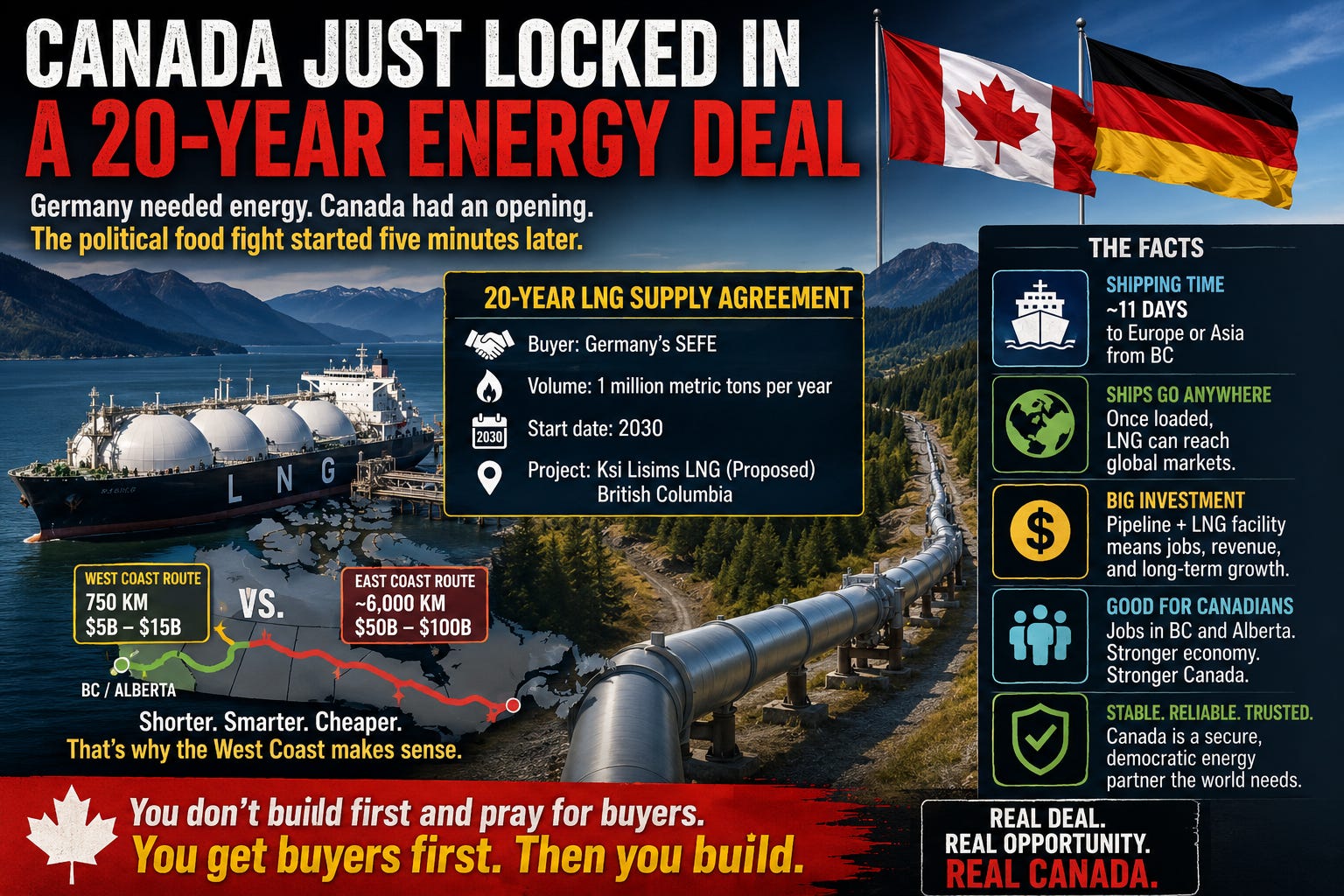
This week, Canada signed a long-term LNG agreement with Germany tied to a proposed West Coast export project in British Columbia.
Not a handshake. Not a “maybe someday.” A real customer. A real agreement. Twenty years. One million metric tons annually. Target start: 2030.
And just like clockwork, the political knives came out.
Some critics immediately started yelling that Canada doesn’t even have the infrastructure yet…
as if somebody builds a billion-dollar export terminal first and then wanders around asking, “Anybody wanna buy some gas?”
That’s not how grown-up business works.
You don’t build the Costco before checking if anybody plans to shop there.
You secure demand first.
Then you build.
That’s exactly what happened with LNG Canada in Kitimat. Buyers committed before the project was fully built.
Nobody blinks when companies do this in the private sector, but somehow when governments help line up international deals, half the country suddenly acts like this is some kind of conspiracy cooked up behind a Tim Hortons dumpster.
Let’s talk geography for a second.
Canada’s natural gas supply sits largely in northeastern BC and northwestern Alberta. The proposed Ksi Lisims project would move gas roughly 750 kilometres to the coast.
That matters.
Because some folks keep insisting Canada should just ship LNG from the East Coast instead… a plan that sounds great until somebody opens a map.
An eastern route would mean dragging gas across roughly 6,000 kilometres of country first.
That’s not a pipeline.
That’s a national stress test.
And the price tag? Estimates for a western route land somewhere in the $5–15 billion range.
An eastern version?
You could be staring at costs pushing $50–100 billion depending on routing and infrastructure.
At some point, reality taps politics on the shoulder and says…
“Hey genius… numbers matter.”
Then there’s the shipping argument.
Critics love acting like BC somehow makes no sense for Germany.
Except ships move.
That’s kind of their whole thing.
Once LNG is loaded, it can go anywhere.
And western ports remain highly competitive globally, especially when compared to the alternatives and bottlenecks other exporters face.
Global energy logistics aren’t decided by social media memes and campaign talking points.
They’re decided by math.
Here’s what actually changed this week:
Canada went from “interesting idea” to “commercially serious project.”
That’s the big story.
Because billion-dollar infrastructure doesn’t move forward based on wishful thinking. It moves when somebody signs a long-term contract and says…
“Yes. We’ll buy it.”
Germany just did that.
And Germany isn’t making random energy decisions for fun. Europe learned a painful lesson about relying too heavily on unstable energy relationships. Countries there are scrambling to diversify long-term supply.
Canada is stable.
Canada is democratic.
Canada delivers.
That matters.
Will the project still face hurdles?
Of course.
Final investment decisions still need to happen. Infrastructure still has to be built. Environmental concerns will be debated. Indigenous partnerships matter. Costs matter.
But pretending this deal means nothing?
That’s politics talking louder than economics.
The bigger question Canadians should ask is simple…
Do we want to be the country that keeps saying no to ourselves?
Or do we want to start acting like a country that understands the world still needs energy…
and Canada might actually have something valuable to sell?
Because whether people like it or not, global markets are moving.
And sitting on the sidelines while everybody else cashes the cheques isn’t a strategy.
It’s procrastination dressed up as principle.
The Recap…
Canada just locked in a 20-year LNG agreement with Germany… and the political arguing started immediately.
Here’s the plain-English version…
You don’t build billion-dollar energy infrastructure before securing customers.
You get buyers first.
Germany just became one.
The Gut-Punch…
Canada has a bad habit of talking itself out of opportunity.
Sometimes it feels like we stand beside the toolbox arguing over whether the hammer is perfect… while somebody else builds the damn house.
Source credit:
Research based on public reporting and transcript notes regarding the Canada–Germany LNG agreement, the proposed BC Ksi Lisims LNG project, infrastructure economics, and energy market logistics.
🔎 The GeezerWise Standard
This space is built on disciplined thinking.
Facts over spin.
Verification before amplification.
Good-faith discussion over tribal noise.
I use AI tools to help shape my spoken drafts into clear writing.
The judgment, conclusions, and final message are mine.
If you’re new here, this explains how I decide what’s worth sharing:
How I Decide What’s Worth Sharing → [link]
💌 Subscribe at GeezerWise.com to receive future letters:
www.geezerwise.com/subscribe
— Fred Ferguson
GeezerWise
#CanadaStrong
Well done! Let's keep Canada Strong! 🇨🇦❤️Good job, Mr. Carney!
Well done Canada! A brilliant bit of foresight by your Government.