

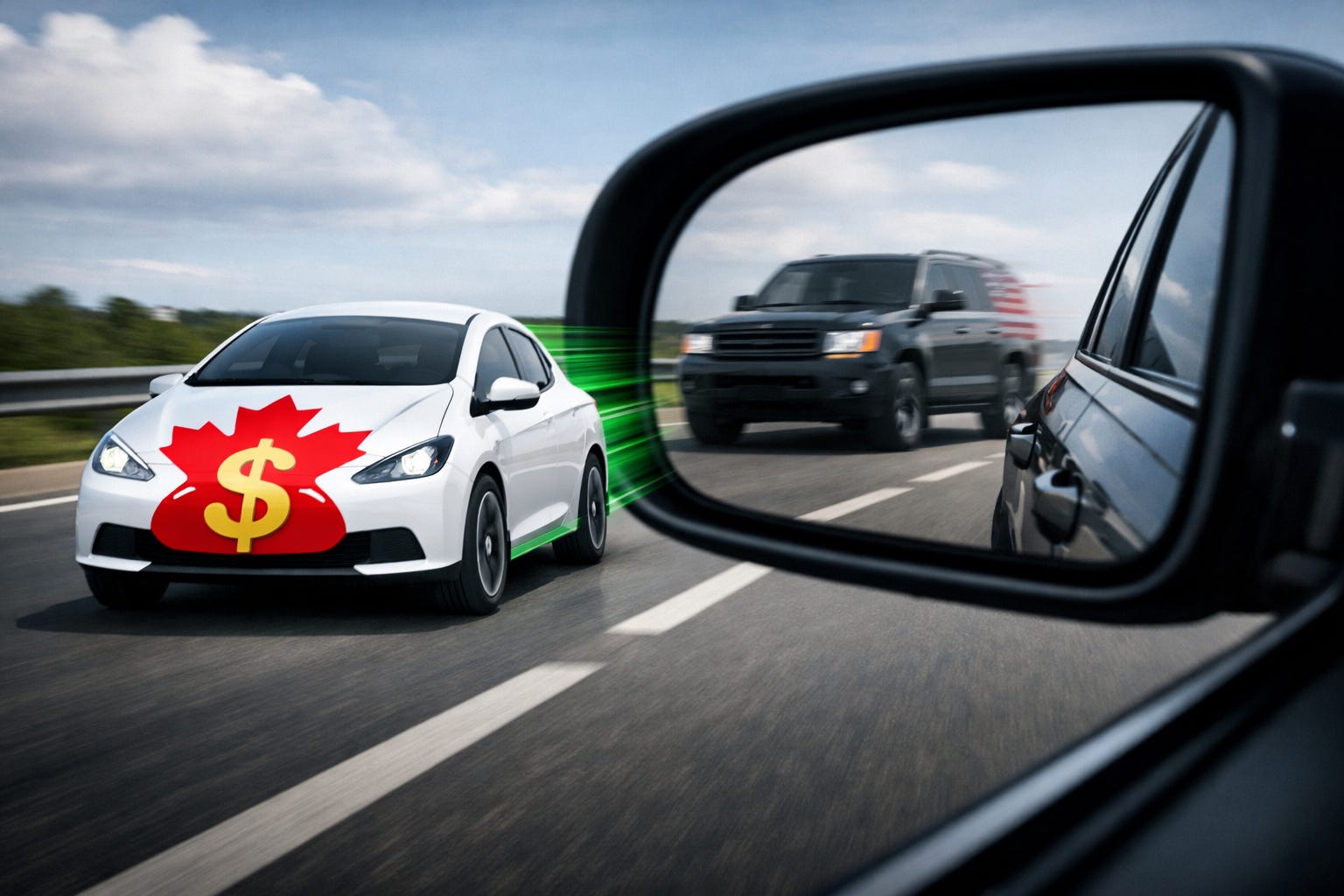
Let’s talk about something ordinary people actually understand.
Car prices.
Because sometimes geopolitics isn’t about missiles or treaties.
Sometimes it’s about what your neighbor paid for their vehicle.
And that’s exactly where a quiet economic shift just started.
Canada recently opened the door to lower-cost Chinese electric vehicles under a controlled import program.
The numbers matter…
About 49,000 vehicles allowed in the first year
Expanding to roughly 70,000 within five years
Many priced under $35,000 CAD (about $25,000 USD)
Right now, most EVs available to Canadians start closer to $40,000 or higher.
So yes… this is a big price shock.
And American auto dealers immediately noticed.
The Real Panic Isn’t About China
Public statements from industry groups frame this as a national security issue or a threat to jobs.
But follow the money and the picture gets clearer.
The traditional U.S. dealership model adds thousands of dollars to vehicle costs through franchise markups, financing margins, and service revenue.
If manufacturers sell directly… or if consumers can see dramatically cheaper alternatives next door… that pricing structure becomes harder to defend.
Competition isn’t the enemy.
Comparison is.
Canada just created a comparison point.
The Strategic Part Most People Missed
This isn’t simply about letting cars into the country.
The agreement reportedly includes expectations that manufacturers will invest in local partnerships or production capacity within a few years.
That’s not accidental.
For decades, foreign companies entering China had to form joint ventures and transfer knowledge to gain market access.
Canada is now applying a similar logic in reverse.
If it works, Canada could end up with…
More affordable vehicles for consumers
New manufacturing investment
Technology transfer
Supply-chain positioning
Meanwhile, the United States… with 100% tariffs blocking entry… risks getting none of those benefits.
The Cross-Border Pressure Problem
Here’s where politics enters the story.
Imagine Americans living near the border watching Canadians drive…
$25,000 electric vehicles
Modern features
Competitive range
Strong safety ratings
While they’re paying significantly more at home.
That kind of comparison creates political pressure faster than any policy debate.
Consumers don’t read trade papers.
They read price tags.
This Is Bigger Than Cars
There’s a broader economic pattern here.
Countries are increasingly making independent decisions based on cost, supply chains, and strategic leverage… not automatic alignment with U.S. policy.
That doesn’t mean alliances are collapsing.
It means economic self-interest is back in fashion.
And when multiple nations do that at once, the center of gravity shifts.
What Likely Happens Next
Based on how these transitions usually unfold…
Initial vehicle quotas sell quickly if demand is strong.
Manufacturers announce local production or battery investments.
Trade negotiations gain new leverage points.
Political pressure rises in higher-cost markets.
Policy debates intensify around affordability vs protection.
None of this is guaranteed.
But the incentives are clear.
The Core Reality
Protection policies work best when everyone follows them.
They become fragile when neighbors don’t.
Canada didn’t just change a tariff.
It changed the comparison.
And comparisons change politics.
The Recap…
Canada may soon have $25K electric cars on the road.
The United States won’t.
That gap isn’t just about vehicles… it’s about strategy, manufacturing, and leverage.
Sometimes geopolitics shows up in your driveway.
The Gut Punch…
Consumers don’t overthrow policies with protests.
They overthrow them with price comparisons.
Source Credit:
Source: Analysis based on reporting and industry commentary discussed in House of L transcript and related public data.
🔎 The GeezerWise Standard
This space is built on disciplined thinking.
Facts over spin.
Verification before amplification.
Good-faith discussion over tribal noise.
I use AI tools to help shape my spoken drafts into clear writing.
The judgment, conclusions, and final message are mine.
If you’re new here, this explains how I decide what’s worth sharing:
How I Decide What’s Worth Sharing → [link]
💌 Subscribe at GeezerWise.com to receive future letters:
www.geezerwise.com/subscribe
— Fred Ferguson
GeezerWise
#CanadaStrong
I worked the graveyard shift for 4 years. When I finally had enough seniority to move to 2nd shift, I quickly realized something. I didn't realize how my body and mental attitude was affected because it had become a constant state of being to the point of normal until I slept at night and realized the change.
American is the same. Being in an environment of suppression for generations, they have no comparison to what it should be like when democracy works as intended. Normal is fighting for dominance of one party over another with separate ideology. Not lower vehicle cost or prescription medicine higher in the US than other countries is not a priority.
Looking forward to it as our second car. We have an SUV to haul the camper around but the second vehicle rarely goes more than 120km, usually 30-35km at a time. An electric car will be perfect.
I costed the mileage against our old Prius that would get 55-60mpg imperial gallon. If we charged an electric at night, when rates are low, the fuel cost was 1/7 of our Prius.