

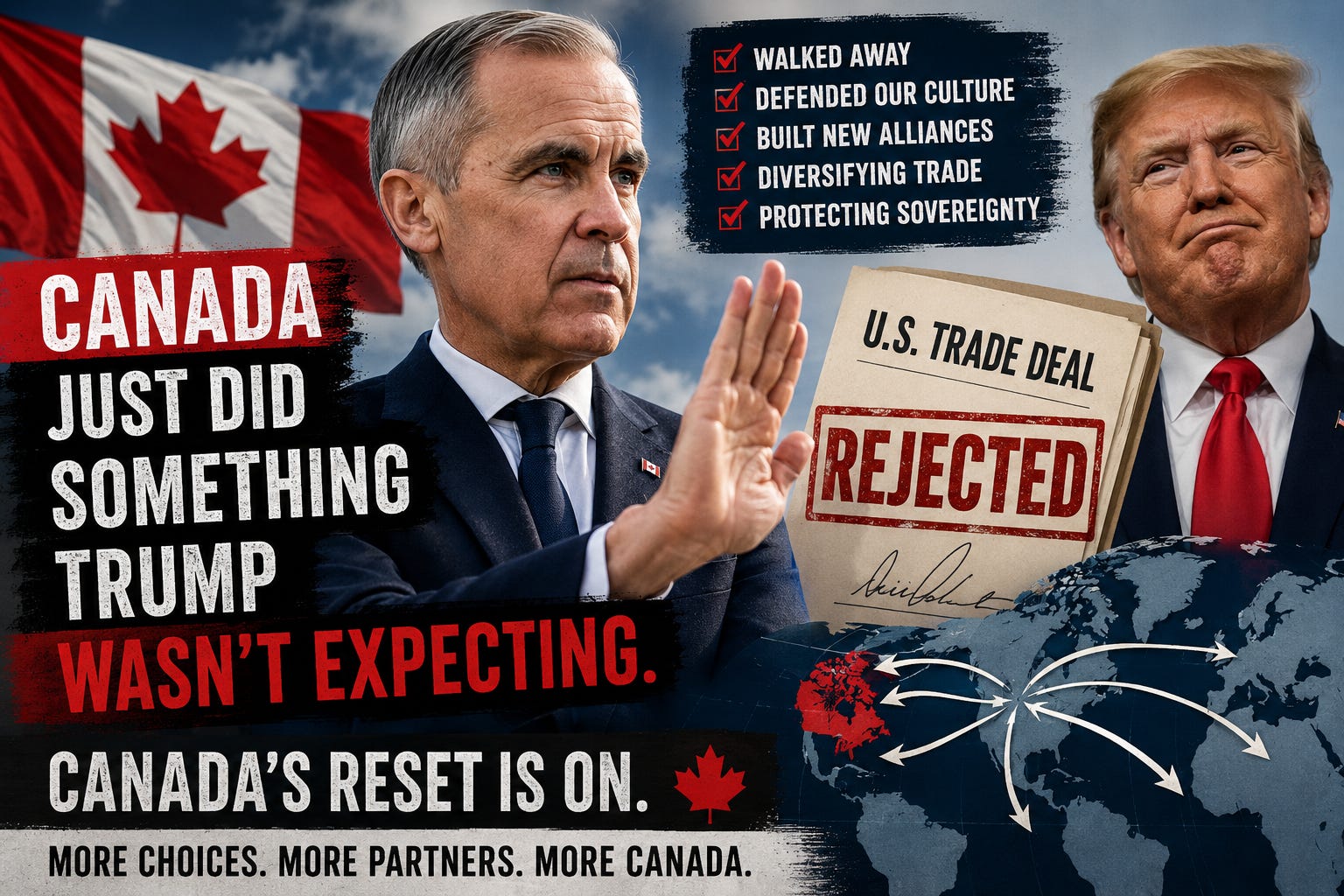
Now we find out whether saying no was merely a negotiating move…
or the beginning of a much bigger Canadian reset.
For most of my life, Canada had one enormous economic advantage.
We lived next door to the richest market on Earth.
We built factories around it. Pipelines around it. Supply chains around it. Entire industries around it.
That worked pretty damn well.
Until living beside your biggest customer started looking an awful lot like living beside your biggest risk.
That is the part of the latest Canada-U.S. trade blowup that matters.
Not whether Mark Carney “beat” Donald Trump.
Not whether Trump is furious.
Not whether somebody in Washington had a bad weekend.
Canada finally acted as though the United States might not go back to being the reliable economic partner we spent decades assuming it would be.
And that changes everything.
Canada was willing to make a deal
This wasn’t Carney marching into negotiations looking for a fight.
Canada’s stated objectives were pretty straightforward.
Preserve tariff-free U.S. access for most Canadian businesses.
Reduce American tariffs on strategic Canadian industries.
Give businesses some stability.
Protect smaller companies.
And maintain Canada’s independence and ability to make its own decisions.
That last one turned out to be rather important.
On August 21, Carney suspended negotiations and ordered Canada’s negotiating team home.
His explanation was blunt enough.
The United States had introduced last-minute changes that Canada considered unfair and uneconomic… changes serious enough to raise questions about whether any agreement could be relied upon.
The United States then imposed 50% tariffs on roughly $28 billion worth of Canadian goods.
Canada announced it would retaliate dollar for dollar.
That’s not a victory parade.
Tariffs hurt.
Canadian businesses and workers will get hit.
American businesses and consumers will get hit too.
This is an ugly situation.
But there’s a difference between paying a price because somebody else imposed it on you and voluntarily signing away your freedom to avoid paying it.
That’s the line Canada appears to have drawn.
And then came the French-language fight
One of the strangest parts of the negotiations involved Canadian cultural and French-language policies.
The United States had raised objections involving French-language labelling and Canadian content requirements.
After the talks collapsed, U.S. officials clarified that French-language measures would not be treated as a trade barrier.
Canada’s trade minister Dominic LeBlanc publicly welcomed that clarification.
That’s worth stopping on for a second.
Because we’re no longer talking about whether a pickup truck contains 62% or 68% North American parts.
We’re talking about another country poking around inside decisions Canadians make about our language and culture.
You don’t need to be French Canadian to understand why that matters.
I’m an old Western Canadian.
And even I can figure this one out.
A trade agreement is supposed to determine how we trade with another country.
It isn’t supposed to give that country the remote control to ours.
Canadians apparently understand that
Here’s where this gets interesting politically.
A national Abacus Data survey conducted after the talks collapsed found 71% of Canadians believed the government made the right decision to suspend negotiations rather than accept the American terms, even when respondents were reminded that doing so could mean higher tariffs and more economic uncertainty.
Only 17% said Canada should have taken the deal.
That’s not exactly a country screaming…
FOR GOD’S SAKE, MARK, SIGN SOMETHING.
Even Alberta… hardly Carney’s political fan club… had 61% saying walking away was the right decision. Quebec was at 79%.
And here’s an important correction to something floating around online.
Carney’s government did have a 66% approval rating in a July Spark Insights poll.
But that poll was conducted before the latest trade talks collapsed.
So we can’t claim walking away gave him a 66% approval rating.
What we can say is that he entered this confrontation with unusually strong approval, and a separate poll taken afterward found seven in ten Canadians supporting the decision to walk.
That’s plenty.
No need to decorate the fish to make it bigger.
But the bigger story isn’t Trump
This is where I think people are missing what Carney is actually doing.
Canada isn’t simply retaliating against the United States.
We’re trying to make the United States less capable of hurting us next time.
That’s a much bigger project.
Carney says Canada has signed more than 20 economic and security agreements across five continents during the past year.
Our existing free-trade agreements provide preferential access to about 1.5 billion consumers.
The government says it intends to double that market access through additional agreements, including negotiations involving India and ASEAN.
Now we’re getting somewhere.
Because Canada does not need to stop trading with America.
That would be stupid.
They’re right next door. They’re enormous. Our economies are deeply connected.
What Canada needs is options.
If you’ve got one customer who buys almost everything you produce, you don’t have a customer.
You’ve got a landlord.
And landlords get awfully brave when they think you have nowhere else to live.
Europe matters more than most Canadians realize
Canada’s relationship with Europe is moving well beyond the old handshake-and-photo-op routine.
Canada became the first non-European country to participate in the European Union’s Security Action for Europe… SAFE… initiative, opening European defence procurement opportunities to Canadian companies.
And it has already produced something tangible.
A Montréal defence technology company received a contract worth more than $10 million to supply Canadian-made tactical radios to Poland… the first Canadian company awarded a contract under SAFE.
There’s also another milestone coming.
Canada will host the next Canada-EU Summit on October 29 and 30.
Before that, Carney is expected in Strasbourg in September as Canada and Europe continue deepening their relationship. European reporting says he has been invited to attend European Commission President Ursula von der Leyen’s State of the Union address on September 16.
Put those pieces together.
Trade.
Defence.
Critical minerals.
Energy.
Technology.
Supply chains.
Canada isn’t looking for another America.
We’re trying to build enough relationships that we never need another America.
There’s a hell of a difference.
This is what sovereignty looks like in the real world
Sovereignty isn’t waving a Canadian flag harder.
It isn’t yelling “Elbows Up” on Facebook.
And it certainly isn’t pretending economic consequences don’t exist.
Real sovereignty is having choices.
It’s having another port.
Another pipeline.
Another customer.
Another defence supplier.
Another market for our aluminum.
Another buyer for our oil, LNG, potash, uranium, lumber and critical minerals.
It’s having enough doors that nobody can stand in front of one of them and trap you inside.
That is the Canadian project now.
And it won’t be finished next month.
Probably not next year either.
We spent decades building an economy designed around easy access to the United States.
Untangling some of that dependency while preserving the parts that still benefit us is going to take years.
There will be mistakes.
There will be costs.
Some Canadian industries will get hammered along the way.
And sooner or later Canada and the United States will almost certainly be sitting across a negotiating table again.
We should.
The objective isn’t permanent hostility.
The objective is permanent independence.
The lesson from August 21
Donald Trump may believe tariffs give the United States enormous leverage over Canada.
He’s right.
They do.
But leverage only works perfectly when the other guy believes he has no alternative.
Canada is starting to build alternatives.
That’s why walking away mattered.
Not because Mark Carney humiliated Donald Trump.
Not because Canada suddenly became more powerful than the United States.
And not because our economic problems magically disappeared Friday night.
It mattered because Canada looked at the cost of the proposed deal and decided:
We can survive tariffs.
What we cannot afford is selling our ability to make our own decisions.
For decades, Canada’s relationship with the United States was built around one assumption…
America would remain our closest, safest and most dependable economic partner.
That assumption is gone.
So now we build something else.
Not an anti-American Canada.
An independent Canada.
And frankly, it’s about bloody time.
The Recap…
Canada didn’t walk away from America.
Canada walked away from a deal it decided wasn’t good enough.
Now we’re building more trade, defence and economic relationships so the next American president… Trump or anybody else… has less power to put Canada over a barrel.
That’s not isolation. That’s insurance.
The Gut-Punch…
For 40 years, Canadians were told we were lucky to have the world’s biggest economy living next door.
We were.
But there’s something we should have learned a long time ago…
Never let your best customer become your only option.
Because the minute they realize you can’t afford to say no…
you can’t.
Canada just did.
Source credit: This article was developed from research notes supplied from a Europe Curious video transcript, with factual claims independently checked against the Prime Minister of Canada, Reuters, Abacus Data, Spark Insights, Canadian government defence information, European reporting and Canada-EU announcements. Unsupported commentary and predictions from the original transcript were not used.
If you enjoy thoughtful conversations, Canadian stories, and the occasional smart-ass observation about the world we’re living in, you’re in the right place.
Subscribe free and get new stories, insights, and observations delivered directly to your inbox.
No paywall.
No spam.
No nonsense.
Leave anytime with a single click.
I promise not to take it personally.
Want to learn French or brush up on your French language skills, Mauril app (Radio Canada) available from the App Store is now #1. It beat out Duo Lingo app. I have been enjoying it as a Quebecer living in Alberta since the separatist referendum in 1995.
Terrific article Fred. Canada is certainly taking the proper approach. It's quite clear to me that, regardless what Jamieson Greer or Howard Lutnick are telling the press, there were unacceptable "red lines" introduced by the US at the 11th hour. Canada can never accept these "proposals".
The press in general often uses a technique called sanewashing, which is the act of minimizing the perceived radical aspects of a person or idea to make them appear more acceptable to a wider audience.
We are all aware of the patently untrue and totally ridiculous things spewing out of Trump's mouth. Since he chooses his sycophants carefully, is it any wonder that Greer and Lutnick follow suit to try to sanitize, i.e.sanewash comments from their boss and lie just as much as he does?