

For decades, Canada treated the United States like the default setting.
Need military equipment? Buy American.
Need trade certainty? Assume Washington had our back.
Need stability? Don’t overthink it.
Well… that old arrangement is starting to crack.
Not with a dramatic breakup. Not with speeches and flag-waving.
More like a homeowner quietly changing the locks after the neighbour starts acting unpredictable.
Because over the past week, Canada made several moves that all point in the same direction:
Diversify. Diversify. Diversify.
And when you line them up side by side, the message becomes hard to miss.
Canada Is Quietly Breaking Old Habits
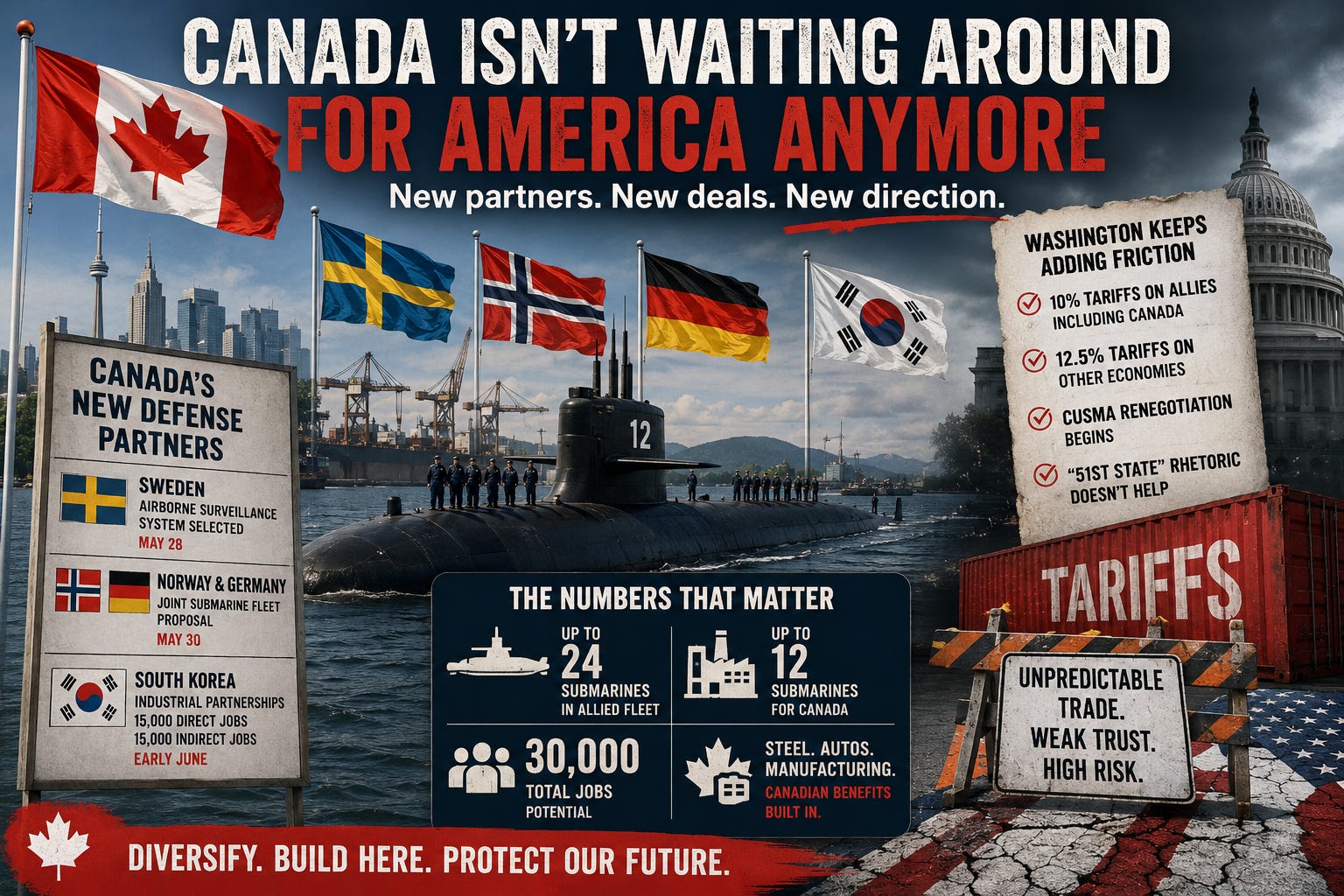
On May 28, Canada picked a Swedish airborne surveillance system instead of sticking with more U.S.-aligned options.
That might sound like bureaucratic wallpaper to normal people.
It isn’t.
Military purchases are long marriages. Once you buy the equipment, you usually stay tied to the supplier for decades through maintenance, upgrades, training, and replacement parts.
Canada choosing a Swedish-built system… with work tied partly to Canadian industry… was more than shopping around.
It was a signal.
We are no longer automatically reaching for the American catalogue.
Then came submarines.
On May 30, Norway and Germany reportedly stepped in with an unusually aggressive proposal… a shared submarine partnership that could involve as many as 24 submarines between allied nations, with Canada potentially buying up to 12 boats of its own.
That alone is interesting.
What makes it more interesting?
Germany and Norway were reportedly willing to shuffle production schedules and give up manufacturing priority to make room for Canada.
That’s not charity.
That’s countries looking at Canada and saying:
“We want you in the club.”
And they’re willing to make sacrifices to get the deal.
South Korea Just Raised the Stakes
As if Europe competing for Canada wasn’t enough, South Korea stepped into the room.
Their proposal reportedly includes major industrial partnerships tied to shipbuilding, manufacturing, steel, and automotive supply chains here at home.
The number getting attention?
Potentially 15,000 direct jobs and another 15,000 indirect jobs connected to the project.
That’s not pocket change.
That’s the kind of economic impact governments dream about.
Especially at a time when Canadian workers are nervous about tariffs, trade disruptions, and cross-border uncertainty.
Here’s the part that matters…
These deals are no longer just about defense.
They’re increasingly being treated like industrial policy.
Instead of simply buying military hardware and shipping taxpayer dollars overseas, Canada appears to be asking…
“What do Canadians get back?”
Jobs?
Factories?
Steel contracts?
Manufacturing?
Supply chains?
Good.
Bring receipts.
Meanwhile… Washington Keeps Adding Friction
At almost the same moment Canada is diversifying, Washington is making the relationship harder.
New tariff threats are back on the table.
The U.S. is reportedly floating 10% tariffs on allies like Canada, while proposing 12.5% tariffs on other economies, partly under claims tied to forced labour concerns.
Let me translate that into plain English…
Nothing says “strong alliance” quite like threatening your closest partners while trade talks are underway.
And yes… all of this is happening while CUSMA renegotiation talks are beginning.
That timing matters.
Because trust is already fragile.
The rhetoric hasn’t exactly helped either.
When politicians and diplomats casually toss around “51st state” comments, even as jokes, people notice.
You can’t spend months poking your neighbour in the ribs and then act confused when they stop borrowing your lawnmower.
This Isn’t Anti-American. It’s Risk Management.
Some people will hear all this and immediately jump to…
“Canada is turning against America!”
No.
That’s too emotional… and frankly too simplistic.
This looks more like basic common sense.
If one customer, one supplier, or one partner becomes unpredictable, you reduce your risk.
Businesses do it.
Families do it.
Countries do it too.
For years, critics argued Canada was overly dependent on American defense suppliers.
Some estimates suggested roughly 70 cents of every military dollar ended up flowing south of the border.
That dependence bought convenience.
But convenience starts feeling expensive when politics turns unstable.
So Canada appears to be making a quiet calculation:
Keep America close.
But stop putting all the eggs in one basket.
The Bigger Story Nobody Wants to Say Out Loud
This is bigger than submarines.
Bigger than tariffs.
Bigger than one trade dispute.
Canada appears to be slowly preparing for a world where the United States is no longer automatically predictable, automatically cooperative, or automatically aligned with Canadian interests.
That doesn’t mean friendship ends.
It means blind dependence does.
Europe sees opportunity.
Asia sees opportunity.
And Canada?
Canada finally seems willing to act like a middle power with options instead of a customer standing in one checkout line.
The old arrangement isn’t collapsing overnight.
But you can feel the shift.
Quietly.
Slowly.
Steadily.
And once countries start building new habits, they rarely go back.
The Recap…
Canada isn’t loudly breaking up with America.
But it is quietly building alternatives.
New defense deals. New partners. New leverage.
Because when your biggest ally starts acting unpredictable, smart countries stop depending on just one door to the house.
The Gut-Punch…
A strong partnership doesn’t die the day trust breaks.
It dies the day someone quietly decides they’d better have a backup plan.
Source credit:
Research compiled from public reporting on Canadian defense procurement discussions, Canada–U.S. trade tensions, proposed tariff discussions, submarine bids, and ongoing CUSMA-related developments.
🔎 The GeezerWise Standard
This space is built on disciplined thinking.
Facts over spin.
Verification before amplification.
Good-faith discussion over tribal noise.
I use AI tools to help shape my spoken drafts into clear writing.
The judgment, conclusions, and final message are mine.
If you’re new here, this explains how I decide what’s worth sharing:
How I Decide What’s Worth Sharing → [link]
💌 Subscribe at GeezerWise.com to receive future letters:
www.geezerwise.com/subscribe
— Fred Ferguson
GeezerWise
#CanadaStrong
This is good news…
Great Post Fred! I think Asia, Sweden, Norway, Germany, South Korea, etc., when they heard the 51st state remark, all raised their heads & said What???!!!! Not on my watch! Canada we like, you, we don't, so, we are doing business with Canada & orangeball can keep on making a fool of himself, his country & the whole world, while we all join with Canada & trade. All those people that could fix the whitehouse situation are sitting on their hands & doing sweet nothing to change anything. Eventually no country will want to do business with them. Sad situation for our lovely neighbours minus the orange one!