

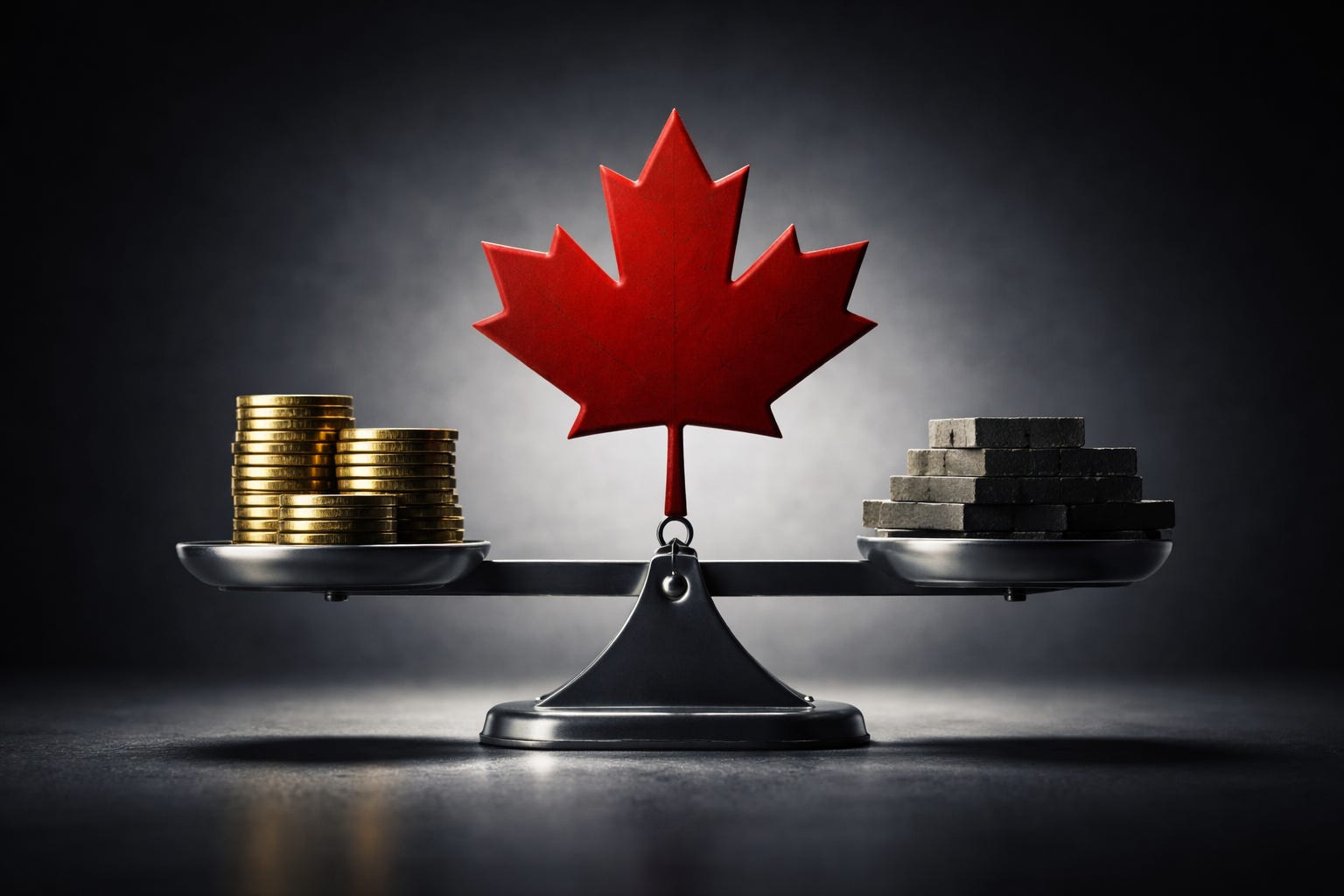
Let’s cut through it clean.
A fresh global economic report just dropped… not from a political party, not from a think tank with an agenda… but from the International Monetary Fund.
And here’s what it actually says…
Canada is performing near the top of the developed world.
Not perfect. Not magical. But strong… especially compared to the pack.
Start with growth.
Canada is projected to hit 1.5% GDP growth in 2026, second in the G7. Only the United States is higher at 2.3%.
Sounds like we’re losing, right?
Not so fast.
The U.S. number is juiced… heavily… by deficit spending. We’re talking trillions in borrowed money, including massive military expenditures that inflate GDP on paper.
That’s not organic growth. That’s economic caffeine.
Canada, meanwhile, is running a tighter ship.
Lowest net debt-to-GDP ratio in the G7
Strong fiscal position
Lower borrowing risk
In plain English… less debt, less chaos, more stability.
Now look at wealth.
The median Canadian adult holds about $219,000 in wealth, compared to $179,000 in the U.S.
That’s not a small gap.
That’s a quality-of-life gap.
And Canadians live nearly four years longer on average.
Funny how that never shows up in the doom headlines.
Now let’s talk investment… the real scoreboard.
Canada pulled in nearly $100 billion in foreign direct investment in 2025… an 18-year high.
That doesn’t happen by accident.
Investors don’t throw money at weak economies. They chase stability, predictability, and opportunity.
Canada checks all three boxes…
Lowest business investment tax rate in the G7 (13.2%)
Competitive corporate structure
Targeted incentives, especially in emerging sectors like clean tech
And money is flowing in fast.
Global investors are buying Canadian bonds… which pushes prices up and interest rates down.
Translation?
They trust the country.
On top of that, Canada is actively diversifying trade… not just talking about it.
A $2.6 billion uranium deal with India
A $70 billion investment commitment from the UAE
Agreements across multiple continents
That’s strategic positioning, not wishful thinking.
Now here’s where it gets messy.
Because right after this report dropped… showing Canada near the top globally… political messaging went the exact opposite direction.
Suddenly, the narrative became…
“Worst in everything.”
Housing. Debt. Investment. Inflation.
All framed as total failure.
That’s not analysis.
That’s messaging.
And here’s the trick: repeat something often enough, clip it into a soundbite, and it starts to feel true… even when the data says otherwise.
Add in a media environment that amplifies conflict instead of clarity… and now you’ve got a full-blown perception gap.
Reality vs storyline.
The reality?
Canada has real challenges.
Housing costs are high.
Household debt is a concern. No serious person denies that.
But the direction of travel matters.
And right now, the data says…
Canada is moving forward… not falling apart.
The storyline?
Everything is broken.
That’s easier to sell. Fear always is.
But here’s the part people miss…
Economies don’t collapse quietly.
If Canada were truly “failing,” global investors wouldn’t be pouring billions into it.
They’d be running the other way.
They’re not.
They’re buying in.
The Recap…
Canada just got graded by the IMF… and it landed near the top of the class.
Strong growth. Solid finances. Massive investment inflows.
But if you only listen to the noise, you’d think the place is collapsing.
It isn’t.
You’re just being sold that story.
The Gut-Punch…
When the numbers say “stable” and the headlines say “disaster”…
you’re not looking at an economic problem.
You’re looking at a narrative problem.
Source credit:
International Monetary Fund (IMF) 2026 Growth Projections and Economic Outlook Report
🔎 The GeezerWise Standard
This space is built on disciplined thinking.
Facts over spin.
Verification before amplification.
Good-faith discussion over tribal noise.
I use AI tools to help shape my spoken drafts into clear writing.
The judgment, conclusions, and final message are mine.
If you’re new here, this explains how I decide what’s worth sharing:
How I Decide What’s Worth Sharing → [link]
💌 Subscribe at GeezerWise.com to receive future letters:
www.geezerwise.com/subscribe
— Fred Ferguson
GeezerWise
#CanadaStrong
LMFAO! The CONSERVATIVE OPPOSITION LEADER had the Audacity to stand in HOC and tell Canadians that Prime Minister Carney doesn’t know ECONOMICS.
You carefully avoided the two questions: who is creating the narrative? Why?