

Sometimes the biggest stories aren’t the loudest.
They’re the ones hiding in plain sight.
If you’ve been watching the headlines over the past year, you’ve probably seen stories about military spending, housing, immigration, tax cuts, trade deals and Alberta politics.
They look like separate issues.
They’re not.
They’re all pieces of the same strategy.
For the first time in decades, Ottawa appears to be rebuilding Canada around one idea…
Become harder to push around.
That applies to our economy.
Our military.
Our borders.
Our housing market.
Even our politics.
For years Canada relied heavily on globalization.
We sold most of our exports south.
We depended on international supply chains.
We assumed the United States would remain our dependable partner.
The world has changed.
Trade wars.
Wars in Europe and the Middle East.
Growing tension with China.
Questions about America’s reliability.
Those realities have forced Canada to rethink its playbook.
That’s showing up almost everywhere.
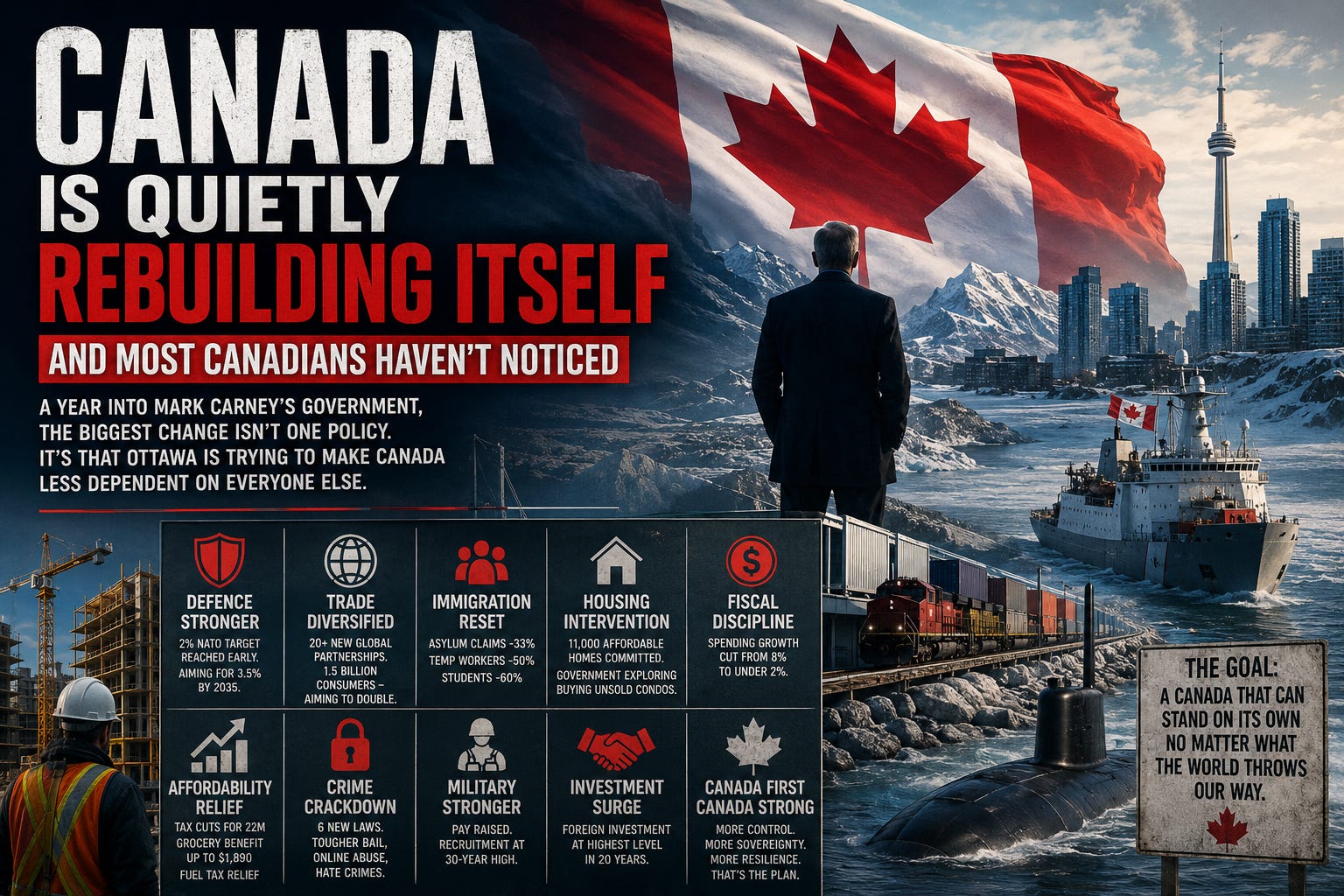
On defence, Canada has moved much faster than many expected.
Military pay has increased.
Recruitment is reportedly at its strongest level in decades.
Canada reached NATO’s 2% spending target earlier than planned and is now talking about moving toward 3.5% over the next decade.
Submarines.
Cybersecurity.
Arctic surveillance.
Northern infrastructure.
Those aren’t isolated purchases.
They’re investments aimed at protecting Canadian sovereignty.
Trade policy has shifted just as dramatically.
Instead of putting almost all our eggs in the American basket, Canada has been signing agreements with countries around the world.
More than twenty new economic and security partnerships have been announced.
The goal isn’t simply more trade.
It’s less dependence.
If one customer becomes unreliable, you need more customers.
Every small business owner understands that.
Countries eventually learn the same lesson.
Immigration has also changed direction.
For years the conversation focused on increasing numbers.
Now the emphasis is control.
Temporary foreign workers have been cut sharply.
International student numbers are being reduced.
Asylum claims are being tightened.
Whether Canadians agree or disagree with those decisions, one thing is clear…
This is one of the largest immigration policy reversals in recent history.
Housing may be the most controversial piece.
The government has already committed thousands of affordable homes, removed GST on qualifying first-time home purchases under $1 million, and reached agreements with provinces to reduce development charges.
Now there’s discussion about government purchasing unsold condominium units and converting them into affordable housing.
That’s unusual.
Normally governments try to encourage markets.
This would mean stepping into the market directly.
Supporters argue it could put empty homes to use.
Critics worry it risks distorting prices and protecting developers from market realities.
Time will tell which side is right.
Meanwhile, Ottawa says it’s trying to slow spending growth overall.
Federal spending growth has reportedly fallen from roughly 8% to under 2%, even as billions continue flowing into defence, housing and infrastructure.
That sounds contradictory until you look closer.
The government appears to be spending less broadly while spending much more aggressively in areas it considers strategic.
Whether that balance holds is another question entirely.
Canadians have also seen targeted relief aimed at affordability.
Middle-income tax reductions.
Temporary fuel-tax relief.
Expanded grocery support for eligible families.
Measures like these won’t solve every cost-of-living problem, but they are clearly intended to ease pressure while larger structural changes take shape.
Then there’s Alberta.
Separatist rhetoric has moved from the political fringe into mainstream discussion.
History shows that once conversations about breaking up a country begin, they can quickly become bigger than the politicians who started them.
Canada doesn’t need its own version of Brexit.
That alone explains why national unity has become part of Ottawa’s broader message about sovereignty.
The common thread through all of this isn’t left or right.
It’s resilience.
Canada is trying to reduce risk on multiple fronts at once.
Less dependence on one trading partner.
More domestic defence capability.
More control over immigration.
Greater housing intervention.
Stronger Arctic presence.
More diversified investment.
Whether every policy succeeds is almost beside the point.
The direction is unmistakable.
Canada is trying to build a country that can absorb more shocks without depending on someone else to rescue it.
That’s a very different vision than the one we’ve followed for most of the past generation.
Some of these policies will work.
Some probably won’t.
Reasonable people can debate every one of them.
But pretending nothing has changed misses the bigger picture.
Canada isn’t just tweaking policy anymore.
It’s redesigning the foundations.
And if that’s what’s really happening...
This may be remembered as one of the biggest shifts in Canadian policy in decades.
The Recap…
Canada’s biggest story isn’t one new law or one spending announcement.
It’s that Ottawa is trying to make the country less dependent on everyone else… economically, militarily and politically.
Whether you support the plan or oppose it, one thing is becoming hard to ignore…
Canada is quietly changing course.
The Gut-Punch…
Countries don’t usually reinvent themselves because life is going well.
They do it because the old playbook stopped working.
The real question isn’t whether Canada is changing.
It’s whether we’re changing fast enough.
Source credit:
Research compiled from recent federal government announcements, public policy statements, housing and defence initiatives, immigration policy updates, NATO commitments, and Canadian economic and trade data.
🔎 The GeezerWise Standard
This space is built on disciplined thinking.
Facts over spin.
Verification before amplification.
Good-faith discussion over tribal noise.
I use AI tools to help shape my spoken drafts into clear writing.
The judgment, conclusions, and final message are mine.
If you’re new here, this explains how I decide what’s worth sharing:
How I Decide What’s Worth Sharing → [link]
💌 Subscribe at GeezerWise.com to receive future letters:
www.geezerwise.com/subscribe
— Fred Ferguson
GeezerWise
#CanadaStrong
A Quick Note About Getting in Touch
One thing I’d like to ask as GeezerWise grows...
Please keep questions, ideas, and conversations in the comments whenever possible.
That’s where I spend my time, and when a good question is asked publicly, everyone benefits from the discussion.
I can’t promise to reply to every comment, but I do read them, and many of my best ideas come directly from our conversations here.
Thanks for helping make GeezerWise a community where we all learn from one another.
Really liked how you interpreted current spending. A jump ahead of PP’s garbage. Good one Fred!
Very very well written Fred! I enjoyed every piece of it :) Nice you inserted the question period with Prime Minister Carney, lots to learn there.