

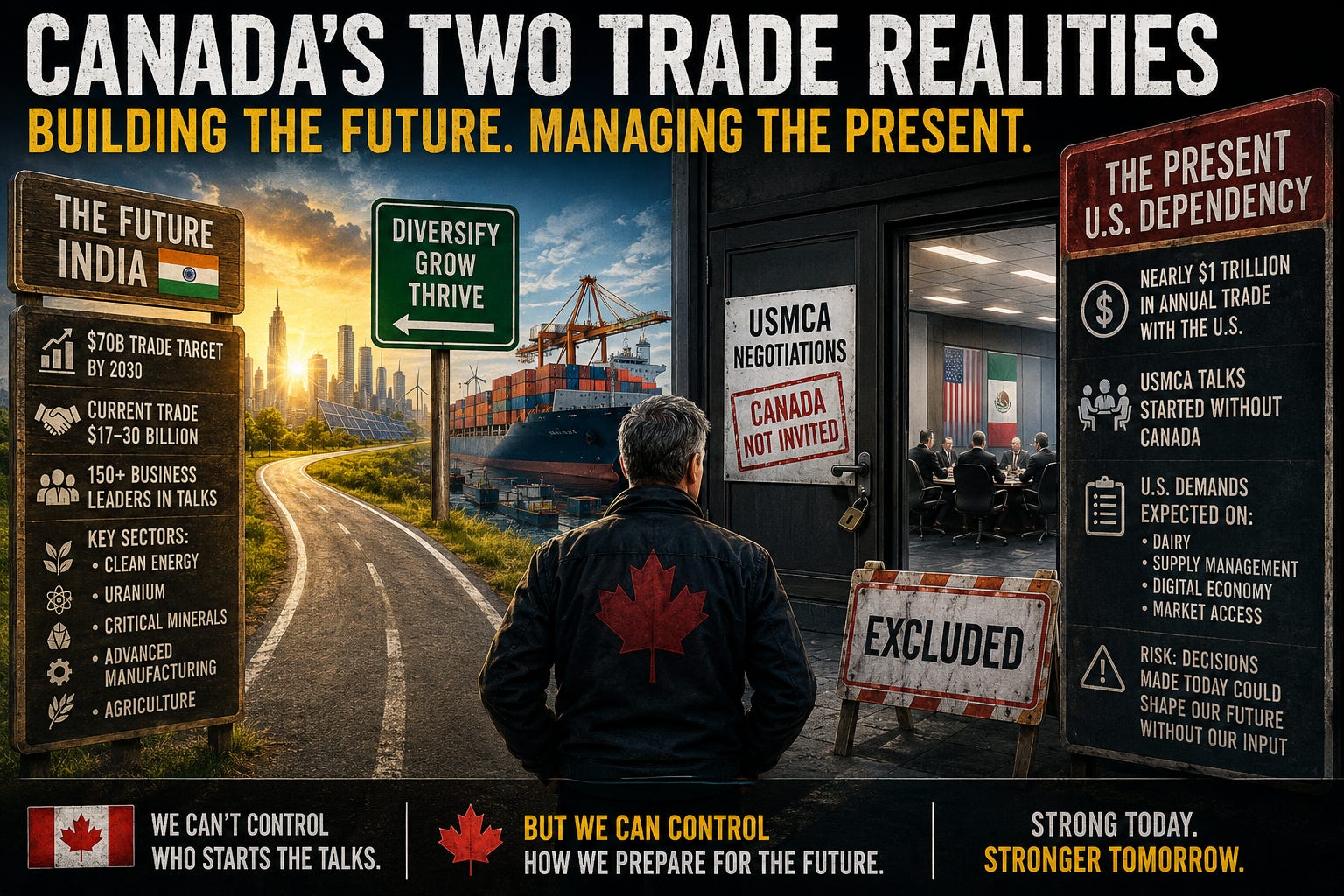
For most of my life, Canada’s trade strategy was simple…
Build the house beside America. Sell to America. Depend on America.
And for a long time, that worked.
Until it didn’t.
Because when your biggest customer starts acting unpredictable, slaps tariffs around like a toddler throwing toys, and changes the rules every few months… eventually you stop asking, “How do we keep this relationship strong?”
You start asking…
“What’s our backup plan?”
That’s what this new push toward India is really about.
And folks… this isn’t some polite diplomatic coffee meeting.
This week, India sent its largest trade delegation ever to Canada, with more than 150 business leaders involved in talks.
The goal? Build something much bigger than what exists today.
Canada and India are now openly talking about expanding trade toward $70 billion by 2030, with sectors like energy, uranium, critical minerals, advanced manufacturing, agriculture, and clean tech sitting on the table.
That’s not casual.
That’s strategic.
But here’s the part people need to understand…
India is the future. America is still the present.
And those are two very different realities.
Because while Canada is busy talking long-term partnerships with India…
The U.S. and Mexico reportedly started early conversations around the next round of CUSMA/USMCA renegotiations… without Canada in the room.
Think about that for a second.
We’re the third partner in the agreement.
Yet there’s a growing feeling that we’re waiting outside while other people start setting the dinner table.
And if the menu gets decided before we sit down?
Guess who gets served whatever’s left.
That matters because the Americans are expected to come hard on things Canada protects fiercely… dairy, supply management, digital rules, trade access, manufacturing leverage.
Meanwhile, Mexico may end up shaping terms that later land in Canada’s lap.
That’s the risk of being reactive.
And right now, whether Ottawa likes hearing it or not, Canada looks a little reactive.
Now before somebody yells…
“See! Trade diversification is failing!”
Slow down.
Because this part matters.
You don’t build economic independence overnight.
If you’ve ever planted a tree, you know the deal…
You don’t get shade next Tuesday.
India is not replacing America next year.
Not even close.
Canada–U.S. trade still sits near $1 trillion annually.
Canada–India trade? Somewhere around $17–30 billion, depending on how you count it.
That’s not a replacement.
That’s an insurance policy being built in real time.
And frankly?
Canada probably should have started sooner.
Because here’s the uncomfortable truth…
For decades, we behaved like America would always be stable, predictable, and broadly aligned with Canadian interests.
Now?
Every election cycle feels like rolling dice beside a campfire full of gasoline.
So Canada is doing what smart countries eventually do…
Diversify.
More Europe.
More Indo-Pacific.
More India.
More relationships where one bad political mood south of the border doesn’t send the whole Canadian economy into panic mode.
That doesn’t mean America stops mattering.
It means Canada stops pretending one customer should control the entire future.
Because dependency feels efficient…
Right up until it becomes dangerous.
And that’s really the story here.
Canada is trying to build leverage before it fully has leverage.
That’s risky.
But doing nothing?
That’s riskier.
Because if the world is shifting… and it clearly is… then standing still isn’t stability.
It’s drift.
And drift has a nasty habit of becoming dependence.
The Recap…
Canada is trying to build a future with India… while still depending on America to survive today.
That’s the awkward part nobody likes talking about.
India may be the long game.
But while Canada plants seeds for tomorrow, Washington and Mexico may already be setting today’s trade rules without us.
New piece up now 🇨🇦
The Gut-Punch…
Canada doesn’t need to “break up” with America.
But any country that depends too heavily on one customer eventually learns the same lesson:
When somebody else controls your paycheck, they also control your stress level.
Source credit:
Research based on current trade reporting, Canada–India economic discussions, and CUSMA/USMCA developments. Research notes used for facts and context was written by GeezerWise.
🔎 The GeezerWise Standard
This space is built on disciplined thinking.
Facts over spin.
Verification before amplification.
Good-faith discussion over tribal noise.
I use AI tools to help shape my spoken drafts into clear writing.
The judgment, conclusions, and final message are mine.
If you’re new here, this explains how I decide what’s worth sharing:
How I Decide What’s Worth Sharing → [link]
💌 Subscribe at GeezerWise.com to receive future letters:
www.geezerwise.com/subscribe
— Fred Ferguson
GeezerWise
#CanadaStrong
🇨🇦💙 Totally agree but a deep dive into Mark Carney needs to be factored in. Right man, right time doesn’t happen often in history. Carney ushered Canada through the asset back mortgage debacle that almost bankrupted Iceland and ushered Britain through Brexit. He’s a macro economist but with what focus? Most macro economists specialize in a school, (Keynesian or Monetarist or Behaviourist ). Carney treats schools of thought as tools, switching between them depending on the phase of the problem.
He views the supply and demand economy as having behavioural problems. First build like-minded countries cooperating on specific issues, bypassing big broken institutions. Every institution he did join gave him a different tool - finance, climate, trade, security, tech development.
He wasn't collecting credentials. He was building the exact network he'd need to act and react to a changing global economy.
The Davos speech wasn't a new idea — it was the activation of 20 years of relationship and trade architecture. He spoke the world listened.
Trump’s simplistic strategy of divide and conquer is amusing but Carney has yet to retaliate in any meaningful way. I doubt the world has seen a better prepared leader than our Prime Minister.
Mark Carney said this about dealing with the world as the way it is, not as we'd like it to be. It applies to this concern you have pointed out that Mexico and USA are going ahead negotiating without Canada re: CUSMA.
Firstly, it can't be CUSMA without Canada. Otherwise, it's just USMA, or USM.
Also, this process of the US trying to intimidate Canada by seeming to have trade talks with Mexico whilst cutting us out, is an ancient negotiation tactic used in almost every union bargaining session I have ever been involved with, not to mention, in the fascist playbook: divide and conquer.
Guarantee you also, that President Sheinbaum, a very smart lady, knows what's going on and while of course wanting the best deal for Mexico, also believes, as PM Carney does, that no deal is better than a bad deal.
Never underestimate your opponent and always trust your allies. Then it's easier to deal with the way things are, not as you wish they would be. ❤️🇨🇦