

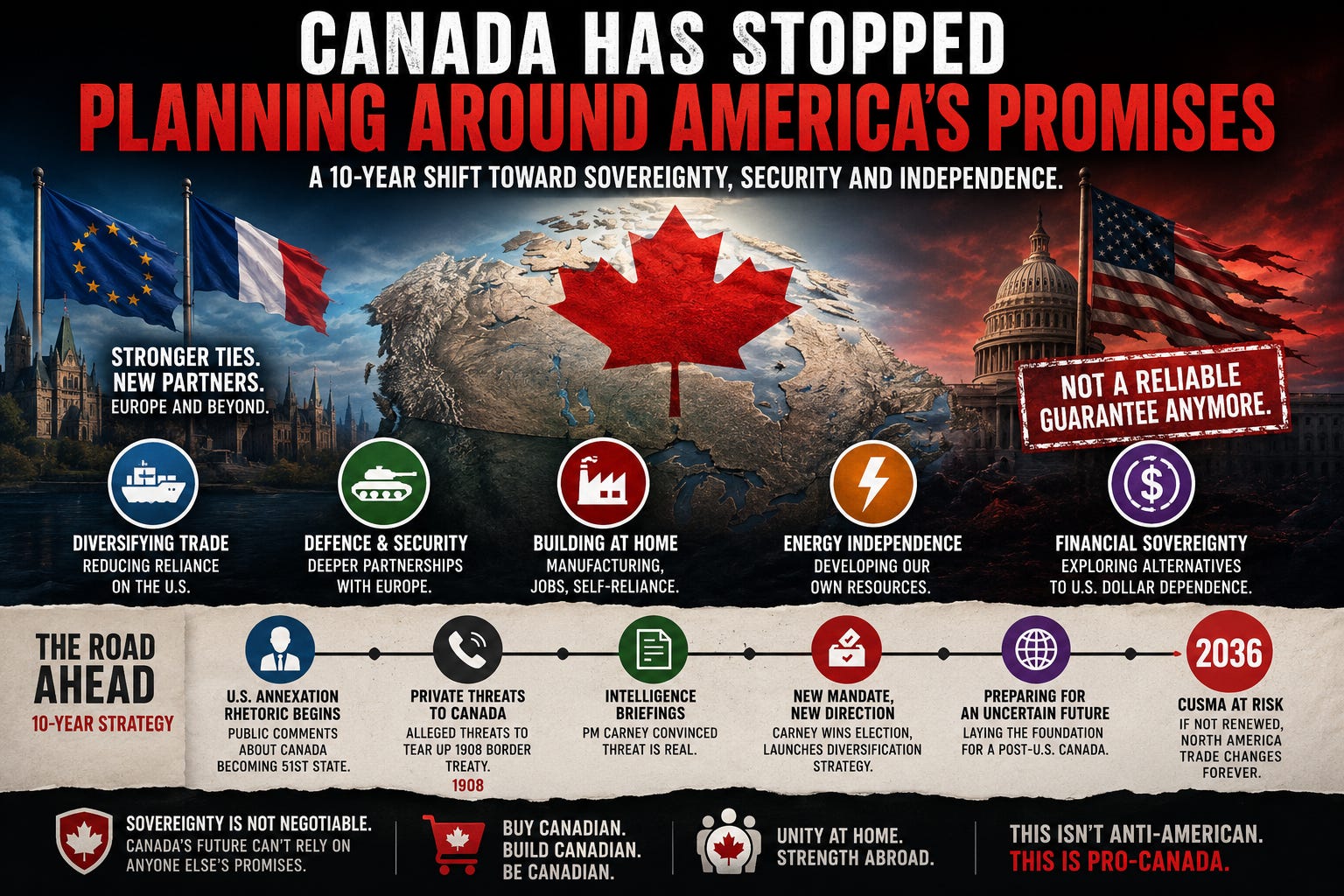
There comes a point when hope stops being a strategy.
For decades, Canada built its economy on one simple assumption… the United States would remain a stable friend, reliable customer, and predictable ally.
Governments changed. Presidents came and went. The relationship endured.
That assumption is now being questioned at the highest levels of government.
Recent reporting suggests Canadian leaders came to believe that talk about annexation wasn’t just political theatre.
Intelligence briefings reportedly convinced Prime Minister Mark Carney that Canada needed to prepare for a future where American pressure could extend far beyond tariffs and trade disputes.
Whether every reported claim ultimately proves accurate isn’t the point.
The point is this…
Canada’s behaviour has changed.
And governments don’t spend billions changing course unless they believe the risk is real.
Instead of treating Washington as the centre of every major decision, Ottawa is spreading its bets.
Trade is expanding beyond North America.
Military partnerships are deepening with European allies.
Technology, manufacturing and critical supply chains are increasingly being viewed through the lens of national security rather than simply lowest cost.
Even conversations about the future of global currencies are starting to reflect a world where relying too heavily on one country’s financial system may no longer be wise.
That represents one of the biggest strategic shifts Canada has made in generations.
The uncertainty surrounding CUSMA only adds to the urgency.
If the agreement isn’t renewed, North America’s trade relationship could look very different by 2036.
That’s close enough to influence decisions being made today, but far enough away to allow Canada time to prepare.
Ten years may sound like a long runway.
It isn’t.
Building factories takes years.
New energy infrastructure takes years.
Defence procurement takes years.
Finding new export markets takes years.
Waiting until the deadline arrives would guarantee failure.
That’s why the groundwork is already being laid.
We’re seeing stronger engagement with European partners, particularly France.
We’re seeing greater emphasis on rebuilding Canadian manufacturing.
We’re seeing more discussion about energy independence and domestic production.
We’re seeing governments encourage Canadians to support Canadian businesses whenever possible.
None of these are isolated events.
They’re pieces of the same puzzle.
At the same time, Canada faces another challenge from within.
Alberta’s separatist debate adds uncertainty at precisely the moment national unity matters most.
Regardless of where anyone stands politically, internal division only complicates Canada’s ability to respond to external pressure.
A country negotiating from a fractured position rarely negotiates from a position of strength.
This is also changing Canadian politics.
Issues that once sat quietly in the background… sovereignty, defence, supply chains, economic resilience and foreign influence… have moved to centre stage.
Even critics who initially dismissed concerns about annexation or strategic pressure have become noticeably more cautious as additional reporting has emerged.
That doesn’t mean every allegation has been proven.
It means the conversation has changed.
Perhaps the biggest lesson is this…
Countries don’t prepare for yesterday.
They prepare for what they think tomorrow might bring.
Canada appears to have concluded that depending too heavily on any single country… even our closest neighbour… is now a risk that needs managing.
That’s a remarkable change for a nation whose prosperity has long been tied to one border.
The next decade won’t be about walking away from the United States.
It will be about making sure Canada can stand firmly on its own feet if it ever has to.
That isn’t hostility.
It’s insurance.
And history has a habit of rewarding countries that buy insurance before they need it.
The Recap…
Canada isn’t acting like a country that expects everything to go back to normal.
It’s diversifying trade.
Strengthening European ties.
Rebuilding manufacturing.
Preparing for uncertainty instead of assuming stability.
That’s not panic.
That’s planning.
The Gut-Punch…
The biggest change isn’t what Washington is saying.
It’s what Ottawa now believes it has to prepare for.
Once trust becomes a strategic risk, you don’t build your future on promises… you build it on options.
Source Credit:
Research based on publicly reported developments, including reporting by The Wall Street Journal, statements by Canadian political leaders, public policy announcements, and ongoing Canada–U.S. trade and foreign policy developments.
If you enjoy thoughtful conversations, Canadian stories, and the occasional smart-ass observation about the world we’re living in, you’re in the right place.
Subscribe free and get new stories, insights, and observations delivered directly to your inbox.
No paywall.
No spam.
No nonsense.
Leave anytime with a single click.
I promise not to take it personally.
Great column Fred, the urgency to establish a strong foothold has never been greater. And all the while the Alberta MAPLE MAGA's are throwing a wrench into our PM's efforts to plot a course for Canada to survive. More than ever before, unity across our country is what is necessary to withstand the assault coming from the Trump authoritarian state.
🇨🇦💙 Our biggest assets? Our Premieres are united. We are united.
Carney is a pragmatic crisis manager who combines steady leadership, financial expertise, and a bias for action when duty calls. This will get messy. Please donate to your local food banks and ELBOWS UP.🫶🏼