

Most diplomatic speeches are forgettable.
Polished words. Safe language. Nothing that moves the needle.
This one was different.
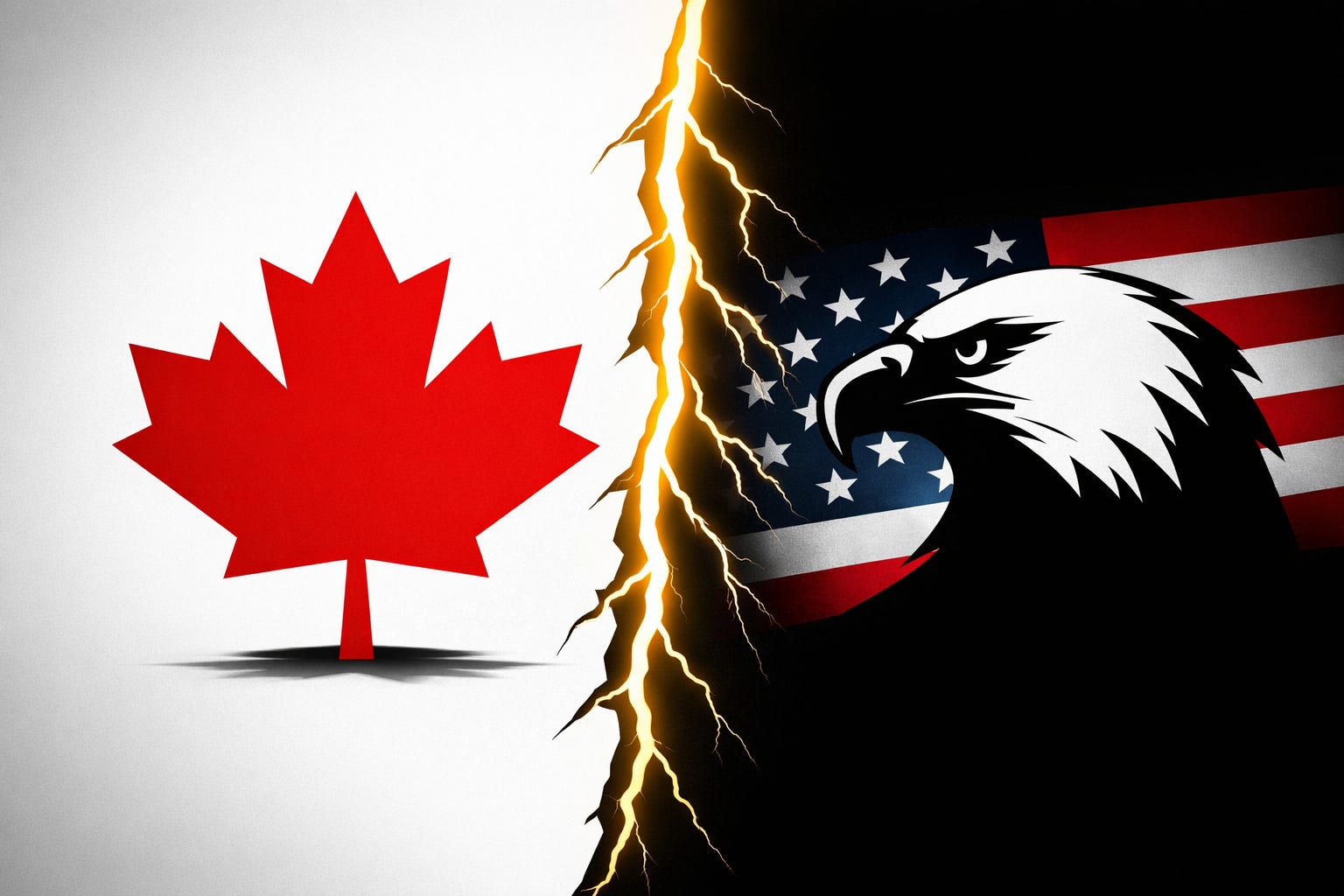
While visiting Australia, Prime Minister Mark Carney delivered a speech that essentially said the quiet part out loud… the old economic relationship with the United States is no longer safe for Canada to depend on.
And the reason is simple.
Economic power is now being used as a weapon.
Tariffs. Financial systems. Supply chains. Market access.
All tools that used to be about cooperation are increasingly used for pressure.
Carney’s message was blunt: when economic integration turns into leverage against you, it stops being partnership and starts becoming dependence.
Canada, he said, can’t afford that anymore.
The End of Comfortable Dependence
For decades Canada leaned heavily on the U.S. market.
Free-trade agreements deepened that relationship. Supply chains became tightly intertwined. Industries were built assuming stable access to the American economy.
That model made sense when the system was predictable.
But when a larger partner begins using tariffs or market access as bargaining tools, that integration becomes a vulnerability.
Carney framed the issue clearly… countries must not allow economic integration to become a source of subordination.
In other words, the convenience of the past created risks for the future.
Why Middle Powers Need Each Other
Carney didn’t pretend Canada can compete with great powers alone.
Large countries can dictate terms because they control massive markets and military strength.
Middle powers don’t have that luxury.
But they do have another option.
Work together.
Carney argued that countries like Canada and Australia should build networks of cooperation issue-by-issue… creating flexible coalitions that strengthen economic resilience without relying on a single dominant partner.
Instead of competing for favour with larger powers, middle economies can combine their influence.
It’s not about replacing one superpower with another.
It’s about spreading risk.
The Strategic Minerals Alliance
One of the most concrete examples discussed was critical minerals.
Canada and Australia together hold enormous reserves of resources needed for modern technology and defense industries.
Between them they produce…
• More than one-third of the world’s lithium
• Roughly one-third of global uranium
• Over 40% of iron ore production
Both countries also rank among the most attractive mining jurisdictions globally.
The two governments are working to strengthen cooperation in this sector, backed by a combined development fund worth roughly $25 billion to accelerate projects.
The goal is simple.
Build supply chains anchored in democratic countries rather than relying on geopolitical rivals or unstable partners.
Rethinking Defence Spending
Another major shift involves defence procurement.
Currently, about 70% of Canada’s defence capital spending flows to U.S. companies.
Carney acknowledged that this level of dependence doesn’t make strategic sense if Canada plans to expand its defence capabilities.
The government plans to invest $500 billion over the next decade in the broader defence ecosystem.
A major pillar of that strategy is building more capability domestically and cooperating with trusted allies.
One example already underway is joint development of Arctic over-the-horizon radar technology with Australia.
The message was clear… security partnerships must diversify as well.
Building a Network Instead of a Single Anchor
Canada has already begun shifting its approach.
According to the speech, the government has signed around 20 economic and security agreements across four continents in the past year alone.
Canada also became the first non-EU country to join Europe’s SAFE defence procurement initiative.
The objective is to create a dense web of partnerships so that no single country holds disproportionate leverage.
That kind of networked strategy doesn’t eliminate risk.
But it reduces vulnerability.
Trust as Strategic Capital
Carney ended on a theme that rarely gets attention in geopolitical analysis: credibility.
Countries that consistently honour agreements build long-term influence.
Canada and Australia, he argued, benefit from that reputation.
Their power doesn’t come from military size or economic dominance.
It comes from reliability.
In an era where alliances shift and agreements sometimes collapse, that kind of trust becomes a strategic asset.
The Bigger Coalition
Carney also pointed to something that rarely gets discussed.
If middle powers cooperate, their combined strength is significant.
Consider the economies of…
• Europe
• Canada
• Australia
• Japan
• South Korea
Together, that group represents…
• A combined GDP larger than the United States
• Roughly three times China’s trade flows
• The largest research and development investment pool in the world
• 62 of the world’s top 100 universities
That’s not a minor alliance.
It’s a massive economic bloc.
And if those countries coordinate strategically, they can shape global systems rather than simply react to them.
What This Really Means
The speech wasn’t just about Australia.
It was about the future of Canada’s foreign policy.
For decades Canada operated under a simple assumption… the American relationship would always be stable.
That assumption is now being reconsidered.
The strategy emerging in Ottawa is not confrontation.
It’s diversification.
More partners.
More supply chains.
More strategic autonomy.
Because relying too heavily on any one power… no matter how friendly… eventually becomes a risk.
And Canada appears determined not to repeat that mistake.
The Recap…
Canada’s Prime Minister just delivered a speech overseas that quietly revealed a major shift in strategy.
The message was simple…
Canada can’t depend on one economic partner anymore.
The future is alliances, diversification, and middle powers working together.
This may reshape global trade more than people realize.
The Gut-Punch…
Dependence looks like partnership… right up until the day it becomes leverage.
Source Credit:
Source: Speech remarks delivered by Prime Minister Mark Carney during his visit to Australia and the Lowy Institute policy forum.
🔎 The GeezerWise Standard
This space is built on disciplined thinking.
Facts over spin.
Verification before amplification.
Good-faith discussion over tribal noise.
I use AI tools to help shape my spoken drafts into clear writing.
The judgment, conclusions, and final message are mine.
If you’re new here, this explains how I decide what’s worth sharing:
How I Decide What’s Worth Sharing → [link]
💌 Subscribe at GeezerWise.com to receive future letters:
www.geezerwise.com/subscribe
— Fred Ferguson
GeezerWise
#CanadaStrong
Excellent, Geezer. Sir Wilfred Laurier said basically that the 19th century belonged to the United States and the 20th would belong to Canada. He was a century off in his famous statement. But with Carney, the 21st century might swing Canada’s way.
🇨🇦🚤⛵️🛥️🛳️⛴️🛶 A rising tide lifts all boats Thank you Carney for your long game..💙