

There’s a moment in every bad relationship when one person stops assuming the other will always be there.
That moment may have just arrived between Canada and the United States.
Because what’s happening right now isn’t really about submarines.
It’s about trust.
For decades, Canada operated like the quiet partner in a long military marriage.
America handled the big decisions. Canada stayed close, stayed loyal, and mostly stayed predictable.
Then something changed.
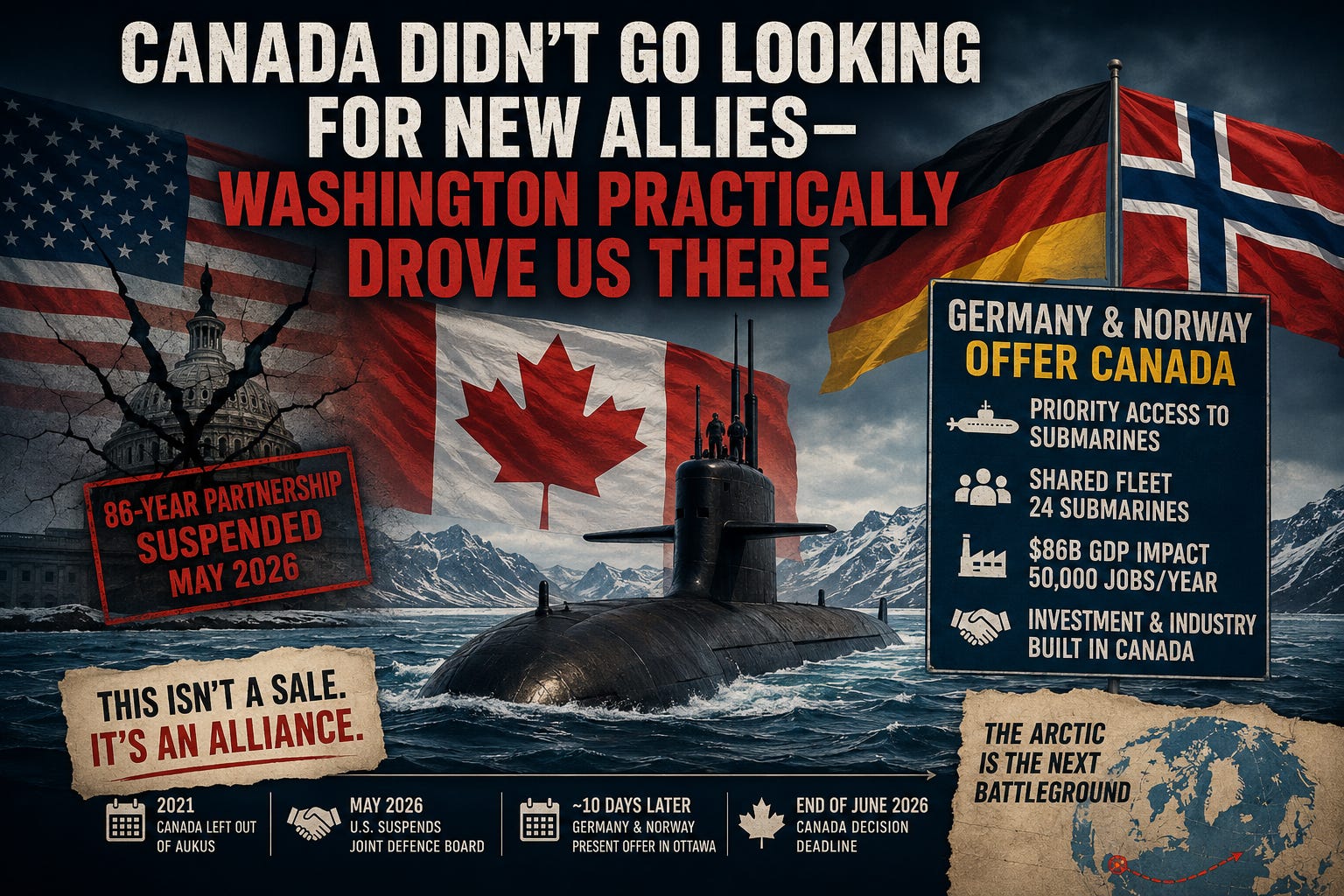
In May, Washington abruptly suspended the Permanent Joint Board on Defence… an 86-year-old Canada–U.S. military partnership that dates back to the Second World War. Eighty-six years.
Gone with the diplomatic equivalent of a shrug.
And here’s the interesting part…
Europe didn’t waste a second.
Roughly ten days later, Germany and Norway walked into Ottawa with something that looked less like a weapons contract and more like a geopolitical invitation.
Their message?
“You don’t have to stand outside the club anymore.”
Canada needs to replace its aging Victoria-class submarines… boats built in another era, for another world.
Ottawa wants 12 new submarines, and the stakes are enormous. We’re talking roughly $60 billion upfront and potentially $120 billion over the life of the program.
But this stopped being a normal procurement process a while ago.
Germany and Norway aren’t just selling submarines.
They’re reportedly willing to hand Canada priority production access by giving up spots from their own orders. Read that again.
Countries are offering to wait longer for their own military hardware so Canada can move faster. That’s not salesmanship.
That’s strategy.
The European proposal reportedly includes a shared submarine structure between Canada, Germany, and Norway… a coordinated fleet concept stretching to around two dozen submarines working together in the Arctic and North Atlantic.
Not separate silos. Shared capability. Shared security thinking.
And suddenly, Canada isn’t sitting at the kids’ table anymore.
Remember when we got frozen out of AUKUS back in 2021?
Australia, the U.K., and the U.S. built a submarine partnership and Canada wasn’t invited.
Plenty of Canadians swallowed that insult with the usual “well, that’s just how things work” shrug.
Funny how fast tables turn.
Now Europe seems to be saying…
“You want a serious seat? Pull up a chair.”
Of course, Germany and Norway aren’t the only players here.
South Korea is making a serious run at this contract too, and they’re not showing up empty-handed.
Their KSS-3 submarine bid reportedly includes faster delivery timelines… possibly arriving a year earlier… and they even demonstrated capability with a submarine voyage to Canada stretching roughly 15,000 kilometres.
That’s not subtle.
That’s industrial chest-thumping with receipts.
Meanwhile, Canada is sitting in an unusually strong position.
For once, we’re not begging for a seat.
We’re being courted.
Competing countries are offering jobs, industrial investment, shipbuilding, minerals partnerships, maintenance facilities, and long-term economic commitments inside Canada.
One estimate tied to the German proposal projects up to $86 billion in GDP impact and tens of thousands of jobs during the early years.
But let’s not pretend this is only economics.
This is foreign policy wearing a hard hat.
The real story here is bigger…
The world is quietly reorganizing itself.
The United States is still powerful… enormously powerful… but it’s no longer the automatic center of gravity for every Western alliance.
Countries are hedging.
Building backups.
Creating alternate routes.
And middle powers like Canada are starting to act less like junior partners and more like independent adults in the room.
That matters.
Especially in the Arctic.
Because while most people are arguing online about culture wars and political slogans, the grown-up countries are already thinking ten years ahead…
shipping lanes, critical minerals, sovereignty, military access, northern security.
The Arctic isn’t tomorrow’s issue.
It’s already the chessboard.
And if Washington thought sidelining Canada would force obedience?
That math may have backfired spectacularly.
Because nothing motivates independence quite like being reminded you’re disposable.
The Recap…
Canada’s submarine decision suddenly became much bigger than submarines.
After Washington weakened an 86-year military partnership, Germany and Norway stepped in fast… offering Canada priority access, shared defense plans, and something even bigger: options.
This may be the moment Canada quietly stopped assuming the U.S. would always be the center of the room.
The Gut-Punch…
Sometimes the fastest way to lose influence is to remind your closest partner they might not actually need you as much as you thought.
Source credit:
Research based on reporting, defense analysis, procurement timelines, and geopolitical developments surrounding Canada’s submarine replacement program and allied defense shifts.
🔎 The GeezerWise Standard
This space is built on disciplined thinking.
Facts over spin.
Verification before amplification.
Good-faith discussion over tribal noise.
I use AI tools to help shape my spoken drafts into clear writing.
The judgment, conclusions, and final message are mine.
If you’re new here, this explains how I decide what’s worth sharing:
How I Decide What’s Worth Sharing → [link]
💌 Subscribe at GeezerWise.com to receive future letters:
www.geezerwise.com/subscribe
— Fred Ferguson
GeezerWise
#CanadaStrong
I'm not so sure that TKMS (the German/Norwegian company) responded because of the US "pausing" the joint board. I interpreted it more as a response to the KSS-III proposal from South Korea (which, besides subs, was looking at establishing a military/heavy-duty vehicle manufacturing plant in Canada, if not a Hyundai factory/partnership too.) And with Hanwha Ocean is known for meeting delivery deadlines and promised four subs by 2030 or so. So TKMS had to sharpen their pencils/spreadsheets -- and they did (though bumping two of Germany's and Norway's subs in the production line to do it). And I think, besides doing a lot of the manufacturing in Canada now, they're still bringing Volvo/Audi to the table too, for some aspects of vehicle manufacturing.
But your broad point is really REALLY spot-on: Canada is aggressively being courted!
This will be a very difficult decision: Go with Europe, and we end up with a highly integrated sub-fleet, with the potential for other joint integrations that are even deeper than those in the current NATO. This is hugely significant, giving an integrated sub fleet of 24 boats (12 Canadian, 6 Norwegian, 6 German) with Arctic coverage being the focus.
But with the Korean bid, it's also a chance to do similar naval development in the Asian/Pacific theatre.
Technically/strategically, we want/need to do both. But really can't. This one is going to be tough!
(Picking Gripens will be a heck of a lot easier!)
I love love love this post Fred. I have read up on some of it, but, you gathered it all together in your usual spectacular way. I feel like the divorce papers are signed & so much love & respect showed up on our doorstep & waterways, with open hands & hearts, from so many countries who all love Canada & Canadians & our PM, because we all have very similar values. Thank you :)