

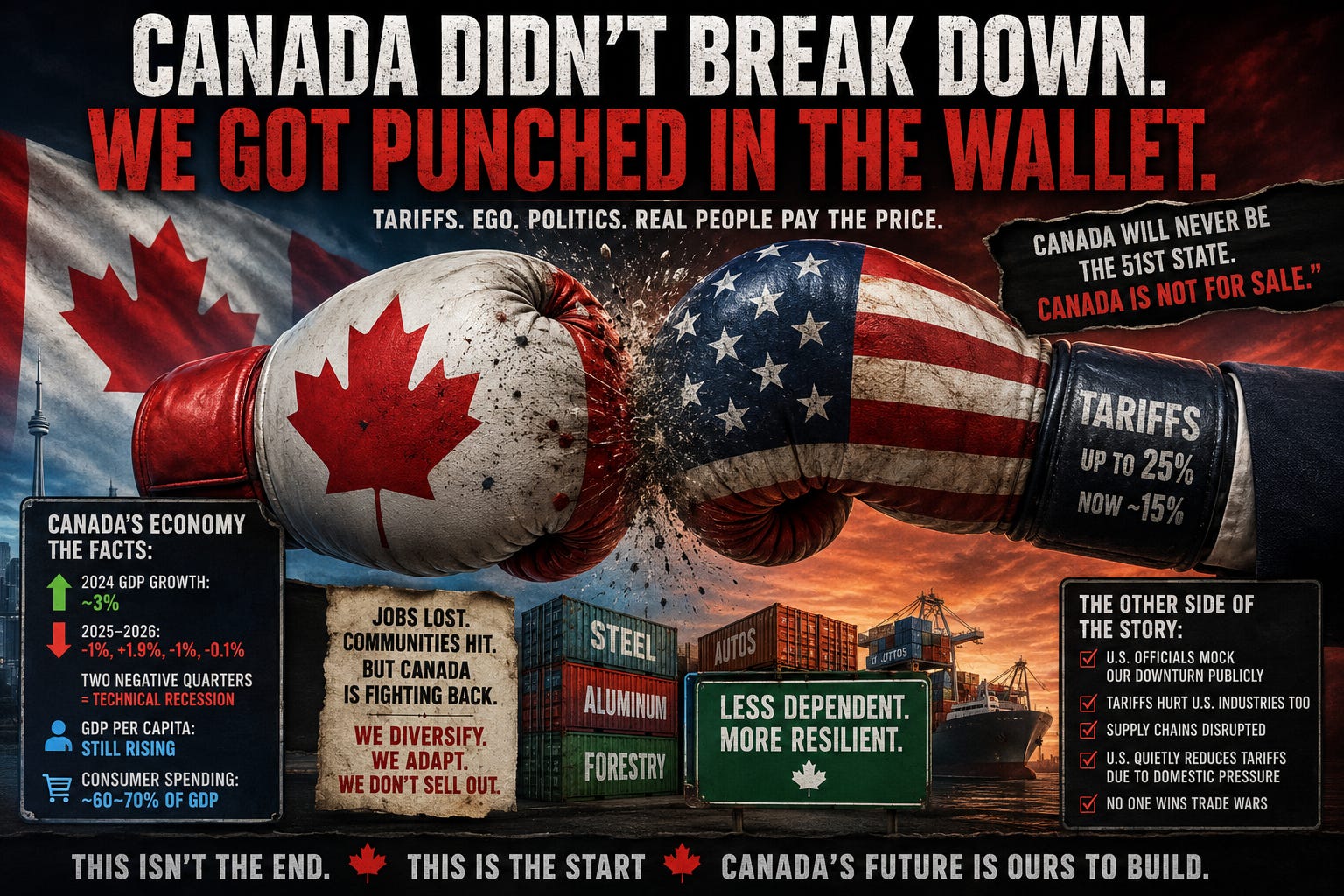
For months, Canadians have been hearing the word recession thrown around like the country just drove into a ditch.
Slow down.
Yes, Canada slipped into what economists call a technical recession — two consecutive quarters of negative growth. That part is true.
But if you’re picturing breadlines, boarded-up factories, and the economic apocalypse some folks online seem oddly excited about, you’re watching the wrong movie.
What actually happened is simpler.
Our biggest customer started picking a fight.
The trouble began when Washington rolled out tariffs aimed squarely at sectors Canada depends on…
Steel, Aluminum, Forestry, and Auto Manufacturing.
Some tariffs landed around 25%, with reductions later in select areas after pressure started building inside the United States itself.
Funny how principles get flexible when voters start complaining.
Let’s call this what it was… economic pressure.
The message wasn’t subtle.
Move production south. Depend less on Canada. Fall in line.
And when your economy has spent decades tied closely to one trading partner, that kind of hit lands hard.
Ontario took punches. Manufacturing jobs started wobbling. Forestry regions felt it. Steel and aluminum sectors got squeezed.
Workers in export-heavy industries suddenly found themselves wondering whether the next shift would be the last.
That uncertainty matters.
But here’s the part that got buried under the screaming headlines.
Canada didn’t collapse.
Not even close.
Before all this started, Canada was posting roughly 3% GDP growth in 2024… steady, boring, normal growth.
Then came tariffs, disrupted supply chains, political gamesmanship, and uncertainty.
Growth turned choppy.
One quarter down.
One quarter up.
Another quarter down.
Eventually, two negatives stacked together and economists stamped the label: technical recession.
That word sounds dramatic. The reality? More like stagnation with a limp.
Consumer spending… which makes up roughly 60–70% of Canada’s economy… kept acting like shock absorbers on a rough road.
People still bought groceries. Still paid bills. Still carried on.
Some economists even argue the numbers looked worse than reality because of unusual factors distorting GDP calculations.
Meanwhile, an awkward little fact rarely makes the headlines:
GDP per person actually kept rising.
In plain English?
The country slowed down, but the sky didn’t fall.
Now here’s where things got weird.
Instead of treating Canada like a longtime ally taking an economic hit, some American political figures decided this was a good time to celebrate.
Public mockery started showing up online.
The old “51st state” garbage got dusted off again.
Nothing says friendship like kicking your neighbour while they’re already limping.
That didn’t go over well up here.
Because Canadians can tolerate a lot.
We’ll argue about politics.
We’ll complain about taxes.
We’ll even apologize after somebody else bumps into us.
But disrespect?
That tends to wake people up.
You can feel the shift happening.
“Buy Canadian” stopped being a slogan and started becoming habit.
Governments started talking more seriously about trade diversification.
More conversations with Europe.
More work with Asia.
More attention on Mexico.
In short… fewer eggs in one basket.
And honestly?
Maybe this overdue kick in the pants was necessary.
Canada got comfortable.
Too comfortable.
When one customer buys most of your stuff, they own more leverage than you’d like to admit.
Losing part of that relationship hurts.
But it also forces reinvention.
Businesses diversify or die.
Countries eventually learn the same lesson.
And here’s the irony in all this:
While some U.S. politicians were publicly mocking Canada’s slowdown, Washington quietly started easing back on parts of the tariff pressure.
Not out of kindness.
Out of self-interest.
Because tariffs don’t just hurt the target.
They boomerang.
American industries got squeezed too. Supply chains jammed up. Costs climbed. Political pressure started building back home.
Turns out nobody escapes economic gravity.
That old warning from economists?
Nobody wins trade wars.
Looks like reality finally caught up.
So yes… Canada hit turbulence.
Yes… jobs were lost.
Yes… growth stalled.
But this wasn’t collapse.
This was a wake-up call.
The bigger story isn’t that Canada stumbled.
It’s that we’re finally realizing what happens when one customer has too much power over your future.
And maybe… just maybe… getting shoved out of the nest is exactly what teaches you how to fly on your own.
The Recap…
Canada technically slipped into a recession.
But let’s be honest…
This wasn’t economic collapse.
This was what happens when your biggest customer starts throwing elbows… and suddenly reminds you how dependent you’ve become.
The strange part?
The harder Washington pushed… the more Canadians started asking one question:
Maybe it’s time we stop building our future around America.
The Gut-Punch…
Sometimes the thing that hurts you the most is the thing you depended on the longest.
Source credit:
Based on economic reporting, GDP data, tariff developments, and Canada–U.S. trade coverage compiled from research notes and public reporting.
🔎 The GeezerWise Standard
This space is built on disciplined thinking.
Facts over spin.
Verification before amplification.
Good-faith discussion over tribal noise.
I use AI tools to help shape my spoken drafts into clear writing.
The judgment, conclusions, and final message are mine.
If you’re new here, this explains how I decide what’s worth sharing:
How I Decide What’s Worth Sharing → [link]
💌 Subscribe at GeezerWise.com to receive future letters:
www.geezerwise.com/subscribe
— Fred Ferguson
GeezerWise
#CanadaStrong
I trust Mark Carney. What i hate is the conservative leader who's name I wont speak out loud. He tries to divide us. As all the conservatives do now. PeePee lies just like trump
Some of our Prime Ministers allowed US ownership and privileges more than others. Now we are paying the price.