

There are two trade negotiations happening between Canada and the United States right now.
One is happening between governments.
The other is happening at the liquor store.
And Donald Trump only has a seat at one of those tables.
Canada is reportedly considering ending provincial restrictions on American alcohol as part of a much larger trade bargain with Washington.
Other possible Canadian concessions include removing retaliatory tariffs on U.S. automobiles and making changes involving dairy policy.
In return, Canada wants meaningful relief from American tariffs hitting steel, aluminum, lumber and autos… along with movement back toward formal Canada-U.S.-Mexico trade talks.
That is government business.
Mark Carney’s government has to look at the whole Canadian economy.
Jobs. Factories. Forestry. Metals. Autos. Agriculture.
Families whose livelihoods can get clobbered when somebody in Washington decides tariffs make good television.
If putting Jack Daniel’s back on a shelf helps protect Canadian jobs, you make the calculation.
That’s what governments are supposed to do.
But here’s the part Washington may be missing.
Putting American booze back on Canadian shelves doesn’t mean Canadians are going to buy the stuff.
And the numbers suggest this isn’t some passing tantrum.
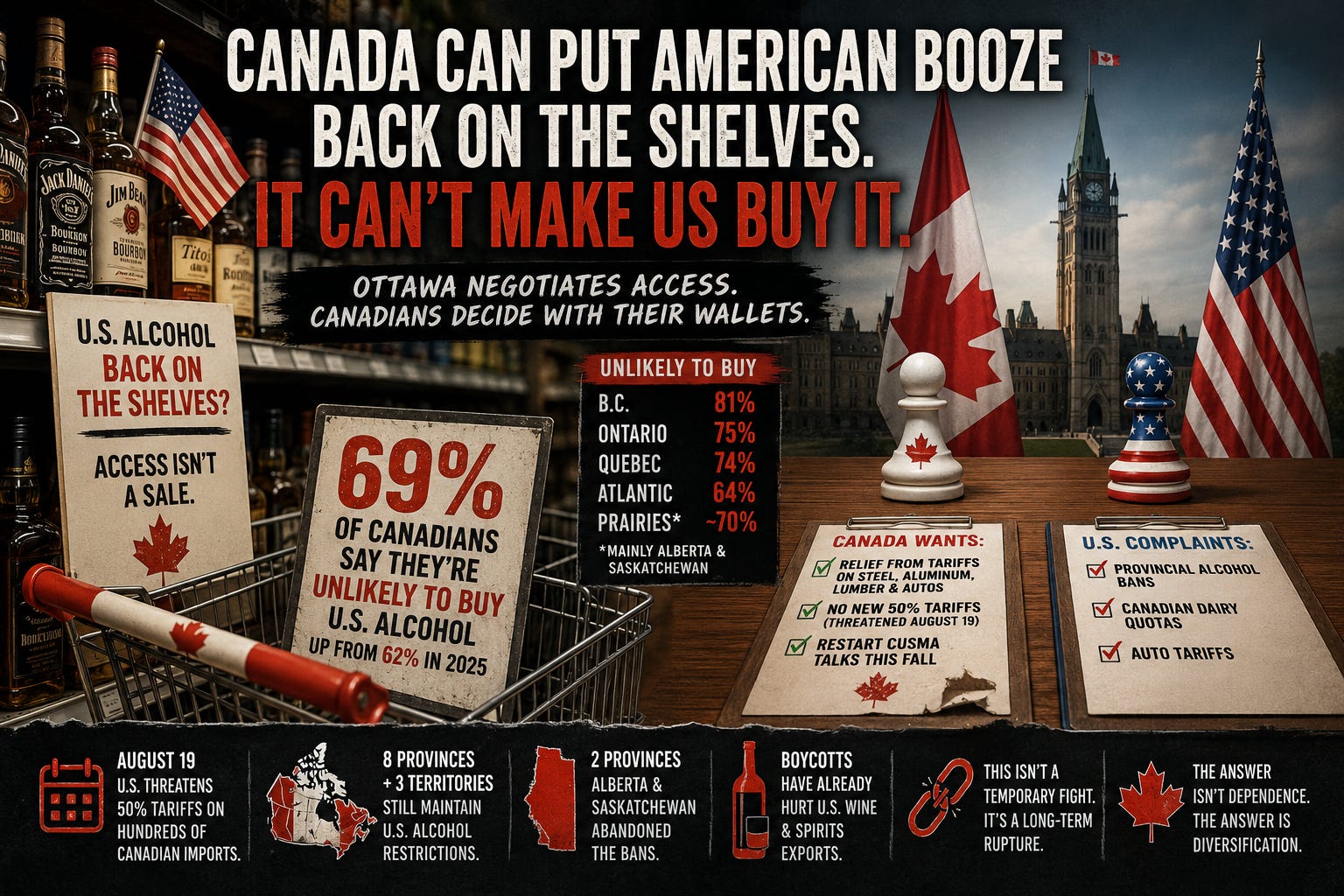
According to polling cited in the source material, 69% of Canadians surveyed in late July said they were unlikely to buy American alcohol if it returned to stores.
A year earlier, that figure was 62%.
The boycott didn’t weaken.
It grew.
British Columbia was reportedly the hardest line of all.
Nearly 81% said they were unlikely to buy American alcohol.
Ontario came in around 75%.
Quebec: 74%.
Even the Prairie grouping was reportedly close to 70%.
That’s not Doug Ford issuing an order.
That’s not David Eby signing something.
That’s Canadians standing in front of a shelf and making a choice.
The Government Can End a Ban. It Can’t End a Boycott.
This is where the trade fight changed.
The original liquor restrictions were government actions. Provinces removed or restricted American alcohol after the United States began imposing trade penalties on Canada.
Eight provinces and three territories reportedly still maintain restrictions.
Alberta and Saskatchewan broke ranks and ended theirs.
But somewhere along the way, something bigger happened.
The government boycott became a consumer boycott.
Those are two very different animals.
A premier can order American bourbon back onto a shelf Tuesday morning.
Nobody can order me to put it in my cart Tuesday afternoon.
That’s the beauty of this thing.
Canada can use the liquor restrictions as a bargaining chip without Canadians surrendering their own leverage.
Ottawa can say…
We’ll restore access.
Fine.
Access granted.
But access isn’t a sale.
That’s a Problem for American Producers
For decades, Canadian companies were told the same thing whenever international competition arrived:
Nobody owes you a customer.
Welcome to the lesson.
American wine and spirits producers can regain access to Canadian shelves and still discover that the Canadian customer they used to have isn’t coming back.
Maybe that customer discovered an Ontario whisky.
A British Columbia wine.
A Quebec gin.
Maybe they found something from Scotland, France, Italy, Australia or somewhere else entirely.
Or maybe they’re simply pissed off.
Consumer habits are funny things.
Companies spend fortunes trying to create them.
Once you’ve forced people to break a habit, getting it back can be considerably harder.
And that’s why this trade war may have accomplished something tariffs alone couldn’t.
It forced Canadians to look around.
Alberta and Saskatchewan Gave Away Their Card Early
There is another lesson here that shouldn’t get buried.
Canada is stronger when Canada negotiates together.
Most provinces and territories maintained the alcohol restrictions.
Alberta and Saskatchewan didn’t.
They abandoned them.
Whatever argument their governments had for doing that, the result was obvious:
Canada had one less bargaining chip.
That’s how leverage works.
You don’t throw your cards on the table before the hand is finished because you’d rather play your own little game.
Provincial autonomy matters.
So does recognizing when another country is applying pressure to Canada.
Those aren’t mutually exclusive ideas.
And Washington certainly understands the value of division.
If Canadian governments start negotiating against each other instead of with each other, somebody else gets the advantage.
It isn’t Canada.
Now Comes the 50% Threat
The immediate stakes are serious.
The source material reports that Washington is threatening 50% tariffs on hundreds of Canadian imports, with August 19 identified as the deadline.
Canada wants relief not only from those threatened tariffs but from existing sectoral tariffs affecting steel, aluminum, lumber and autos. American negotiators, however, reportedly aren’t offering to eliminate all of those existing tariffs.
That leaves Canada with a pretty straightforward question:
What exactly are we getting for what we’re giving?
If dropping the liquor restrictions helps secure substantial protection for Canadian workers and industries, there’s a deal worth discussing.
If Canada gives up leverage and gets another temporary promise that can disappear with the next presidential mood swing?
Different story.
Because this fight stopped being about whisky months ago.
It’s about reliability.
Canada Has Learned Something Bigger
For most of my lifetime, Canada could make one enormous assumption:
Whatever disagreements we had with Washington, the United States would remain our dependable economic partner.
We built an astonishing amount of our economy around that assumption.
Maybe too much.
Now Canadians are discovering the cost of depending so heavily on one customer.
That doesn’t mean cutting America off.
That’s nonsense.
The United States will remain one of Canada’s most important trading partners.
But important and indispensable aren’t the same word.
Canada needs more customers.
More suppliers.
More domestic production.
More east-west trade.
More Europe.
More Asia.
More Mexico.
More options.
Because options are leverage.
And dependence is leverage somebody else owns.
The source material itself points toward the larger strategic shift: diversify Canadian trade and reduce long-term exposure to American policy changes.
That’s the real story hiding behind the liquor shelf.
Ottawa Negotiates. We Shop.
I actually think Canadians can hold two ideas in their heads at the same time.
The federal government should negotiate whatever sensible agreement best protects Canada’s economy.
And Canadian consumers can continue deciding where their own money goes.
Those aren’t contradictory.
They’re complementary.
Carney’s job is protecting the macro economy.
Our job is deciding what deserves our twenty bucks.
So if American bourbon comes back, fine.
Put it on the shelf.
Put a little price tag underneath it.
Dust it occasionally.
Because the most interesting number in this entire story isn’t 50%.
It’s 69%.
That’s the percentage of Canadians in the cited poll who reportedly said they were unlikely to start buying American alcohol again.
Up from 62%.
Washington can negotiate with Ottawa.
It can pressure premiers.
It can threaten tariffs.
It can demand market access.
But there’s one thing Donald Trump can’t negotiate.
What Canadians decide to do with their own damn wallets.
The Recap…
Canada may offer to end provincial restrictions on American alcohol as part of a bigger tariff deal.
But 69% of Canadians surveyed reportedly say they’re still unlikely to buy it.
That’s the part Washington can’t negotiate.
Getting back onto the shelf isn’t the same as getting back into the shopping cart.
The Gut-Punch…
Governments can reopen markets. They can’t restore trust by decree.
America may get its booze back onto Canadian shelves.
Getting Canadians back as customers could take a hell of a lot longer.
Source credit: Based on the supplied research transcript covering Canada-U.S. trade negotiations, provincial U.S. alcohol restrictions, threatened 50% tariffs, and July 28–30, 2026 polling on Canadian consumer intentions. Polling figures and negotiation details are presented as reported in that source material and have not been independently verified here.
If you enjoy thoughtful conversations, Canadian stories, and the occasional smart-ass observation about the world we’re living in, you’re in the right place.
Subscribe free and get new stories, insights, and observations delivered directly to your inbox.
No paywall.
No spam.
No nonsense.
Leave anytime with a single click.
I promise not to take it personally.
The political language around this felt very transparently tongue and cheek and in some ways bafflingly exposes even further how incompetent Republican politicians can be
Like ya Carney can put it in writing that they’ll stop the booze ban and put It back on the shelves but do these idiots not realize it’s the PEOPLE that started this?
We’re the ones who have control over what we do and don’t buy, personally this was the easiest boycott for me because I don’t really drink much alcohol in general, the only time I do is at social gatherings (bars, parties etc)
I'm not sure that we have straight-forward answers to why AB and SK "folded too early." Probably a combination of "all of the above" -- and you can put whatever thoughts you want into the "above" bucket.
Both AB's CPC and SK's Sask Party have significant right-wing electorate -- though not the whole of the parties think this way. Much like American Republicans -- not all are MAGA.
I suspect that Moe -- who is extremely good at talking logic to these things, to cover up whatever real reasons they had for doing it -- would be the first to state the exact point that I suspect all of us would say: "we can put it on the shelves -- but how many people will actually BUY it? Those that don't buy it - well, see Americans, we TOLD you. Don't blame my government. For those that do, well, we respect your right to do that (and remember who to vote for during the next election!)"
Whatever. From what I can discover, American alcohol sales in both provinces is substantially lower than what it was before.