

For decades, the United States had a simple assumption about Canada.
If Washington squeezed hard enough, Ottawa would eventually blink.
That assumption is getting expensive.
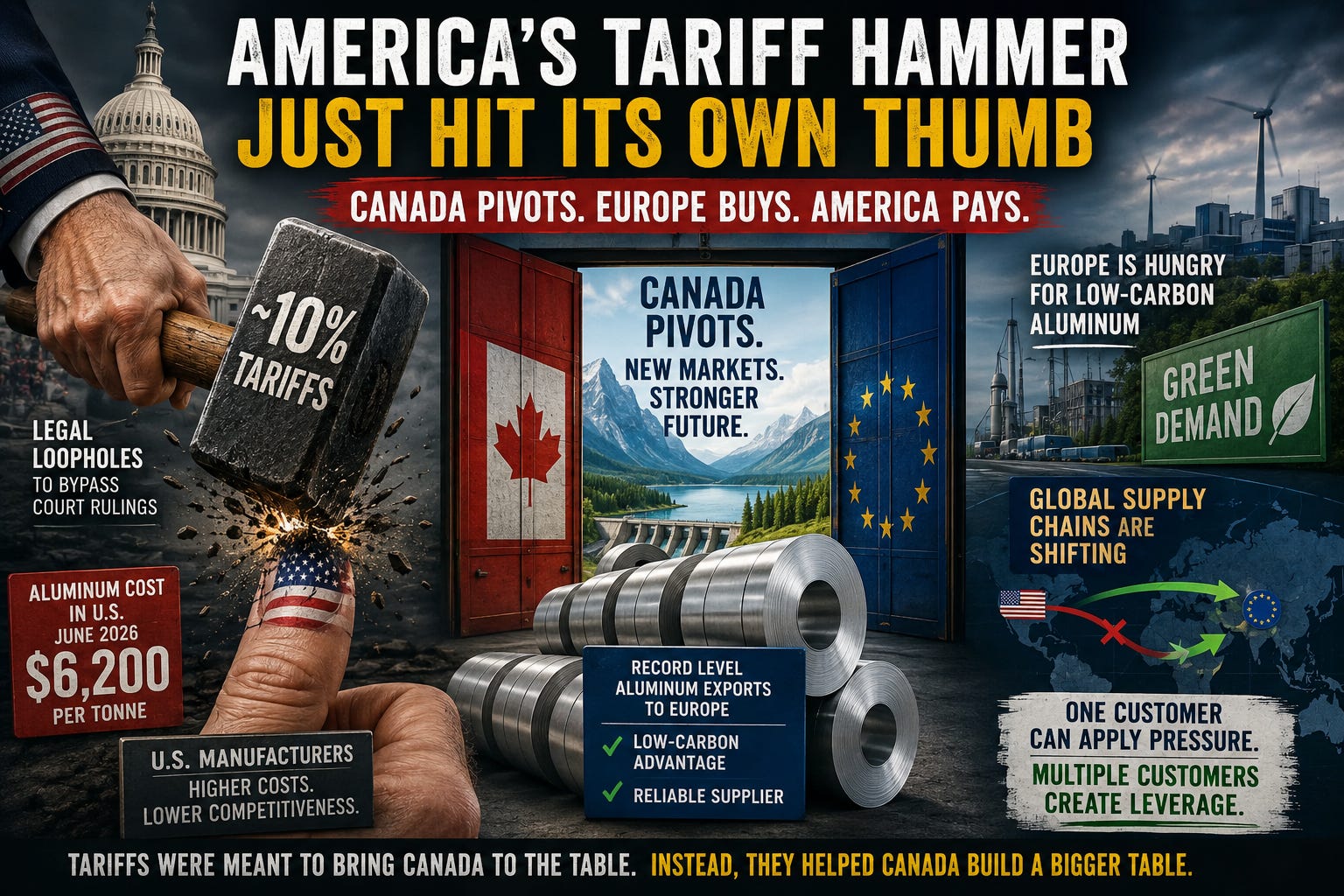
The latest threat coming out of the United States is another round of tariffs on Canadian goods, reportedly around 10%.
What’s different this time is how they’re trying to do it.
Previous tariff actions ran into legal trouble in American courts.
Now there are signs Washington is looking for legal workarounds to achieve the same result through a different route.
The timing isn’t accidental.
Trade negotiations under CUSMA are approaching, and tariffs have become less of an economic policy and more of a negotiating tactic.
The message is simple… apply pressure first, negotiate second.
The problem is that Canada isn’t standing in the same place it was a few years ago.
While Washington was busy reaching for the tariff toolbox, Canada was quietly building new customers.
And Europe was waiting.
One of the biggest shifts has happened in aluminum.
Europe’s push toward cleaner manufacturing has created enormous demand for low-carbon materials.
That’s where Canada suddenly looks very attractive.
Our aluminum industry runs largely on hydroelectric power, giving Canadian producers an environmental advantage that many competitors simply can’t match.
European buyers noticed.
Canadian aluminum exports to Europe have surged as manufacturers scramble to secure cleaner supply chains for automobiles, electric vehicles, construction materials, and industrial production.
That changes the entire negotiating landscape.
A country that depends on one customer can be bullied.
A country with multiple customers can negotiate.
Meanwhile, the tariff strategy appears to be producing some unintended consequences south of the border.
American manufacturers that rely on aluminum aren’t celebrating.
They’re paying more.
By June 2026, aluminum prices in the United States had climbed to roughly $6,200 per tonne.
That’s a cost increase that eventually works its way through factories, supply chains, and consumer prices.
In other words, the tariff weapon designed to pressure Canada is also hitting American industry.
Again.
That’s becoming a pattern.
Washington imposes tariffs to strengthen domestic competitiveness.
Domestic manufacturers end up paying more for raw materials.
Foreign suppliers find new markets.
Then Washington wonders why the leverage isn’t working the way it used to.
The larger story isn’t really about aluminum.
It’s about power.
For generations, Canada built much of its economy around access to the American market.
It made sense at the time.
The United States was the biggest customer next door.
But putting too much of your future in the hands of one customer comes with risks.
We’re seeing those risks play out in real time.
Every new tariff threat, every trade dispute, every attempt at economic coercion pushes Canada to diversify faster.
Europe isn’t replacing the United States overnight.
Nobody serious is claiming that.
What is happening, however, is something far more important.
Canada is proving it has options.
And options create leverage.
The irony is almost impossible to miss.
The United States is using tariffs to increase its bargaining power before trade talks.
Instead, those same tactics are accelerating Canada’s search for alternative markets, strengthening Canada-Europe ties, and raising costs for American manufacturers.
That’s not exactly a winning strategy.
If one door closes, Canada is no longer standing there waiting for permission to come back in.
We’re already walking through another one.
The Recap...
Washington is reportedly preparing new tariffs on Canadian goods ahead of trade talks.
A few years ago that might have worked.
Today, Canada is selling more low-carbon aluminum into Europe while American manufacturers face aluminum costs approaching $6,200 a tonne.
The pressure campaign is still happening.
The difference is Canada now has somewhere else to sell.
The Gut-Punch...
The biggest mistake in business is depending on a customer who thinks you have nowhere else to go.
Canada is finally proving that we do.
And every tariff threat makes that lesson a little clearer.
Source credit:
Research compiled from trade reports, aluminum market data, CUSMA negotiation developments, and public reporting on Canada-Europe trade diversification trends.
🔎 The GeezerWise Standard
This space is built on disciplined thinking.
Facts over spin.
Verification before amplification.
Good-faith discussion over tribal noise.
I use AI tools to help shape my spoken drafts into clear writing.
The judgment, conclusions, and final message are mine.
If you’re new here, this explains how I decide what’s worth sharing:
How I Decide What’s Worth Sharing → [link]
💌 Subscribe at GeezerWise.com to receive future letters:
www.geezerwise.com/subscribe
— Fred Ferguson
GeezerWise
#CanadaStrong
Great post Fred! Doesn't orange man realize it is useless to offer us used bubblegum? We are moving to cleaner countries, friendlier people, smiling, charming negotiations :)
You know we have the Greer/Trump really worried if they use the expression "you don't have the cards" . . . . ;-)
Though "we don't need anything from you" is a close second. The aluminum is a critical example -- everybody needs it right now (if doing most military or high-tech manufacturing). Almost all Canadian aluminum (used to) goes States-side. Now, at least half of it goes to Europe (and as you noted, the stuff that is sold to USA is now 25% more expensive.