

For decades, Canada lived with one uncomfortable truth…
When America sneezed, we reached for the tissues.
The tariff war may end up being the event that finally changed that.
Washington launched tariffs claiming foreign countries would pay the price while American manufacturing roared back to life.
It sounded simple enough. Charge imports. Protect workers. Shrink the trade deficit.
Reality had other ideas.
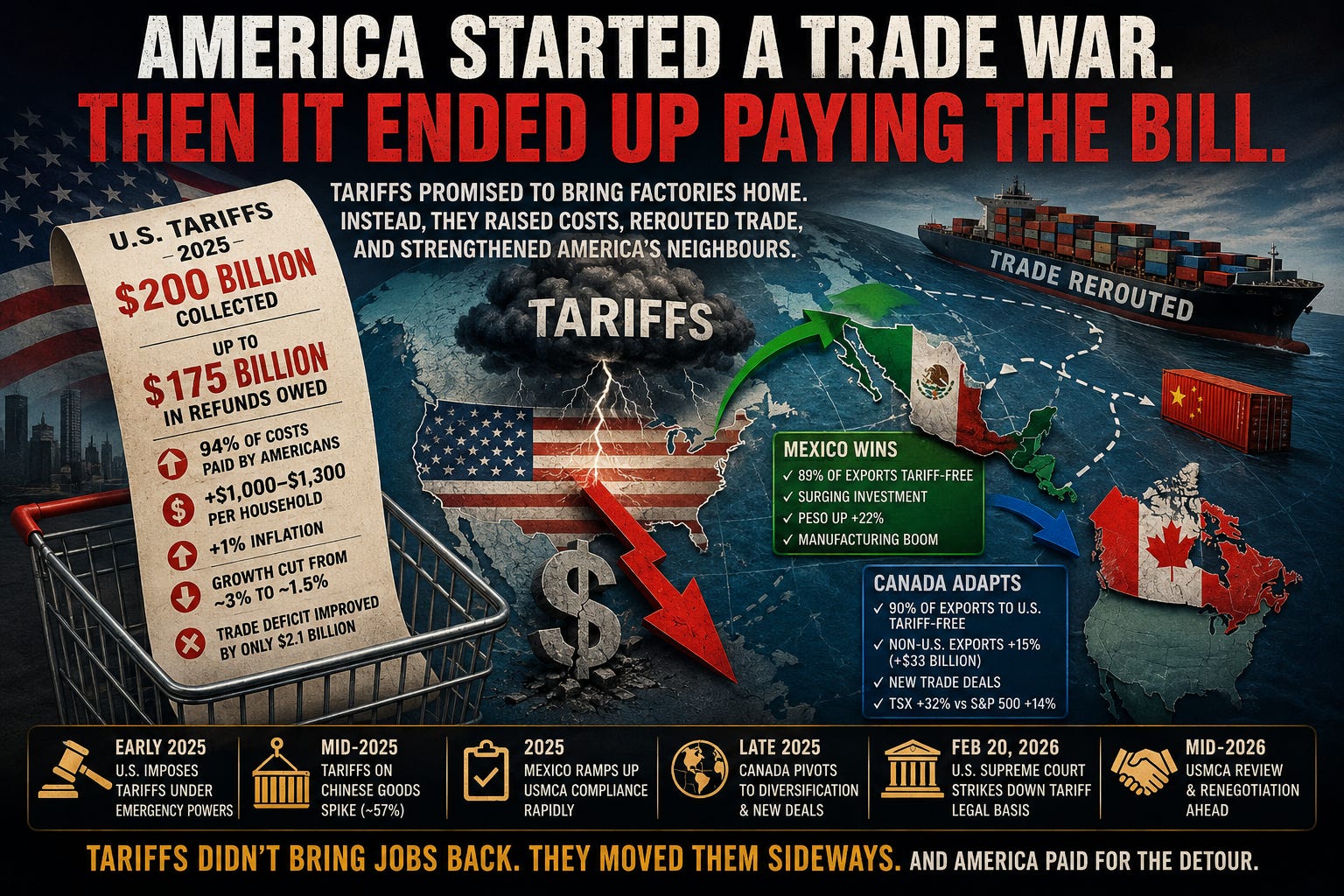
By the end of 2025, the United States had collected roughly $200 billion in tariff revenue. Sounds impressive until you ask a simple question.
Who actually wrote the cheque?
Study after study reached the same conclusion.
Most of the cost never landed on foreign governments.
It landed on American importers, American businesses and, eventually, American families standing in checkout lines.
Estimates suggest between 86% and 94% of those tariff costs stayed inside the United States, adding roughly $1,000 to $1,300 a year to the average household budget while nudging inflation higher.
That’s not exactly sticking it to China.
The bigger surprise is that the policy barely achieved its stated goal.
America’s enormous trade deficit improved by only about $2.1 billion… a rounding error measured against a deficit worth hundreds of billions.
That’s like spending thousands of dollars renovating your house only to discover you fixed one loose doorknob.
Meanwhile, economic growth slowed sharply. Forecasts that once pointed toward roughly 3% growth slipped closer to 1.5%, leaving Americans paying more without getting much in return.
While Washington was fighting yesterday’s trade battle, Mexico quietly started winning tomorrow’s.
Instead of complaining about tariffs, Mexican manufacturers learned to play by the rules of the USMCA.
Companies restructured supply chains, increased North American content and qualified for tariff-free access.
The result?
The share of Mexican exports entering the U.S. without tariffs jumped from roughly 45% to nearly 89%.
Investment followed.
Manufacturing expanded.
The peso strengthened dramatically against the U.S. dollar.
Mexico didn’t beat the system.
It simply learned how the system worked faster than everyone else.
China also proved something governments often forget.
Global supply chains are incredibly adaptable.
When direct exports became expensive because average tariffs climbed toward 57% on many Chinese goods, companies found another route.
Some production shifted through Mexico.
Some components moved across multiple borders before reaching American consumers.
Trade didn’t stop.
It simply took a different road.
That’s the thing about modern supply chains.
Block one highway and traffic immediately finds another.
Canada didn’t escape unscathed.
Steel.
Automotive manufacturing.
Export-heavy industries.
Many communities in Ontario and Quebec felt real pain.
Canadian households also faced higher costs, with estimates suggesting annual impacts approaching $1,700 to $2,000.
But something unexpected happened.
Instead of spending every waking hour retaliating against Washington, Canada gradually started asking a different question.
“What if we stopped putting almost all our eggs in one basket?”
That question changed everything.
Trade missions expanded.
New agreements were signed.
Exports to countries outside the United States grew by roughly $33 billion, an increase of about 15%.
Today, roughly 90% of Canadian exports entering the U.S. remain tariff-free, while Canada is becoming less dependent on a single customer than at any point in recent history.
Pain forced diversification.
And diversification builds resilience.
Then came the legal twist.
In early 2026, the U.S. Supreme Court struck down much of the executive authority used to justify these emergency tariffs.
Suddenly, a policy sold as a show of strength was standing on shaky legal ground.
That decision could eventually require as much as $175 billion in tariff refunds while weakening Washington’s leverage heading into the upcoming USMCA review.
It’s difficult to negotiate from a position of strength when the legal foundation beneath your strategy has already started to crack.
Perhaps the biggest lesson isn’t about America, Canada or Mexico.
It’s about how the world works now.
Governments still think they can reshape global commerce with blunt instruments.
Businesses think in spreadsheets.
Supply chains think in alternatives.
Capital thinks in opportunities.
The faster those things move, the harder it becomes for any government to force a particular outcome.
Tariffs didn’t bring the world back to the way it used to be.
They simply encouraged the world to find another route.
The Recap…
The trade war didn’t unfold the way its architects promised.
Americans paid most of the bill.
Mexico adapted faster than anyone expected.
Canada absorbed some hard hits… but finally accelerated the diversification it had been talking about for years.
Sometimes the biggest changes don’t come from winning the fight.
They come from realizing you shouldn’t be fighting the same battle anymore.
The Gut-Punch…
The biggest surprise wasn’t that tariffs failed to stop global trade.
It was discovering that in a connected world, supply chains can change direction faster than governments can change policy.
Canada didn’t come out untouched.
But for the first time in decades, we also came out looking beyond Washington… and that may turn out to be the biggest victory of all.
Source credit:
Research compiled from publicly available economic reports, trade data, court decisions, market analysis, and North American trade statistics covering 2025–2026.
If you enjoy thoughtful conversations, Canadian stories, and the occasional smart-ass observation about the world we’re living in, you’re in the right place.
Subscribe free and get new stories, insights, and observations delivered directly to your inbox.
No paywall.
No spam.
No nonsense.
Leave anytime with a single click.
I promise not to take it personally.
Good article. There is absolutely no use in negotiating against ourselves and capitulating to try to get a so-called deal. Diversification is a much better strategy.
Yes but... why is it taking so long to rid ourselves of inter provincial trade barriers? We have been told so often that doing so will increase our prosperity enormously.