

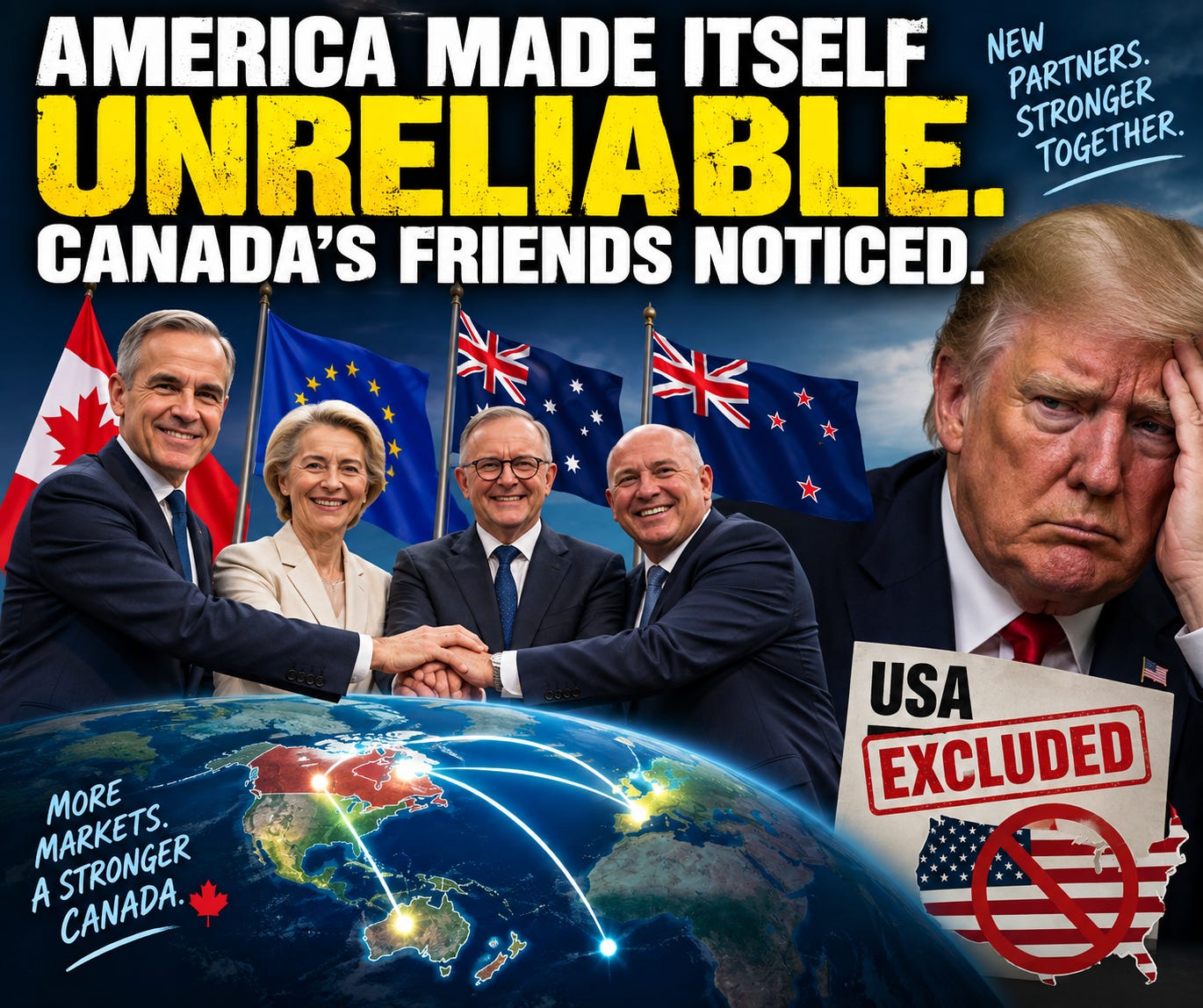
There’s something happening around Canada right now…
that I don’t think we should dismiss as another bunch of diplomatic handshakes.
Countries are starting to connect the dots.
And those dots increasingly lead around the United States instead of through it.
Canada has put retaliatory tariffs on $27.6 billion worth of American imports.
Not symbolic tariffs.
Real ones.
Rates of 15, 25 and 50 percent covering products in sectors including steel and aluminum, dairy, appliances, agricultural equipment, pulp and paper, plastics and electronics.
The Canadian government says they’re designed to match the American tariffs dollar for dollar and rate for rate.
That’s the stick.
But what interests me more is what Canada is doing with the other hand.
We’re building exits.
Not an exit from America.
An exit from dependence on America.
And there’s a hell of a difference.
Europe just said something worth paying attention to
EU Ambassador to Canada Geneviève Tuts says Europe and Canada are working toward a new partnership that doesn’t neatly fit any of the EU’s existing models.
Her word was “unique.”
Not Switzerland.
Not Norway.
Not Britain.
Something designed specifically for Canada and the European Union.
Prime Minister Mark Carney heads to Strasbourg next week, where he’s expected to address the European Parliament after what Tuts described as an exceptional invitation for a non-European leader.
And discussions are expected to continue toward a possible announcement at the Canada-EU summit in late October.
That doesn’t mean Canada is joining Europe.
It doesn’t mean we’ve replaced the United States.
And it sure as hell doesn’t mean somebody flipped a switch and redirected two countries’ economies overnight.
It means something much more believable.
Canada and Europe see value in becoming more important to each other.
That’s enough.
Because this isn’t starting from scratch.
Canada and the EU already have CETA.
We already signed a Security and Defence Partnership in 2025.
Canada has also become the first non-European country to participate in the EU’s SAFE defence procurement program.
The conversations now reach well beyond simply buying and selling more stuff.
Defence.
Critical minerals.
Industrial policy.
Energy.
Economic security.
Digital issues.
Manufacturing.
That’s starting to look less like another trade agreement and more like an economic relationship being deliberately widened.
And Europe isn’t the only one looking north
Something similar is happening across the Pacific.
New Zealand Trade Minister Todd McClay says his country is working on deepening trade with Canada and that an announcement on two-way trade is coming.
Australian Trade Minister Don Farrell was standing beside him when he made those remarks.
Farrell said something I thought was particularly interesting.
Canada, Australia and New Zealand are countries operating in the space of free and fair trade.
And he believes we can do a lot more together.
Here’s the convenient part.
We don’t have to invent the plumbing.
Canada, Australia and New Zealand are already members of the CPTPP.
The pipes exist.
We just haven’t been pushing nearly enough through them.
This is where Trump’s trade strategy may have badly miscalculated Canada
For decades, Canada’s relationship with the United States was built around a perfectly rational idea.
They’re huge.
They’re rich.
They’re next door.
Sell them stuff.
Lots of stuff.
The problem wasn’t trading with America.
The problem was allowing one customer to become so important that losing access to that customer could threaten entire Canadian industries.
Anybody who has ever run a business understands this.
If one customer represents most of your revenue, you don’t really have a customer.
You have a boss.
Canada spent decades telling ourselves geography made that unavoidable.
Trump may have finally convinced us it isn’t.
The numbers are already moving
Canada is still enormously dependent on the American market.
Nobody should pretend otherwise.
But dependence has been declining.
Statistics Canada data showed the U.S. accounted for about 66 percent of Canadian exports in July, while the year-to-date share was roughly 68 percent, down from about 73 percent previously.
Exports to non-U.S. markets increased 7.4 percent in July.
That’s not Canada divorcing America.
That’s diversification.
And there’s an important distinction.
I don’t want Canada to stop selling to Americans.
I’d like Americans buying everything Canadian companies can profitably sell them.
But I’d also like Europe buying it.
And Australia.
And New Zealand.
And Japan.
And South Korea.
And Mexico.
And whoever else wants to trade with us without demanding the keys to the bloody house.
This may be the biggest unintended consequence of Trump’s trade war
Trump’s strategy seems built around American market power.
The United States is enormous.
Everybody wants access.
Therefore Washington can use that access as leverage.
There’s only one little problem.
Leverage works best when people believe they have nowhere else to go.
Canada is now spending enormous political and economic energy proving that we do.
Europe is looking for reliable democratic partners.
Canada is looking for markets beyond the United States.
Australia and New Zealand want stronger relationships with countries committed to predictable trade.
Everybody suddenly has the same incentive.
Build more doors.
That’s why I think we’re looking at something bigger than another Canada-U.S. tariff spat.
The old Canadian strategy was basically…
Keep Washington happy and hope nothing changes.
That strategy died.
The replacement is starting to become visible.
Trade with America.
Trade with Europe.
Trade across the Pacific.
Build Canadian manufacturing.
Process more Canadian resources here.
Strengthen defence partnerships.
Build supply chains that don’t depend on one border staying friendly forever.
And make damn sure no foreign president ever again gets to look at Canada and think:
They have nowhere else to go.
Because we’re building somewhere else to go right now.
The Recap…
Canada just slapped counter-tariffs on $27.6 billion of U.S. goods.
At the same time, Europe is talking about a “unique” new partnership with Canada, while New Zealand and Australia are talking about deeper trade.
That’s not Canada abandoning America.
That’s Canada making sure America is never our only option again.
The Gut-Punch…
America’s biggest advantage was never its tariffs.
It was that its allies believed they couldn’t afford to go anywhere else.
Trump is teaching them that they can.
Source credit:
Research inspired by the video “Trump PANICS as Canada, EU, Australia and New Zealand UNITE — USA EXCLUDED.” Facts independently checked against Government of Canada trade measures, Canadian Press reporting on EU-Canada discussions, Statistics Canada/Global Affairs Canada trade data, and reporting from New Zealand.
If you enjoy thoughtful conversations, Canadian stories, and the occasional smart-ass observation about the world we’re living in, you’re in the right place.
Subscribe free and get new stories, insights, and observations delivered directly to your inbox.
No paywall.
No spam.
No nonsense.
Leave anytime with a single click.
I promise not to take it personally.
Maybe Canada can do some emergency shipments of diesel fuel to Australia and NZ once Trump cuts them off. That would go a long way towards building up even greater relationships.
PM Carney seems to have opened up some eyes in other countries- am so proud of what he is doing for the betterment of Canadian business exports but also to be somewhat of a guiding light for other like minded countries. Yes Australia is about to have a fuel problem- they too have learned the hard lessen of relying on the US to honour their agreements. Dumbfounding they had their fuel storage on US soil ? Need to do some research as to why that is the case