

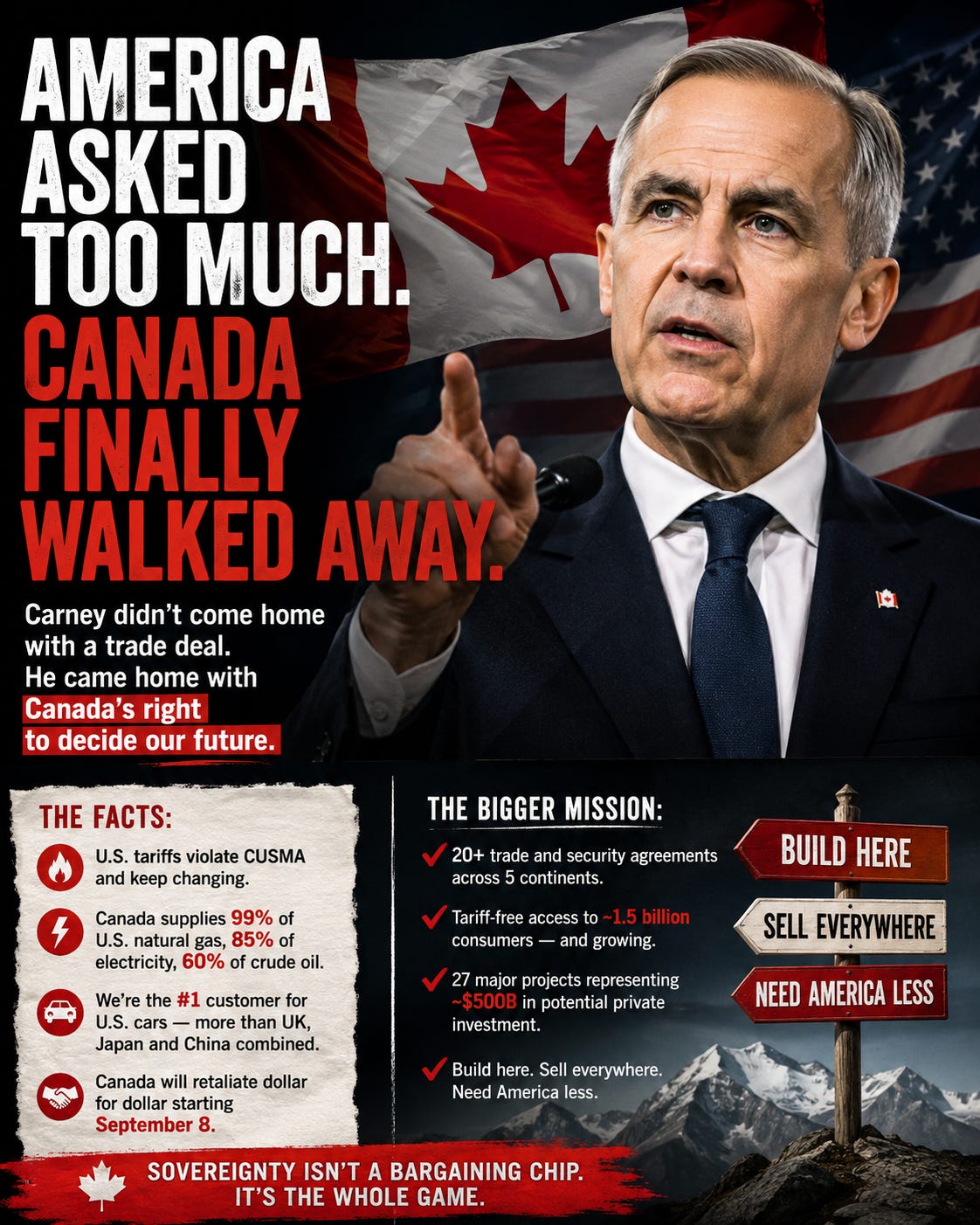
There are times when no deal is the deal.
Canada reached one of those moments Friday night.
For months, Mark Carney’s government negotiated with the Trump administration looking for something Canada could actually live with.
Not perfection.
Not some glorious victory where Donald Trump suddenly discovered the joys of predictable international trade.
Just a workable agreement that protected Canadian jobs, reduced the American tariffs hammering strategic industries and gave Canadian businesses some certainty about what the rules would be tomorrow morning.
Canada was prepared to give.
Then the United States apparently decided Canada should give some more.
And then some more.
Finally, Washington reached for something Canada had no business giving away at all…
our freedom to decide where else in the world we trade.
That’s when Carney called the negotiators home.
And I think Canadians need to understand just how important that decision may turn out to be.
Canada Didn’t Walk Away Over Hurt Feelings
Carney’s explanation was remarkably simple…
“They asked too much and offered too little.”
Behind those seven words was a much bigger problem.
Canada had offered substantial compromises.
We were prepared to remove remaining retaliatory tariffs on steel, aluminum and automobiles if Washington substantially lowered its tariffs enough to make Canadian exports economically viable again.
The federal government was prepared to encourage provinces to put American booze back on their shelves.
Canada was even prepared to make administrative changes around supply management… without dismantling the system, changing American quotas or giving away the tariff protections behind it.
That’s negotiation.
You give something.
I give something.
We both go home slightly annoyed.
That’s usually how you know you’ve got a deal.
But Canada had several lines it would not cross.
Our sovereignty.
Our French language.
Our culture.
Our ability to protect important Canadian industries.
And, critically, our ability to make agreements with countries other than the United States.
Those weren’t bargaining chips.
Then Came the Last-Minute Demands
Carney says the Americans changed the terms as negotiations were approaching the finish line.
One dispute involved automobiles.
Canada wanted meaningful tariff relief covering the integrated Canadian auto industry.
According to Carney, Washington wanted medium and heavy-duty trucks excluded.
That matters.
We’re not discussing numbers on a spreadsheet.
We’re discussing Canadian factories and Canadian jobs.
But the bigger problem came when the Americans sought restrictions on Canada’s ability to negotiate trade arrangements elsewhere.
Think about what that means.
Canada is trying to reduce its dependence on the United States.
We’re opening markets in Europe.
We’re expanding relationships across Asia.
We’re looking at energy, critical minerals, agriculture, defence and manufacturing opportunities around the world.
And now our largest trading partner reportedly wanted influence over our ability to build those alternatives.
Carney called it what it was…
a question of sovereignty.
That’s where this stopped being merely a tariff negotiation.
Canada Has Seen This Movie Before
There’s a historical wrinkle worth remembering.
The old NAFTA contained an energy proportionality provision that limited Canada’s flexibility around energy exports.
That provision disappeared when NAFTA was replaced by CUSMA.
Canada finally had more room to diversify.
We’re now spending billions trying to build exactly that ability.
Trans Mountain gives Canadian oil greater Pacific access.
Ports are being expanded.
New energy corridors are being discussed.
Trade agreements are being signed.
Canada is deliberately building doors that don’t all open south.
So why in hell would we sign a new agreement restricting our ability to use them?
That would be like finally paying off the mortgage and then asking the old bank manager for permission to rearrange the furniture.
No.
Trump’s Trade-Deficit Story Has a Canadian Problem
Carney also went directly after one of Trump’s favourite complaints… America supposedly gets ripped off because it runs a merchandise trade deficit with Canada.
There’s a rather large moose sitting in the middle of that argument.
Energy.
According to Carney, Canada supplies:
99% of U.S. natural-gas imports
85% of U.S. electricity imports
60% of U.S. crude-oil imports
America buys enormous amounts of Canadian energy because America needs enormous amounts of Canadian energy.
Remove energy from the picture and Trump’s simple “trade deficit equals getting ripped off” story becomes considerably harder to sell.
And Carney added another fact Americans rarely hear.
Canada is the largest customer for American automobiles.
We buy more American-built cars than Britain, Japan and China combined.
Canada is also the largest customer for 26 American states and among the top three customers for 45.
Last year Americans sold almost $600 billion in goods and services to Canadians.
That’s roughly $1.6 billion every day.
This isn’t charity flowing north.
It’s commerce flowing both ways.
And Now Canada Hits Back
The new American tariffs are here.
So Canada is responding.
Carney announced that Canada will match Washington’s new tariffs dollar for dollar.
The countermeasures will concentrate on sectors including steel, dairy, appliances, agricultural equipment, pulp and paper and electronics.
They are scheduled to take effect Tuesday, September 8, after Labour Day.
And Carney didn’t pretend this comes free.
Canadian consumers may pay more.
We may have fewer choices.
Businesses will get hurt.
Some completely innocent American companies will get caught in the crossfire.
Trade wars are stupid precisely because everybody ends up paying something.
But there’s another cost that doesn’t appear on a grocery receipt:
dependence.
And Canada has finally started putting a price on that too.
This Is Bigger Than Trump Now
This may be the most important part of Carney’s message.
Canada’s diversification strategy isn’t an emergency escape hatch anymore.
It’s the national strategy.
Over the last year, Canada has signed more than 20 trade and security agreements across five continents.
Canadian businesses now have tariff-free access to approximately 1.5 billion consumers.
Carney says that number could double through additional agreements.
Meanwhile, 27 projects representing roughly $500 billion in potential private investment have been referred to the Major Projects Office.
Ports.
Mines.
Energy corridors.
Electricity infrastructure.
LNG.
Nuclear.
Oil and gas.
Defence.
Shipbuilding.
Aerospace.
Critical minerals.
The point isn’t to stop trading with America.
That would be economic lunacy.
The United States is beside us.
It has more than 340 million consumers.
We have deeply integrated supply chains built over generations.
We’re going to trade with Americans.
But there’s an enormous difference between having a customer and needing that customer so badly that he gets to dictate the terms.
That’s the lesson Canada is learning.
The Part Trump May Have Miscalculated
Trump’s tariffs were supposed to create leverage.
And they certainly have inflicted pain.
But they’ve also created something Washington probably didn’t bargain for.
Millions of Canadians started changing behaviour.
Buying Canadian.
Vacationing here.
Skipping American alcohol.
Looking at labels.
Thinking about where their money goes.
None of those decisions alone changes a continental economy.
Millions of them do.
More importantly, Canadian businesses and governments started asking a question we should have been asking twenty years ago:
Who else can we sell to?
Once that question becomes permanent, the old Canada-U.S. relationship doesn’t simply snap back into place when Trump eventually disappears.
Businesses find customers.
Supply chains move.
Ports get built.
Pipelines find oceans.
Relationships form.
Habits change.
And dependence shrinks.
That’s the long game.
Walking Away Wasn’t the Failure
I know what Pierre Poilievre’s crowd will say.
Carney failed to get a deal.
Fine.
Let them say it.
Because sometimes a prime minister’s job isn’t getting a deal.
It’s knowing which deal Canada must never sign.
If Washington wanted lower tariffs, that’s negotiable.
If Washington wanted better access to Canadian markets, that’s negotiable.
If Washington wanted changes that benefited both countries, sit down and sharpen the pencils.
But if the price of American market access becomes Canada’s ability to decide its own relationships with the rest of the world?
Pack the briefcases.
Call the plane.
Come home.
Canada can survive tariffs.
We can build markets.
We can build ports.
We can build pipelines and railways and factories and power grids.
It will take money.
It will take time.
Some of it will hurt.
What we cannot rebuild nearly as easily is sovereignty once we’ve voluntarily traded pieces of it away.
So no, Canada didn’t get the deal.
Good.
Because judging by what was sitting on that table at the end, the smartest thing Mark Carney did was leave it there.
The Recap…
Canada was prepared to compromise to get a fair U.S. trade deal.
Then Washington pushed further… including restrictions Carney says would have interfered with Canada’s ability to make other trade deals.
Carney called the negotiators home.
Now Canada will retaliate dollar for dollar while accelerating the bigger mission:
Build here. Sell everywhere. Need America less.
The Gut-Punch…
A bad trade deal can cost you money.
A bad sovereignty deal can cost you your country.
Carney knew which one was sitting on the table.
And he walked.
Source credit:
Prime Minister of Canada… Prime Minister Carney delivers remarks on Canada-U.S. trade negotiations, August 22, 2026.
Additional research notes derived from the supplied video transcript; commentary and opinions from the original narrator were excluded from the factual basis of this article.
If you enjoy thoughtful conversations, Canadian stories, and the occasional smart-ass observation about the world we’re living in, you’re in the right place.
Subscribe free and get new stories, insights, and observations delivered directly to your inbox.
No paywall.
No spam.
No nonsense.
Leave anytime with a single click.
I promise not to take it personally.
This, I did not know.
"The old NAFTA contained an energy proportionality provision that limited Canada’s flexibility around energy exports.
That provision disappeared when NAFTA was replaced by CUSMA."
Wow, so Brian Mulroney signed the trade deal that limited Canada's energy exports. When one considers how Poilievre has whined like old gears about oil, this takes on new context.
CUSMA eliminated this provision. No wonder the red-hats are pissing mad about Canada accelerating energy exports to non US refineries.
Canada's sovereignty is not negotiable.
And that weird Jivani guy has some sort of relationship with JD Eyeliner, and apparently is trying to 'help'.
Thank goodness our negotiating team, and Prime Minister, are holding the line.
Now, it's our turn.
Make Boycotts Great Again.
Trump’s Administration has destroyed our friendship. Absolutely appalling