

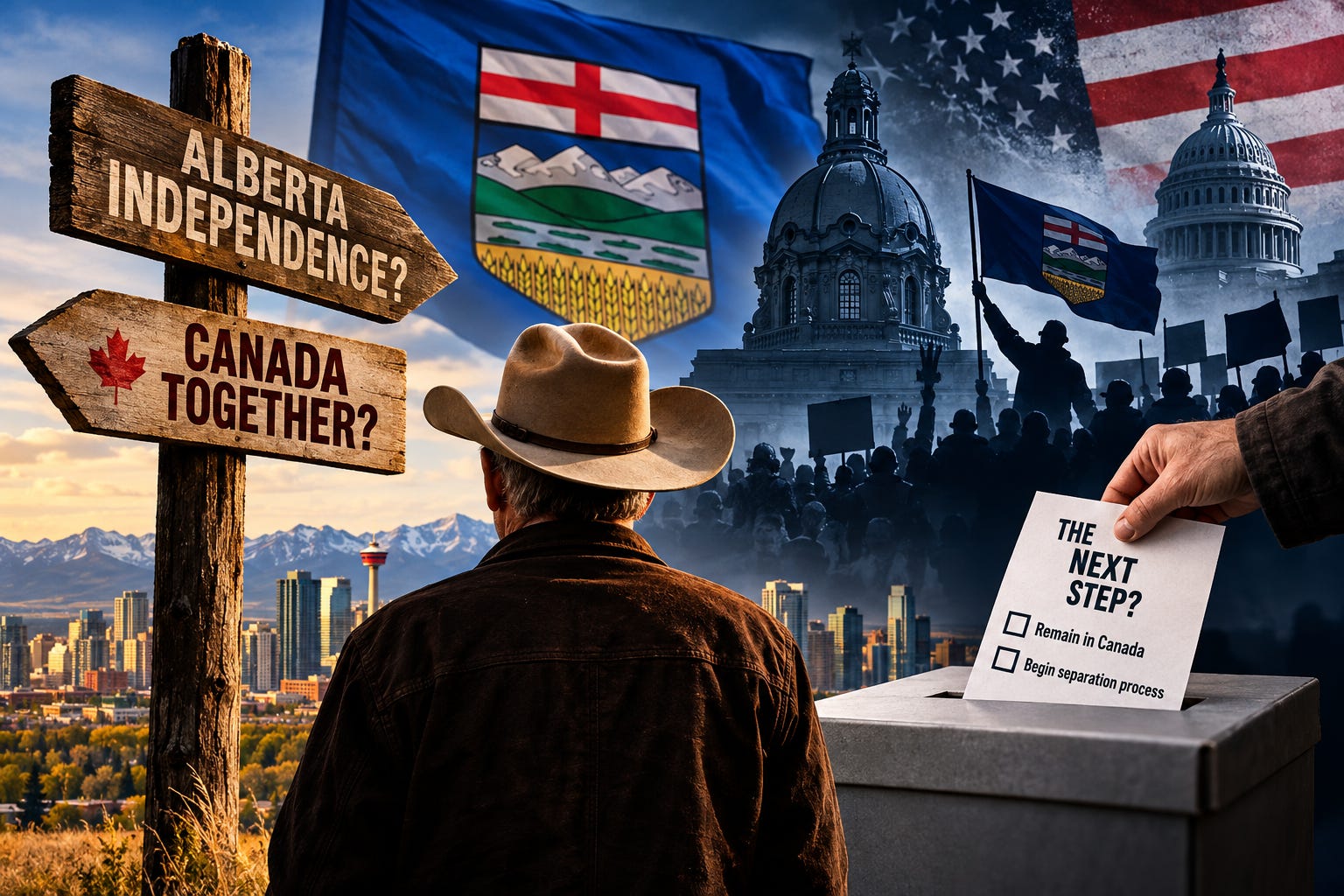
I lived in Calgary for more than 30 years.
I knew Albertans were angry with Ottawa. Hell, complaining about Ottawa was practically a provincial pastime.
I remember the Western alienation, the fights over energy policy, the resentment toward Pierre Trudeau and the feeling that decisions affecting Alberta were being made thousands of kilometres away.
None of that is new.
But I just watched the investigation by CBC’s the fifth estate below that showed me stuff that I didn’t know and it inspired this article.
How a relatively small group of Alberta independence activists managed to become influential enough that the entire province is now being asked to vote on its constitutional future.
And the numbers are where this gets interesting.
According to Elections Alberta, the independence petition received 222,597 verified signatures.
That’s about 7.5% of Alberta’s eligible voters.
The petition met the legal threshold. That’s important. The organizers followed a political process that allowed them to advance their cause.
But here’s the other important part.
Signing a petition to hold a referendum is not the same as voting to leave Canada.
And 7.5% certainly isn’t a mandate for independence.
So how did we get here?
The party became the battleground
The CBC investigation follows three prominent independence advocates: Dennis Modry, Jeff Rath and Mitch Sylvestre.
It traces how the Alberta Prosperity Project and other activists worked to build influence inside the United Conservative Party.
Their strategy wasn’t simply to convince millions of Albertans to abandon Canada.
It was to organize politically, recruit supporters and influence the people who controlled the governing party.
The investigation describes how the anger surrounding COVID restrictions helped mobilize people who were already deeply suspicious of government.
That anger became political organization.
Jason Kenney faced a leadership review in May 2022. He received just over 51% support and subsequently resigned.
Danielle Smith won the leadership race that followed.
The documentary examines how independence-minded activists became involved in that contest and how Smith courted voters concerned about Alberta’s autonomy.
That’s the part that fascinated me.
You don’t necessarily need to win over an entire province to change its political direction.
Sometimes you only need enough organized people inside the party that governs it.
And once those people become important to winning leadership contests, they become much harder for party leaders to ignore.
Now look at what Albertans are being asked
On October 19, Albertans will face a question about whether their province should remain in Canada or begin the legal process toward a future binding referendum on separation.
Read that carefully.
They’re not being asked to leave Canada immediately.
They’re being asked whether the government should start a process that could lead to another referendum.
That’s an important distinction, and one that can easily disappear when people start shouting about independence.
Danielle Smith says she supports Alberta remaining in Canada.
I take her statement as her stated position.
But her government also put this question before the province.
And the CBC investigation makes clear that some of the separatist activists who helped build political pressure are now unhappy with her because she hasn’t gone far enough.
Think about that.
A premier who says she wants Alberta to stay in Canada is facing pressure from independence advocates who believe she is standing in their way.
Meanwhile, Albertans who never wanted this fight are being asked to participate in it.
That’s quite a political mess.
Then there’s Washington
This is where my concern goes beyond Alberta politics.
Alberta independence advocates have reportedly held meetings with American officials.
The contacts have attracted enough attention that Canada’s foreign influence watchdog has publicly addressed why earlier meetings fall outside the new federal registry’s reporting requirements.
But we need to be precise.
The meetings don’t establish that the Trump administration is directing or financing Alberta separatism. U.S. Ambassador Pete Hoekstra has denied that the administration is strategizing with the movement.
That distinction matters.
Still, I find the idea of Canadian separatists seeking political relationships in Washington troubling, particularly when the American president has repeatedly talked about Canada becoming the 51st state.
Albertans have every right to debate their future.
Americans don’t get to decide it for them.
And anyone campaigning to break up Canada should expect some pretty tough questions about what they’re discussing with foreign governments.
The people who were here first
There’s another part of the investigation I don’t want to overlook.
First Nations leaders have challenged the independence initiative over treaty rights and consultation.
Those rights aren’t a minor technical problem that separatists can simply work around.
Treaties existed long before anyone started arguing about an independent Alberta.
You can’t draw a new international border, declare a new country and assume that everyone whose rights are affected will simply go along with it.
The legal and constitutional questions are enormous.
And they’re not going away because somebody collects signatures.
What bothers me most
I don’t begrudge Albertans their frustrations with Ottawa.
I lived there long enough to understand that some grievances are real, even when I disagree with the proposed solutions.
But I also know that Alberta is much bigger than any political party, any premier or any independence organization.
And Canada is bigger than the arguments between Alberta and Ottawa.
What this investigation helped me understand is that a determined political movement doesn’t always need majority public support to gain influence.
It can start by gaining influence where the decisions are made.
Inside a political party.
Inside a leadership contest.
Inside the machinery that decides what eventually appears on a ballot.
That doesn’t make the process illegal or automatically undemocratic.
It does mean the rest of us had better pay attention.
Because a province can find itself debating its future long before most of its citizens ever agreed that its future needed to be up for debate.
I spent more than 30 years in Calgary.
I thought I understood Alberta politics pretty well.
Apparently, I still had some things to learn.
And I suspect I’m not the only one.
The Recap…
A CBC investigation traces how Alberta independence activists gained influence inside the governing UCP.
The independence petition qualified with verified signatures from approximately 7.5% of eligible voters.
Now Albertans face an October 19 vote on whether to begin the legal process toward another separation referendum.
The question isn’t just whether Alberta wants independence. It’s how the province got to this point.
The Gut-Punch…
You don’t have to convince a majority of people to change the political agenda. Sometimes you only have to organize the minority that politicians are afraid to lose.
Sources
CBC’s the fifth estate — The Alberta Question: How Did We Get Here? (original investigation and interviews).
Elections Alberta — July 24, 2026 petition verification results
Elections Alberta — Official October 19 referendum questions
Global News — U.S. ambassador responds to separatist meeting reports
If you enjoy thoughtful conversations, Canadian stories, and the occasional smart-ass observation about the world we’re living in, you’re in the right place.
Subscribe free and get new stories, insights, and observations delivered directly to your inbox.
No paywall.
No spam.
No nonsense.
Leave anytime with a single click.
I promise not to take it personally.
If you enjoy thoughtful conversations, Canadian stories, and the occasional smart-ass observation about the world we’re living in, you’re in the right place.
Subscribe free and get new stories, insights, and observations delivered directly to your inbox.
No paywall.
No spam.
No nonsense.
Leave anytime with a single click.
I promise not to take it personally.
I commented on an item you did some months back about this.
This is the same modus and (probably) the same players as Brexit.
As a Brit who watched his country (from Europe while working there) taken over by frauds, charlatans, spivs and grifters who took the country out of the EU using an advisory referendum as a vehicle - I really must urge you all to WAKE UP.
You can see the direction of travel taken in the UK since and the absolute disaster that we now face. You have also seen the way the US will behave when one of the herd strays. To paraphrase your PM - and our former Bank of England manager - if you aren’t surrounded by your herd you will succumb to the wolves.