

I found a number this week that made me stop.
$104 billion.
Not government spending.
Not some ten-year promise.
Not politicians announcing money they might spend someday.
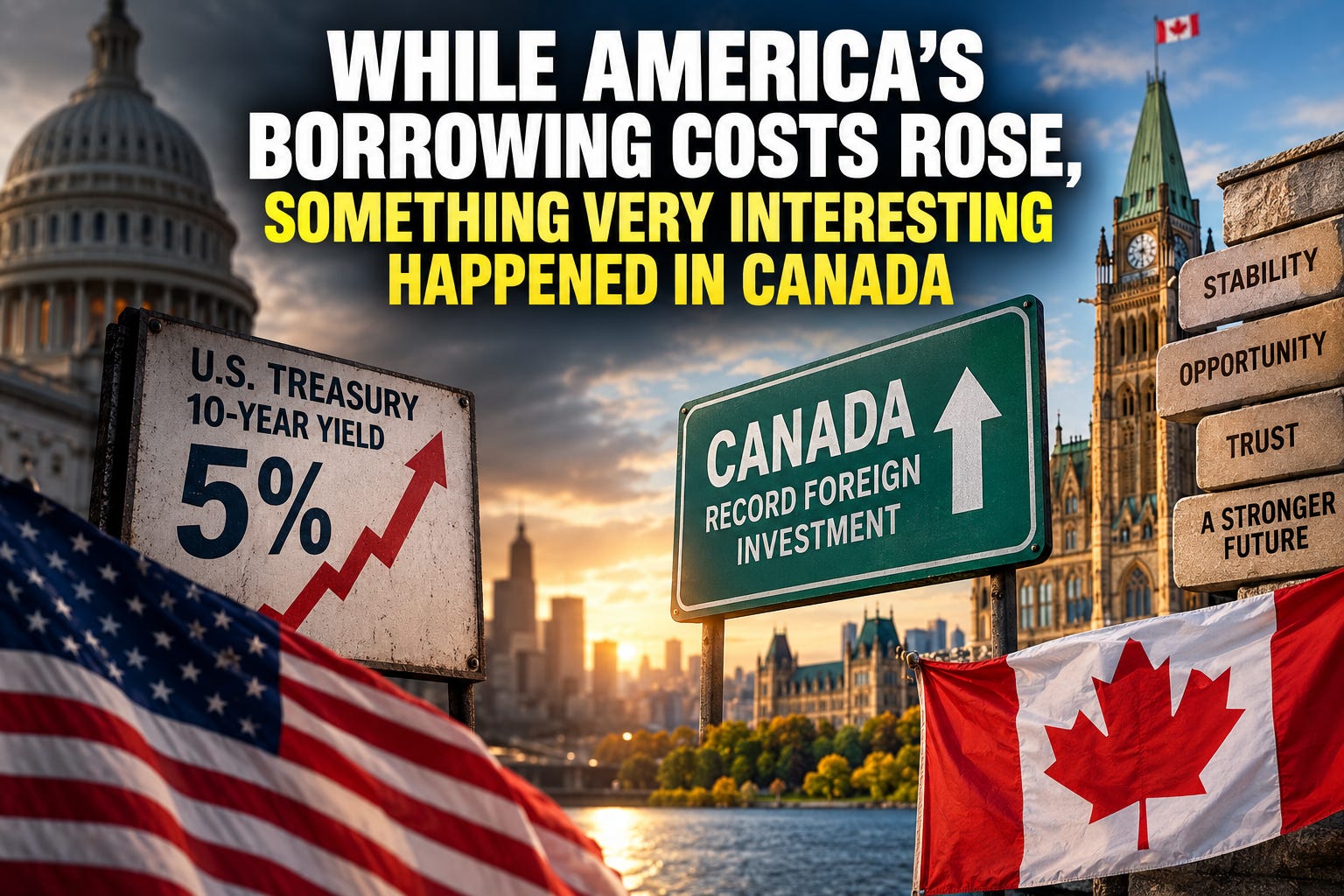
Foreign investors bought $104 billion worth of Government of Canada bonds in the first seven months of 2026.
Statistics Canada calls that amount unprecedented.
For comparison, during the same period last year, foreign investors bought just $13.8 billion.
That got my attention.
Because while all of us have been watching tariffs, trade threats, summits and political fireworks, something much quieter has been happening underneath it all.
Money has been moving.
And money doesn’t give a damn about campaign slogans.
Look at what happened in July
Foreign investors added another $20.7 billion of Canadian securities to their holdings.
Canadian investors, meanwhile, sold a record $31 billion of U.S. shares that month.
They also sold another $5.1 billion of U.S. government bonds.
That made July the sixth consecutive month in which Canadian investors reduced their holdings of U.S. government bonds.
Total since January?
$37.3 billion sold.
That’s not my interpretation.
That’s Statistics Canada.
Now, before somebody runs off screaming that the American dollar is collapsing and Wall Street is moving to Moose Jaw, settle down.
That’s not what these numbers prove.
Canadian investors also bought a record amount of U.S. shares during the first half of the year before that big July reversal.
Capital markets are complicated beasts.
But something significant has happened in Canadian debt markets.
During the first half of 2026, foreign investors bought a record $175 billion of Canadian debt securities.
Same period in 2025?
$20.9 billion.
That’s an eightfold increase.
That deserves more attention than another politician yelling into a microphone.
Now look south
At almost exactly the same time, U.S. government borrowing costs were climbing.
On September 15, the yield on the benchmark 10-year U.S. Treasury moved above 5%, reaching its highest level since 2007.
The Federal Reserve then raised its target interest-rate range by a quarter point to 3.75%–4.00%.
Higher Treasury yields matter because they eventually crawl into damn near everything.
Mortgages.
Business borrowing.
Government debt-servicing costs.
Car loans.
Credit.
But here’s where I part company with some of the stuff I’ve been seeing online.
You can’t look at rising American yields and simply declare…
“The world doesn’t trust America anymore.”
It’s a hell of a headline.
It’s just not what the evidence proves.
This has been a broader global bond selloff. Germany, Japan and other major borrowers have also experienced sharply higher yields.
Inflation worries, government debt levels, interest-rate expectations and geopolitical risks are all involved.
So I’m not going to manufacture a prettier story than the numbers give me.
I don’t need to.
Because the Canadian numbers are already remarkable.
Then Carney put $100 trillion in one room
On September 15, Prime Minister Mark Carney addressed the Canada Investment Summit in Toronto.
The people in the room represented investors from nearly 30 countries managing more than $100 trillion in assets.
Read that again.
Not $100 billion.
$100 trillion.
The summit produced announcements representing nearly $500 billion in new Canadian investment commitments and opportunities, according to the Prime Minister’s Office.
And Carney knew exactly what those people were listening for.
Not slogans.
Risk.
Debt.
Predictability.
Returns.
He told them Canada had what he called its strongest fiscal position in the G7 and announced that the government expected to balance its operating budget next year, a year earlier than planned.
He also said the government was reducing the size of the federal civil service by 10%, cutting spending on consultants by 20%, and reducing annual operating-spending growth from more than 8% to less than 2%.
Whether Ottawa actually delivers all of that will eventually be measurable.
For now, those are government commitments… not accomplishments we should count before they happen.
But here’s what isn’t a promise…
Investors are already buying Canadian government debt in record amounts.
That’s the part I keep coming back to.
There’s another word creeping into this story
Trust.
Carney used it himself after the investment summit.
He told reporters Canada’s greatest strength was something that doesn’t appear on a balance sheet…
trust.
A couple of days later, standing before the European Parliament, he explained what Canada was trying to build with Europe.
Not another superpower bloc.
Not another bully.
He said Canada and Europe were pursuing resilience so that nobody could control their markets, impair their sovereignty or dictate their choices.
That word… resilience… matters.
Because I don’t think Canada’s lesson from this trade war should be…
Replace America with Europe.
That would just be buying ourselves a new basket for all those eggs.
The smarter lesson is…
Never again leave Canada dependent on one customer, one supplier, one market or one government behaving itself.
The United States remains enormously important to Canada.
It isn’t disappearing.
Neither is the largest economy in the world.
But diversification isn’t divorce.
It’s insurance.
And for years Canadians talked about diversification as though it were one of those jobs we’d get around to after cleaning the garage.
Then somebody finally gave us a reason to clean the damned garage.
Now we’re building trade relationships elsewhere, attracting international capital, strengthening ties with Europe and trying to give Canadian businesses more than one door to knock on.
And while that is happening, global investors are buying Canadian government bonds in amounts Statistics Canada has never recorded before.
That doesn’t prove Canada has “won.”
It doesn’t prove America has “lost.”
And it certainly doesn’t mean every dollar currently flowing toward Canada will stay here forever.
It tells us something simpler.
Canada has options.
More than we had before.
And after the last couple of years, I’ll take that.
The Recap…
Foreign investors bought an unprecedented $104 billion in Government of Canada bonds during the first seven months of 2026.
Canadian investors sold $37.3 billion of U.S. government bonds over the same period.
And investors managing more than $100 trillion recently showed up in Toronto to look at Canadian opportunities.
Forget the slogans for a minute.
Watch where the money goes.
The Gut-Punch…
Canada doesn’t need America to fail for Canada to succeed.
We just need enough alternatives that nobody gets to decide our future for us.
That’s what economic sovereignty looks like.
Source credit:
Statistics Canada… Canada’s international transactions in securities, June and July 2026; Statistics Canada… Canada’s balance of international payments, second quarter 2026; Prime Minister of Canada… Canada Investment Summit, September 15, 2026; Prime Minister of Canada… Address to the European Parliament, September 17, 2026; Reuters reporting on global government bond markets and U.S. Treasury yields; U.S. Federal Reserve, September 16, 2026 monetary-policy decision.
If you enjoy thoughtful conversations, Canadian stories, and the occasional smart-ass observation about the world we’re living in, you’re in the right place.
Subscribe free and get new stories, insights, and observations delivered directly to your inbox.
No paywall.
No spam.
No nonsense.
Leave anytime with a single click.
I promise not to take it personally.
Thanks Fred, for this amazing summary!
MARK CARNEY IS ONE OF KIND THAT YOU MAY SEE IN YOUR LIFETIME AND HE IS DOING GREAT SO FAR GETTING CANADA
OPTIONS WHICH THEY NEVER HAD BEFORE WHICH IS A REALLY GOOD THINGS WORKING TOGETHER PRODUCES RESULTS WHICH IS WHAT ALL Countries need RIGHT NOW.NOW THE FUTURE LOOKS BRIGHTER AND MORE HOPE THAN WE HAVE ENCOUNTERED IN A LONG TIME